

processes, either because they are problematic
to propagate efficiently in bioreactors, difficult
to engineer, or opportunistic human pathogens. Based on the logical assumption that
fungi by evolution likely are the best producers
of fungal products, we therefore envision that
there will be an increasing demand of transferring relevant genes and pathways from novel,
exotic fungi to well-characterized fungal cell
factories.
Filamentous fungi have been widely used
for heterologous production of industrial
enzymes, taking advantage of their large protein secretory capacity. The most commonly
used fungal species for this purpose are Trichoderma reesei and members of the genus Aspergillus, e.g., Aspergillus niger and Aspergillus
oryzae, and thus, most studies have been performed with these species. More recently, filamentous fungi have also been employed for
heterologous production of SMs, typically as a
part of an SM pathway elucidation strategy. For
these studies, classical model fungi like Aspergillus nidulans and Neurospora crassa have
been added to the repertoire of cell factories.
The usefulness of fungal industrial workhorses
and general model systems is also reflected by
the development of substantial genetic toolboxes and methodologies for heterologous
gene expression for these species.
The current trend for heterologous gene
expression is to implement a synthetic biology
approach. Hence, a host strain is transformed
with a gene-expression cassette, generated from
libraries of bio-blocks (see Sect. III), which are
individually functional molecular units that can
be combined by simple and seamless DNA
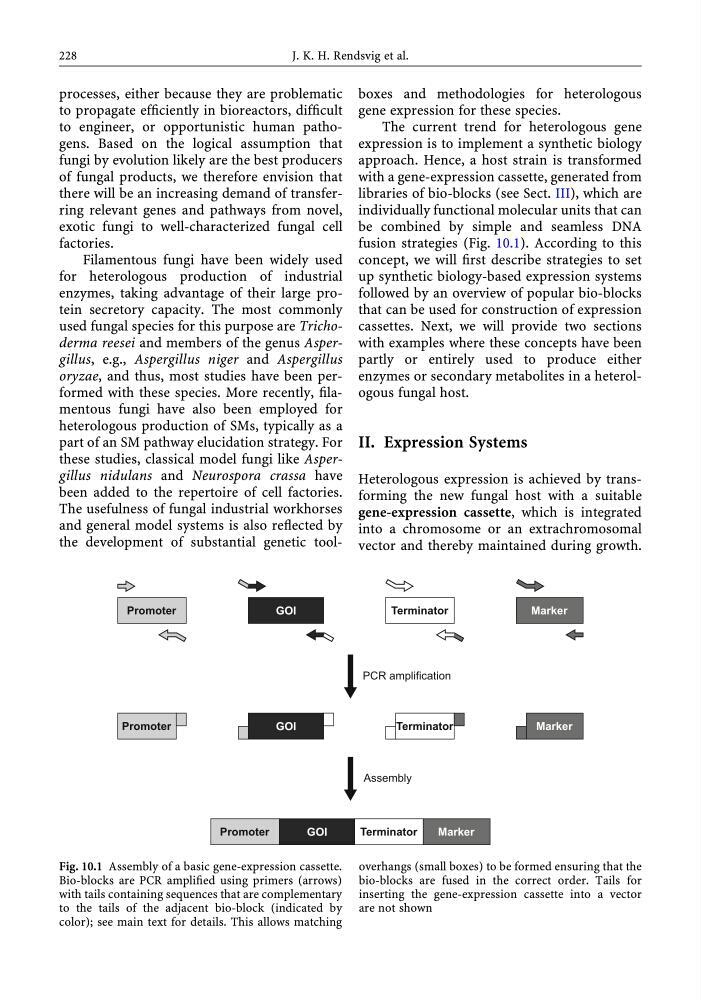
fusion strategies (Fig. 10.1). According to this
concept, we will first describe strategies to set
up synthetic biology-based expression systems
followed by an overview of popular bio-blocks
that can be used for construction of expression
cassettes. Next, we will provide two sections
with examples where these concepts have been
partly or entirely used to produce either
enzymes or secondary metabolites in a heterologous fungal host.
II. Expression Systems
Heterologous expression is achieved by transforming the new fungal host with a suitable
gene-expression cassette, which is integrated
into a chromosome or an extrachromosomal
vector and thereby maintained during growth.
PCR amplification
Assembly
Marker
Terminator
GOI
Promoter
Promoter
GOI
Terminator
Marker
Promoter
GOI
Terminator
Marker
Fig. 10.1 Assembly of a basic gene-expression cassette.
Bio-blocks are PCR amplified using primers (arrows)
with tails containing sequences that are complementary
to the tails of the adjacent bio-block (indicated by
color); see main text for details. This allows matching
overhangs (small boxes) to be formed ensuring that the
bio-blocks are fused in the correct order. Tails for
inserting the gene-expression cassette into a vector
are not shown
228
J. K. H. Rendsvig et al.
to propagate efficiently in bioreactors, difficult
to engineer, or opportunistic human pathogens. Based on the logical assumption that
fungi by evolution likely are the best producers
of fungal products, we therefore envision that
there will be an increasing demand of transferring relevant genes and pathways from novel,
exotic fungi to well-characterized fungal cell
factories.
Filamentous fungi have been widely used
for heterologous production of industrial
enzymes, taking advantage of their large protein secretory capacity. The most commonly
used fungal species for this purpose are Trichoderma reesei and members of the genus Aspergillus, e.g., Aspergillus niger and Aspergillus
oryzae, and thus, most studies have been performed with these species. More recently, filamentous fungi have also been employed for
heterologous production of SMs, typically as a
part of an SM pathway elucidation strategy. For
these studies, classical model fungi like Aspergillus nidulans and Neurospora crassa have
been added to the repertoire of cell factories.
The usefulness of fungal industrial workhorses
and general model systems is also reflected by
the development of substantial genetic toolboxes and methodologies for heterologous
gene expression for these species.
The current trend for heterologous gene
expression is to implement a synthetic biology
approach. Hence, a host strain is transformed
with a gene-expression cassette, generated from
libraries of bio-blocks (see Sect. III), which are
individually functional molecular units that can
be combined by simple and seamless DNA
fusion strategies (Fig. 10.1). According to this
concept, we will first describe strategies to set
up synthetic biology-based expression systems
followed by an overview of popular bio-blocks
that can be used for construction of expression
cassettes. Next, we will provide two sections
with examples where these concepts have been
partly or entirely used to produce either
enzymes or secondary metabolites in a heterologous fungal host.
II. Expression Systems
Heterologous expression is achieved by transforming the new fungal host with a suitable
gene-expression cassette, which is integrated
into a chromosome or an extrachromosomal
vector and thereby maintained during growth.
PCR amplification
Assembly
Marker
Terminator
GOI
Promoter
Promoter
GOI
Terminator
Marker
Promoter
GOI
Terminator
Marker
Fig. 10.1 Assembly of a basic gene-expression cassette.
Bio-blocks are PCR amplified using primers (arrows)
with tails containing sequences that are complementary
to the tails of the adjacent bio-block (indicated by
color); see main text for details. This allows matching
overhangs (small boxes) to be formed ensuring that the
bio-blocks are fused in the correct order. Tails for
inserting the gene-expression cassette into a vector
are not shown
228
J. K. H. Rendsvig et al.