

78
organoboron reagents, organosilicon reagents) successfully convert C(sp
3
)−H
bonds to other functional groups en route to a wide range of more complicated compounds [113]. It is noteworthy that, recently, the use of mono- and bidentate ligands
has proven to be effective for accelerating C(sp
3
)−H activation, which provides
great opportunities to control both reactivity and selectivity (including enantioselectivity) in the C−H functionalization reactions [114–118].
3.4.1 Cyano Anions as Nucleophiles
The cyanation of Csp
3
−H bonds adjacent to N atoms in tertiary amines is an important method to form α-amino nitriles, which are versatile precursors of amino acids
and have a broad and important usage in biochemistry as well as medical sciences
(Scheme 3.53). Ru salts are the typical catalysts in these reactions, and the details
have been well reviewed in recent years [98, 119].
In 2003, Murahashi and co-workers reported the pioneer work in this field [120].
The oxidative cross-coupling between methyl groups adjacent to tertiary amines
and sodium cyanide was catalyzed by RuCl 3 nH 2 O under 1 atm pressure of O 2 . N,NDimethylaniline was converted to N-methyl-N-phenylamino-acetonitrile smoothly
in 88% yield. After that, modifications have been made in the catalyst [121–125],
oxidant [126], cyano source [127–129], and other reaction conditions [130, 131].
air, 80 °C
H
Ar
nano-Fe 2 O 3 (20 mol%)
K 2 CO 3 , tBuOOtBu
+
63%
5 1%
(o/m/p = 71/20/9)
61%
(o/m/p = 61/29/1)
56%
5 3%
(o/m = 69/31)
41%
B 2 pin 2
Bpin
Ar
Bpin
Bpin
Bpin
Me
Me
Bpin
Bpin
Bpin
Me
Me
Me
Me
Me
Me
MeO
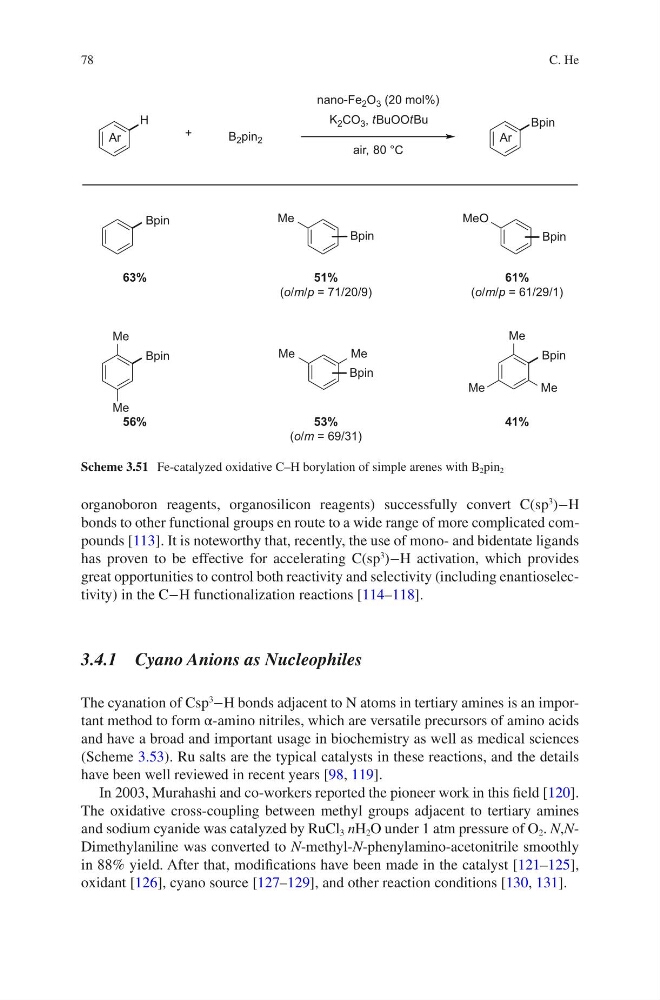
Scheme 3.51 Fe-catalyzed oxidative C–H borylation of simple arenes with B 2 pin 2
C. He
organoboron reagents, organosilicon reagents) successfully convert C(sp
3
)−H
bonds to other functional groups en route to a wide range of more complicated compounds [113]. It is noteworthy that, recently, the use of mono- and bidentate ligands
has proven to be effective for accelerating C(sp
3
)−H activation, which provides
great opportunities to control both reactivity and selectivity (including enantioselectivity) in the C−H functionalization reactions [114–118].
3.4.1 Cyano Anions as Nucleophiles
The cyanation of Csp
3
−H bonds adjacent to N atoms in tertiary amines is an important method to form α-amino nitriles, which are versatile precursors of amino acids
and have a broad and important usage in biochemistry as well as medical sciences
(Scheme 3.53). Ru salts are the typical catalysts in these reactions, and the details
have been well reviewed in recent years [98, 119].
In 2003, Murahashi and co-workers reported the pioneer work in this field [120].
The oxidative cross-coupling between methyl groups adjacent to tertiary amines
and sodium cyanide was catalyzed by RuCl 3 nH 2 O under 1 atm pressure of O 2 . N,NDimethylaniline was converted to N-methyl-N-phenylamino-acetonitrile smoothly
in 88% yield. After that, modifications have been made in the catalyst [121–125],
oxidant [126], cyano source [127–129], and other reaction conditions [130, 131].
air, 80 °C
H
Ar
nano-Fe 2 O 3 (20 mol%)
K 2 CO 3 , tBuOOtBu
+
63%
5 1%
(o/m/p = 71/20/9)
61%
(o/m/p = 61/29/1)
56%
5 3%
(o/m = 69/31)
41%
B 2 pin 2
Bpin
Ar
Bpin
Bpin
Bpin
Me
Me
Bpin
Bpin
Bpin
Me
Me
Me
Me
Me
Me
MeO
Scheme 3.51 Fe-catalyzed oxidative C–H borylation of simple arenes with B 2 pin 2
C. He