

77
3.3.7.3 C–H and B 2 pin 2 as Nucleophiles
During the last decade, significant progress has been made on Ir- and Rh-catalyzed
C−H borylation reactions, in which the regioselectivity is controlled by either sterics or a directing group [41], while the oxidative cross-couplings between C–H
bonds and organoboron reagents to form C–B bonds are rare.
In 2010, Wang and co-worker described a nano-Fe 2 O 3 -catalyzed oxidative C–H
borylation of simple arenes with diboron pinacol ester in the presence of tert-butyl
peroxide as the oxidant (Scheme 3.51) [109]. Interestingly, the regioselectivity of
this transformation was controlled by electronic effects of substituents.
Assisted by the highly efficient −CONHAr [Ar = (4-CF 3 )C 6 F 4 ] auxiliary, Yu and
co-workers reported a Pd-catalyzed oxidative ortho-C−H borylation with
N-arylbenzamides (Scheme 3.52) [110]. A modified dibenzylideneacetone (dba)
ligand, a weak base TsONa, and a strong oxidant K 2 S 2 O 8 are crucial for obtaining
good yields. The reaction is tolerant of electron-deficient and electron-rich benzamides derived from readily available benzoic acids.
3.4 C(sp
3
)–H and Organometallic Reagents as Nucleophiles
Despite intensive efforts have been devoted, selective activation/functionalization of
alkyl C(sp
3
)−H bonds still remains a great challenge in catalysis. The lack of the
assistance of π-groups to engage in the transformations makes them even more
“inert” [111, 112]. Although C(sp
3
)−H bonds are more difficult than other types of
C−H bonds to cleave, they are not completely inert, which can be activated by
directing groups or being adjacent to heteroatoms like N, O, or S. During the last
10 years, several examples have been reported that the oxidative cross-couplings
between C(sp
3
)−H bonds and organometallic reagents (e.g., cyano anions,
N
R 2
R 1
2
N
R 2
R 1
OAc
N
R 2
R 1
Pd(TFA) 2 (5 mol%)
AgOAc (2.0 equiv)
DMSO, 60 °C, 12 h, O 2
N
Me
OAc
N
Me
N
Me
OAc
N
Me
80%
Me
Me
78%
N
Bn
OAc
N
Bn
MeO
OMe
60%
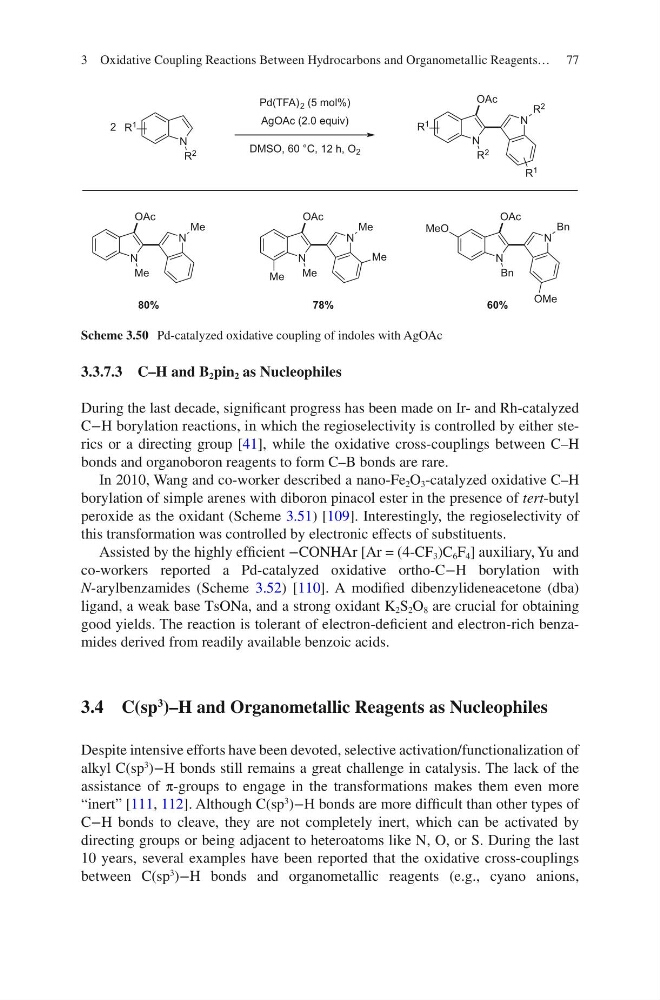
Scheme 3.50 Pd-catalyzed oxidative coupling of indoles with AgOAc
3 Oxidative Coupling Reactions Between Hydrocarbons and Organometallic Reagents…
3.3.7.3 C–H and B 2 pin 2 as Nucleophiles
During the last decade, significant progress has been made on Ir- and Rh-catalyzed
C−H borylation reactions, in which the regioselectivity is controlled by either sterics or a directing group [41], while the oxidative cross-couplings between C–H
bonds and organoboron reagents to form C–B bonds are rare.
In 2010, Wang and co-worker described a nano-Fe 2 O 3 -catalyzed oxidative C–H
borylation of simple arenes with diboron pinacol ester in the presence of tert-butyl
peroxide as the oxidant (Scheme 3.51) [109]. Interestingly, the regioselectivity of
this transformation was controlled by electronic effects of substituents.
Assisted by the highly efficient −CONHAr [Ar = (4-CF 3 )C 6 F 4 ] auxiliary, Yu and
co-workers reported a Pd-catalyzed oxidative ortho-C−H borylation with
N-arylbenzamides (Scheme 3.52) [110]. A modified dibenzylideneacetone (dba)
ligand, a weak base TsONa, and a strong oxidant K 2 S 2 O 8 are crucial for obtaining
good yields. The reaction is tolerant of electron-deficient and electron-rich benzamides derived from readily available benzoic acids.
3.4 C(sp
3
)–H and Organometallic Reagents as Nucleophiles
Despite intensive efforts have been devoted, selective activation/functionalization of
alkyl C(sp
3
)−H bonds still remains a great challenge in catalysis. The lack of the
assistance of π-groups to engage in the transformations makes them even more
“inert” [111, 112]. Although C(sp
3
)−H bonds are more difficult than other types of
C−H bonds to cleave, they are not completely inert, which can be activated by
directing groups or being adjacent to heteroatoms like N, O, or S. During the last
10 years, several examples have been reported that the oxidative cross-couplings
between C(sp
3
)−H bonds and organometallic reagents (e.g., cyano anions,
N
R 2
R 1
2
N
R 2
R 1
OAc
N
R 2
R 1
Pd(TFA) 2 (5 mol%)
AgOAc (2.0 equiv)
DMSO, 60 °C, 12 h, O 2
N
Me
OAc
N
Me
N
Me
OAc
N
Me
80%
Me
Me
78%
N
Bn
OAc
N
Bn
MeO
OMe
60%
Scheme 3.50 Pd-catalyzed oxidative coupling of indoles with AgOAc
3 Oxidative Coupling Reactions Between Hydrocarbons and Organometallic Reagents…