

67
ZnCl 2
.
TMEDA and 2 equiv. of ArMgBr) at 0 °C (Scheme 3.40) [86]. Interestingly,
the intricate reaction conditions were quite critical for the successful arylation. The
author found that Ph 2 Zn reagents prepared from PhMgBr are effective, while prepared from PhLi are ineffective, indicating the different nature of zinc reagents arising from different preparation methods.
Then, the same group extended the substrate to an aryl imine by using similar
conditions, in which 4,4-di-tert-butyl-2,2-bipyridine (dtbpy) was used as the ligand
instead of 1,10-phenanthroline (Scheme 3.41) [87]. A variety of aryl imines derived
from acetophenones were used in this oxidative C–H/C–C coupling. It is noteworthy that C–Br, C–Cl, C–OTf, and C–OTs were well tolerated as functional groups in
the transformation. Later, these reactions could also be achieved under oxygen
atmosphere [88]. By slowly employing oxygen into the system, oxidative crosscoupling of the two reactants took place smoothly to give the corresponding products in moderate to good yields.
+ Me 3 Si Ar
PdCl 2 (MeCN) 2 (5 mol%)
CuCl 2 (2 equiv)
ClCH 2 CH 2 Cl
80
o C, 16 h
S
R 2
R 1
H
H
S
R 2
R 1
Ar
S
nBu
S
Ph
S
Cl
S
67% (90% )
+
S
R 2
R 1
Ar
major
Me
S
78% (88% )
F
S
81% (89%
b
b
b
b
b
b
b
b
)
Br
S
45% (88% )
CF 3
S
75% (98% )
Me
76% (91% )
73% (79% )
50% (>99% )
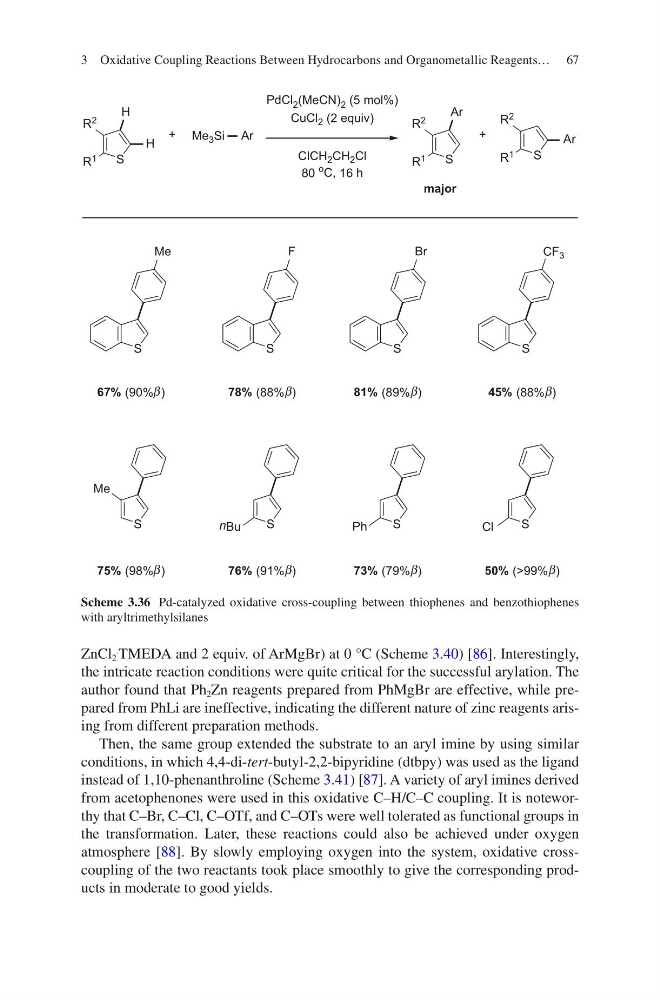
Scheme 3.36 Pd-catalyzed oxidative cross-coupling between thiophenes and benzothiophenes
with aryltrimethylsilanes
3 Oxidative Coupling Reactions Between Hydrocarbons and Organometallic Reagents…
ZnCl 2
.
TMEDA and 2 equiv. of ArMgBr) at 0 °C (Scheme 3.40) [86]. Interestingly,
the intricate reaction conditions were quite critical for the successful arylation. The
author found that Ph 2 Zn reagents prepared from PhMgBr are effective, while prepared from PhLi are ineffective, indicating the different nature of zinc reagents arising from different preparation methods.
Then, the same group extended the substrate to an aryl imine by using similar
conditions, in which 4,4-di-tert-butyl-2,2-bipyridine (dtbpy) was used as the ligand
instead of 1,10-phenanthroline (Scheme 3.41) [87]. A variety of aryl imines derived
from acetophenones were used in this oxidative C–H/C–C coupling. It is noteworthy that C–Br, C–Cl, C–OTf, and C–OTs were well tolerated as functional groups in
the transformation. Later, these reactions could also be achieved under oxygen
atmosphere [88]. By slowly employing oxygen into the system, oxidative crosscoupling of the two reactants took place smoothly to give the corresponding products in moderate to good yields.
+ Me 3 Si Ar
PdCl 2 (MeCN) 2 (5 mol%)
CuCl 2 (2 equiv)
ClCH 2 CH 2 Cl
80
o C, 16 h
S
R 2
R 1
H
H
S
R 2
R 1
Ar
S
nBu
S
Ph
S
Cl
S
67% (90% )
+
S
R 2
R 1
Ar
major
Me
S
78% (88% )
F
S
81% (89%
b
b
b
b
b
b
b
b
)
Br
S
45% (88% )
CF 3
S
75% (98% )
Me
76% (91% )
73% (79% )
50% (>99% )
Scheme 3.36 Pd-catalyzed oxidative cross-coupling between thiophenes and benzothiophenes
with aryltrimethylsilanes
3 Oxidative Coupling Reactions Between Hydrocarbons and Organometallic Reagents…