

66
regioselectively trifluoromethylated, affording the desired trifluoromethylated
heteroarenes and arenes in moderate to good yields (Scheme 3.37) [83]. The efficiency of this transformation is highly dependent on the low pKa of these C−H
bonds. Meanwhile, the combination of Cu(OH) 2 , 1,10-Phen, Ag 2 CO 3 , and KF was
found to be the best conditions for the direct oxidative trifluoromethylation of
indoles (Scheme 3.38).
Intrigued by the report from Qing et al. on the direct copper-catalyzed oxidative
trifluoromethylation of acidic C−H bonds of electron-deficient heteroarenes, Yu and
co-workers developed an ortho-trifluoromethylation of inert aryl C−H bonds with
CF 3 SiMe 3 using amide-oxazoline directing group in the presence of Cu(OAc) 2 ,
Ag 2 CO 3 , KF, and NMO (N-methylmorpholine N-oxide) (Scheme 3.39) [84].
3.3.4 Organozinc Reagents as Nucleophiles
Organozinc reagents, widely used in Negishi cross-coupling reactions, have also
been applied in oxidative cross-coupling reactions. Since 2008, Nakamura and coworkers have developed a series of iron-catalyzed oxidative coupling between
2-arylpyridine derivatives or aryl imines and arylzinc reagent via C–H bond activation [85–89]. The nitrogen heterocycles and imino groups served as the directing
groups in the reaction. In the presence of Fe(acac) 3 (10 mol%), 1,10-phenanthroline
(10 mol%), and oxidant 1,2-dichloro-2-methylpropane (2.0 equiv), 2-arylpyridine
derivatives reacted smoothly with diarylzinc reagents (prepared from 1 equiv. of
+
Pd(OAc) 2 (10 mol%)
N 2 , rt, 18 h
N
Me
90%
N
R 2
Ar
N
Me
55%
N
Me
93%
(MeO) 3 Si Ar
HOAc/EtOH
Ag 2 O, TBAF
R 1
N
R 2
H
R 1
CF 3
OMe
Cl
N
Me
22%
N
Me
26%
N
Bn
74%
NC
CO 2 Me
MeO
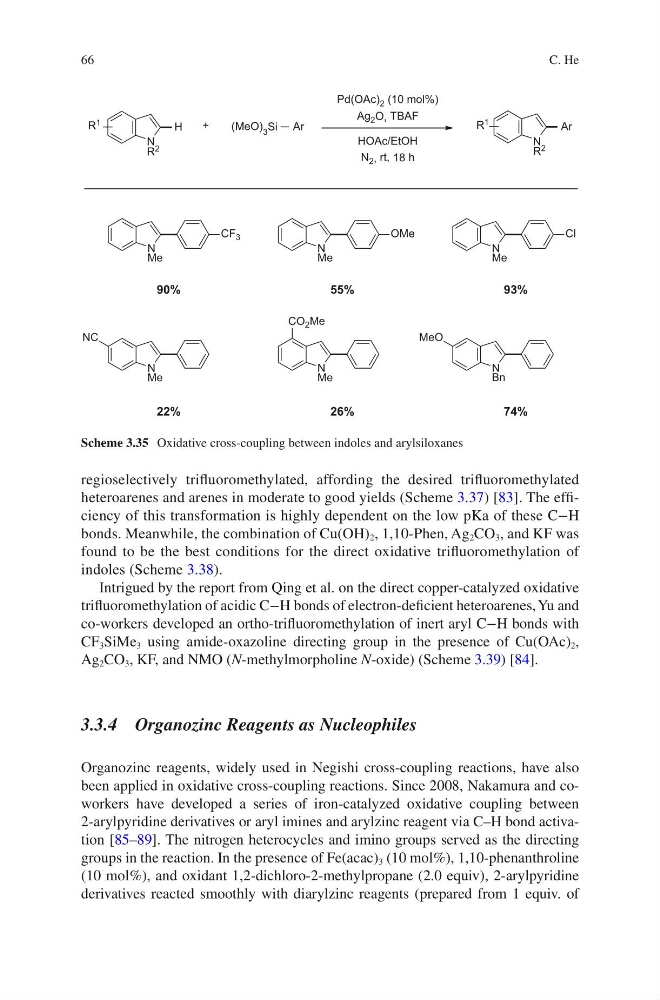
Scheme 3.35 Oxidative cross-coupling between indoles and arylsiloxanes
C. He
regioselectively trifluoromethylated, affording the desired trifluoromethylated
heteroarenes and arenes in moderate to good yields (Scheme 3.37) [83]. The efficiency of this transformation is highly dependent on the low pKa of these C−H
bonds. Meanwhile, the combination of Cu(OH) 2 , 1,10-Phen, Ag 2 CO 3 , and KF was
found to be the best conditions for the direct oxidative trifluoromethylation of
indoles (Scheme 3.38).
Intrigued by the report from Qing et al. on the direct copper-catalyzed oxidative
trifluoromethylation of acidic C−H bonds of electron-deficient heteroarenes, Yu and
co-workers developed an ortho-trifluoromethylation of inert aryl C−H bonds with
CF 3 SiMe 3 using amide-oxazoline directing group in the presence of Cu(OAc) 2 ,
Ag 2 CO 3 , KF, and NMO (N-methylmorpholine N-oxide) (Scheme 3.39) [84].
3.3.4 Organozinc Reagents as Nucleophiles
Organozinc reagents, widely used in Negishi cross-coupling reactions, have also
been applied in oxidative cross-coupling reactions. Since 2008, Nakamura and coworkers have developed a series of iron-catalyzed oxidative coupling between
2-arylpyridine derivatives or aryl imines and arylzinc reagent via C–H bond activation [85–89]. The nitrogen heterocycles and imino groups served as the directing
groups in the reaction. In the presence of Fe(acac) 3 (10 mol%), 1,10-phenanthroline
(10 mol%), and oxidant 1,2-dichloro-2-methylpropane (2.0 equiv), 2-arylpyridine
derivatives reacted smoothly with diarylzinc reagents (prepared from 1 equiv. of
+
Pd(OAc) 2 (10 mol%)
N 2 , rt, 18 h
N
Me
90%
N
R 2
Ar
N
Me
55%
N
Me
93%
(MeO) 3 Si Ar
HOAc/EtOH
Ag 2 O, TBAF
R 1
N
R 2
H
R 1
CF 3
OMe
Cl
N
Me
22%
N
Me
26%
N
Bn
74%
NC
CO 2 Me
MeO
Scheme 3.35 Oxidative cross-coupling between indoles and arylsiloxanes
C. He