

43
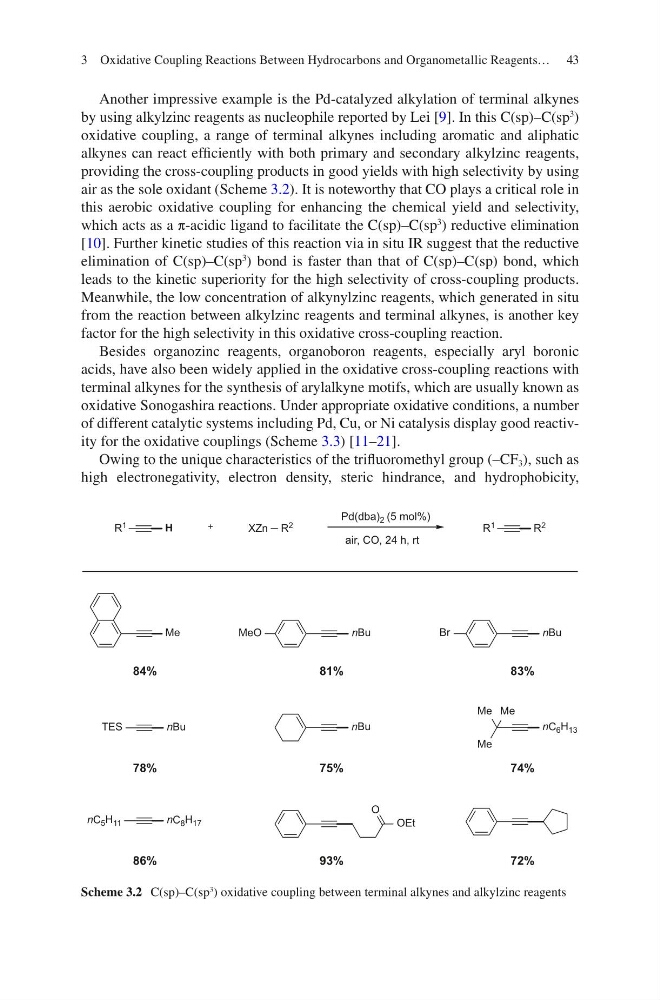
Another impressive example is the Pd-catalyzed alkylation of terminal alkynes
by using alkylzinc reagents as nucleophile reported by Lei [9]. In this C(sp)–C(sp
3
)
oxidative coupling, a range of terminal alkynes including aromatic and aliphatic
alkynes can react efficiently with both primary and secondary alkylzinc reagents,
providing the cross-coupling products in good yields with high selectivity by using
air as the sole oxidant (Scheme 3.2). It is noteworthy that CO plays a critical role in
this aerobic oxidative coupling for enhancing the chemical yield and selectivity,
which acts as a π-acidic ligand to facilitate the C(sp)–C(sp
3
) reductive elimination
[10]. Further kinetic studies of this reaction via in situ IR suggest that the reductive
elimination of C(sp)–C(sp
3
) bond is faster than that of C(sp)–C(sp) bond, which
leads to the kinetic superiority for the high selectivity of cross-coupling products.
Meanwhile, the low concentration of alkynylzinc reagents, which generated in situ
from the reaction between alkylzinc reagents and terminal alkynes, is another key
factor for the high selectivity in this oxidative cross-coupling reaction.
Besides organozinc reagents, organoboron reagents, especially aryl boronic
acids, have also been widely applied in the oxidative cross-coupling reactions with
terminal alkynes for the synthesis of arylalkyne motifs, which are usually known as
oxidative Sonogashira reactions. Under appropriate oxidative conditions, a number
of different catalytic systems including Pd, Cu, or Ni catalysis display good reactivity for the oxidative couplings (Scheme 3.3) [11–21].
Owing to the unique characteristics of the trifluoromethyl group (–CF 3 ), such as
high electronegativity, electron density, steric hindrance, and hydrophobicity,
R 1
H
XZn R 2
R 1
R 2
Pd(dba) 2 (5 mol%)
air, CO, 24 h, rt
Me
84%
nBu
81%
MeO
nBu
83%
Br
TES
nBu
78%
nBu
75%
nC 6 H 13
74%
nC 5 H 11
nC 8 H 17
86%
93%
72%
Me
Me Me
OEt
O
Scheme 3.2 C(sp)–C(sp
3
) oxidative coupling between terminal alkynes and alkylzinc reagents
3 Oxidative Coupling Reactions Between Hydrocarbons and Organometallic Reagents…
Another impressive example is the Pd-catalyzed alkylation of terminal alkynes
by using alkylzinc reagents as nucleophile reported by Lei [9]. In this C(sp)–C(sp
3
)
oxidative coupling, a range of terminal alkynes including aromatic and aliphatic
alkynes can react efficiently with both primary and secondary alkylzinc reagents,
providing the cross-coupling products in good yields with high selectivity by using
air as the sole oxidant (Scheme 3.2). It is noteworthy that CO plays a critical role in
this aerobic oxidative coupling for enhancing the chemical yield and selectivity,
which acts as a π-acidic ligand to facilitate the C(sp)–C(sp
3
) reductive elimination
[10]. Further kinetic studies of this reaction via in situ IR suggest that the reductive
elimination of C(sp)–C(sp
3
) bond is faster than that of C(sp)–C(sp) bond, which
leads to the kinetic superiority for the high selectivity of cross-coupling products.
Meanwhile, the low concentration of alkynylzinc reagents, which generated in situ
from the reaction between alkylzinc reagents and terminal alkynes, is another key
factor for the high selectivity in this oxidative cross-coupling reaction.
Besides organozinc reagents, organoboron reagents, especially aryl boronic
acids, have also been widely applied in the oxidative cross-coupling reactions with
terminal alkynes for the synthesis of arylalkyne motifs, which are usually known as
oxidative Sonogashira reactions. Under appropriate oxidative conditions, a number
of different catalytic systems including Pd, Cu, or Ni catalysis display good reactivity for the oxidative couplings (Scheme 3.3) [11–21].
Owing to the unique characteristics of the trifluoromethyl group (–CF 3 ), such as
high electronegativity, electron density, steric hindrance, and hydrophobicity,
R 1
H
XZn R 2
R 1
R 2
Pd(dba) 2 (5 mol%)
air, CO, 24 h, rt
Me
84%
nBu
81%
MeO
nBu
83%
Br
TES
nBu
78%
nBu
75%
nC 6 H 13
74%
nC 5 H 11
nC 8 H 17
86%
93%
72%
Me
Me Me
OEt
O
Scheme 3.2 C(sp)–C(sp
3
) oxidative coupling between terminal alkynes and alkylzinc reagents
3 Oxidative Coupling Reactions Between Hydrocarbons and Organometallic Reagents…