

42
coupling reactions between hydrocarbons and organometallic reagents. This part of
the chapter is structured by the hybridization of the C–H bonds, as well as the differences between organometallic reagents.
3.2 C(sp)–H and Organometallic Reagents as Nucleophiles
Terminal alkynes, with their C(sp)–H bonds formed from sp orbitals, are acidic
hydrocarbons, which can be generally deprotonated by strong bases such as butyllithium, Grignard reagents, or NaNH 2 . Owing to their acidity, terminal alkynes are
usually employed as nucleophiles in carbon–carbon and carbon–heteroatom bondforming reactions.
In terms of oxidative couplings, terminal alkynes can be used directly as nucleophiles to couple with another nucleophile, which provides an effective way to install
triple bonds into molecules. Most oxidative couplings involving terminal alkynes as
nucleophiles normally occur with another X–H nucleophile, while the oxidative
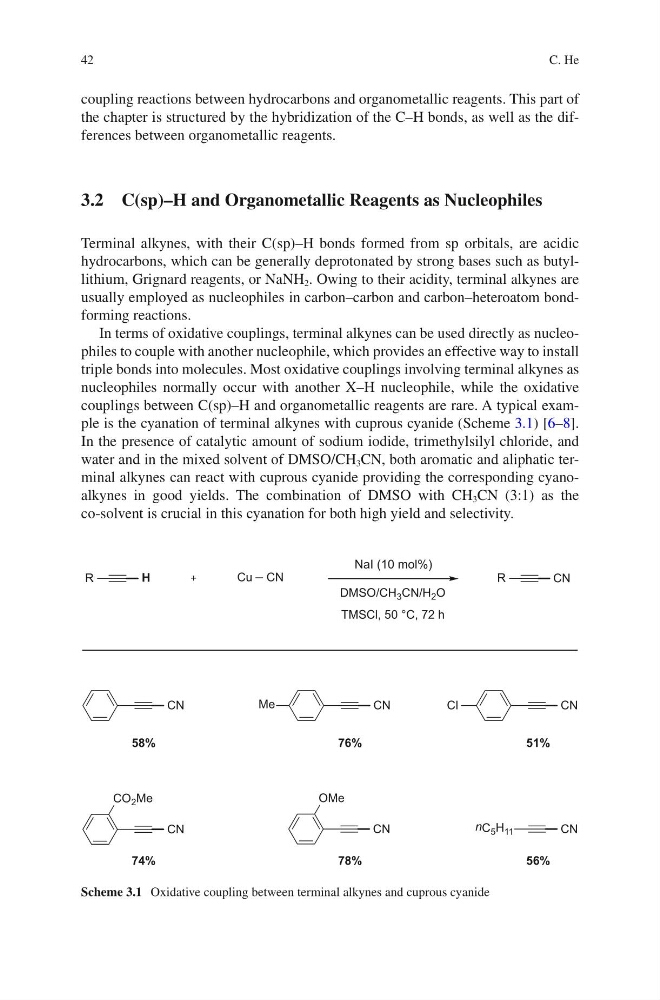
couplings between C(sp)–H and organometallic reagents are rare. A typical example is the cyanation of terminal alkynes with cuprous cyanide (Scheme 3.1) [6–8].
In the presence of catalytic amount of sodium iodide, trimethylsilyl chloride, and
water and in the mixed solvent of DMSO/CH 3 CN, both aromatic and aliphatic terminal alkynes can react with cuprous cyanide providing the corresponding cyanoalkynes in good yields. The combination of DMSO with CH 3 CN (3:1) as the
co-solvent is crucial in this cyanation for both high yield and selectivity.
R
H
Cu CN
R
CN
NaI (10 mol%)
CN
58%
CN
76%
Me
CN
51%
CN
74%
CN
78%
nC 5 H 11
CN
56%
DMSO/CH 3 CN/H 2 O
TMSCl, 50 °C, 72 h
CO 2 Me
OMe
Cl
Scheme 3.1 Oxidative coupling between terminal alkynes and cuprous cyanide
C. He
coupling reactions between hydrocarbons and organometallic reagents. This part of
the chapter is structured by the hybridization of the C–H bonds, as well as the differences between organometallic reagents.
3.2 C(sp)–H and Organometallic Reagents as Nucleophiles
Terminal alkynes, with their C(sp)–H bonds formed from sp orbitals, are acidic
hydrocarbons, which can be generally deprotonated by strong bases such as butyllithium, Grignard reagents, or NaNH 2 . Owing to their acidity, terminal alkynes are
usually employed as nucleophiles in carbon–carbon and carbon–heteroatom bondforming reactions.
In terms of oxidative couplings, terminal alkynes can be used directly as nucleophiles to couple with another nucleophile, which provides an effective way to install
triple bonds into molecules. Most oxidative couplings involving terminal alkynes as
nucleophiles normally occur with another X–H nucleophile, while the oxidative
couplings between C(sp)–H and organometallic reagents are rare. A typical example is the cyanation of terminal alkynes with cuprous cyanide (Scheme 3.1) [6–8].
In the presence of catalytic amount of sodium iodide, trimethylsilyl chloride, and
water and in the mixed solvent of DMSO/CH 3 CN, both aromatic and aliphatic terminal alkynes can react with cuprous cyanide providing the corresponding cyanoalkynes in good yields. The combination of DMSO with CH 3 CN (3:1) as the
co-solvent is crucial in this cyanation for both high yield and selectivity.
R
H
Cu CN
R
CN
NaI (10 mol%)
CN
58%
CN
76%
Me
CN
51%
CN
74%
CN
78%
nC 5 H 11
CN
56%
DMSO/CH 3 CN/H 2 O
TMSCl, 50 °C, 72 h
CO 2 Me
OMe
Cl
Scheme 3.1 Oxidative coupling between terminal alkynes and cuprous cyanide
C. He