

24
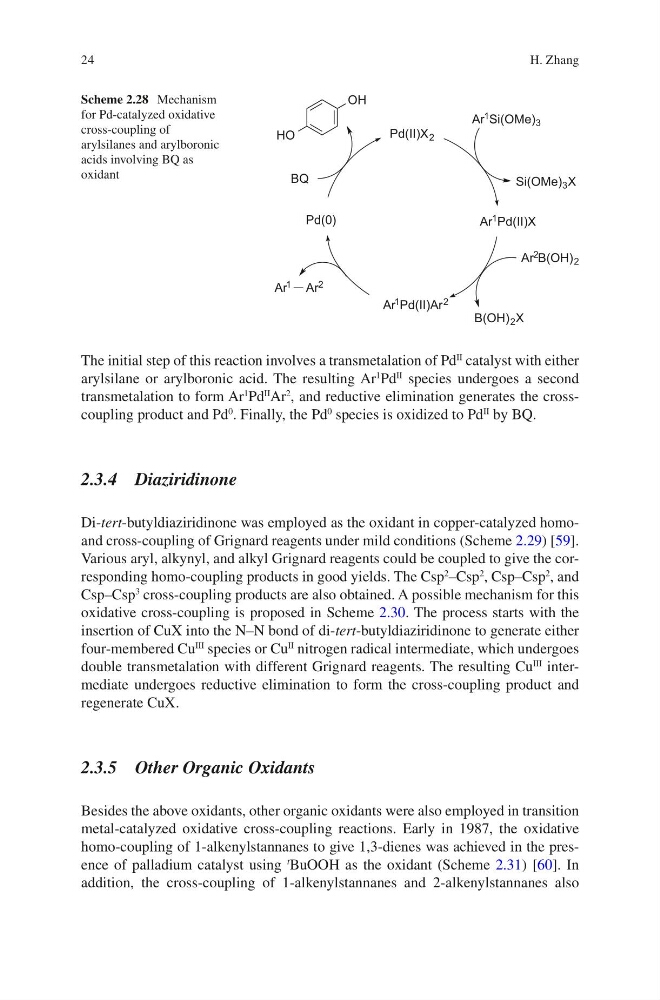
The initial step of this reaction involves a transmetalation of Pd
II
catalyst with either
arylsilane or arylboronic acid. The resulting Ar
1
Pd
II
species undergoes a second
transmetalation to form Ar
1
Pd
II
Ar
2
, and reductive elimination generates the crosscoupling product and Pd
0
. Finally, the Pd
0
species is oxidized to Pd
II
by BQ.
2.3.4 Diaziridinone
Di-tert-butyldiaziridinone was employed as the oxidant in copper-catalyzed homoand cross-coupling of Grignard reagents under mild conditions (Scheme 2.29) [59].
Various aryl, alkynyl, and alkyl Grignard reagents could be coupled to give the corresponding homo-coupling products in good yields. The Csp
2
–Csp
2
, Csp–Csp
2
, and
Csp–Csp
3
cross-coupling products are also obtained. A possible mechanism for this
oxidative cross-coupling is proposed in Scheme 2.30. The process starts with the
insertion of CuX into the N–N bond of di-tert-butyldiaziridinone to generate either
four- membered Cu
III
species or Cu
II
nitrogen radical intermediate, which undergoes
double transmetalation with different Grignard reagents. The resulting Cu
III
intermediate undergoes reductive elimination to form the cross-coupling product and
regenerate CuX.
2.3.5 Other Organic Oxidants
Besides the above oxidants, other organic oxidants were also employed in transition
metal-catalyzed oxidative cross-coupling reactions. Early in 1987, the oxidative
homo-coupling of 1-alkenylstannanes to give 1,3-dienes was achieved in the presence of palladium catalyst using
t
BuOOH as the oxidant (Scheme 2.31) [60]. In
addition, the cross-coupling of 1-alkenylstannanes and 2-alkenylstannanes also
Pd(II)X 2
Ar 1 Pd(II)X
Ar 1 Pd(II)Ar 2
Pd(0)
Ar 1 Si(OMe) 3
Si(OMe) 3 X
Ar 2 B(OH) 2
B(OH) 2 X
Ar 1 Ar 2
BQ
OH
HO
Scheme 2.28 Mechanism
for Pd-catalyzed oxidative
cross-coupling of
arylsilanes and arylboronic
acids involving BQ as
oxidant
H. Zhang
The initial step of this reaction involves a transmetalation of Pd
II
catalyst with either
arylsilane or arylboronic acid. The resulting Ar
1
Pd
II
species undergoes a second
transmetalation to form Ar
1
Pd
II
Ar
2
, and reductive elimination generates the crosscoupling product and Pd
0
. Finally, the Pd
0
species is oxidized to Pd
II
by BQ.
2.3.4 Diaziridinone
Di-tert-butyldiaziridinone was employed as the oxidant in copper-catalyzed homoand cross-coupling of Grignard reagents under mild conditions (Scheme 2.29) [59].
Various aryl, alkynyl, and alkyl Grignard reagents could be coupled to give the corresponding homo-coupling products in good yields. The Csp
2
–Csp
2
, Csp–Csp
2
, and
Csp–Csp
3
cross-coupling products are also obtained. A possible mechanism for this
oxidative cross-coupling is proposed in Scheme 2.30. The process starts with the
insertion of CuX into the N–N bond of di-tert-butyldiaziridinone to generate either
four- membered Cu
III
species or Cu
II
nitrogen radical intermediate, which undergoes
double transmetalation with different Grignard reagents. The resulting Cu
III
intermediate undergoes reductive elimination to form the cross-coupling product and
regenerate CuX.
2.3.5 Other Organic Oxidants
Besides the above oxidants, other organic oxidants were also employed in transition
metal-catalyzed oxidative cross-coupling reactions. Early in 1987, the oxidative
homo-coupling of 1-alkenylstannanes to give 1,3-dienes was achieved in the presence of palladium catalyst using
t
BuOOH as the oxidant (Scheme 2.31) [60]. In
addition, the cross-coupling of 1-alkenylstannanes and 2-alkenylstannanes also
Pd(II)X 2
Ar 1 Pd(II)X
Ar 1 Pd(II)Ar 2
Pd(0)
Ar 1 Si(OMe) 3
Si(OMe) 3 X
Ar 2 B(OH) 2
B(OH) 2 X
Ar 1 Ar 2
BQ
OH
HO
Scheme 2.28 Mechanism
for Pd-catalyzed oxidative
cross-coupling of
arylsilanes and arylboronic
acids involving BQ as
oxidant
H. Zhang