

23
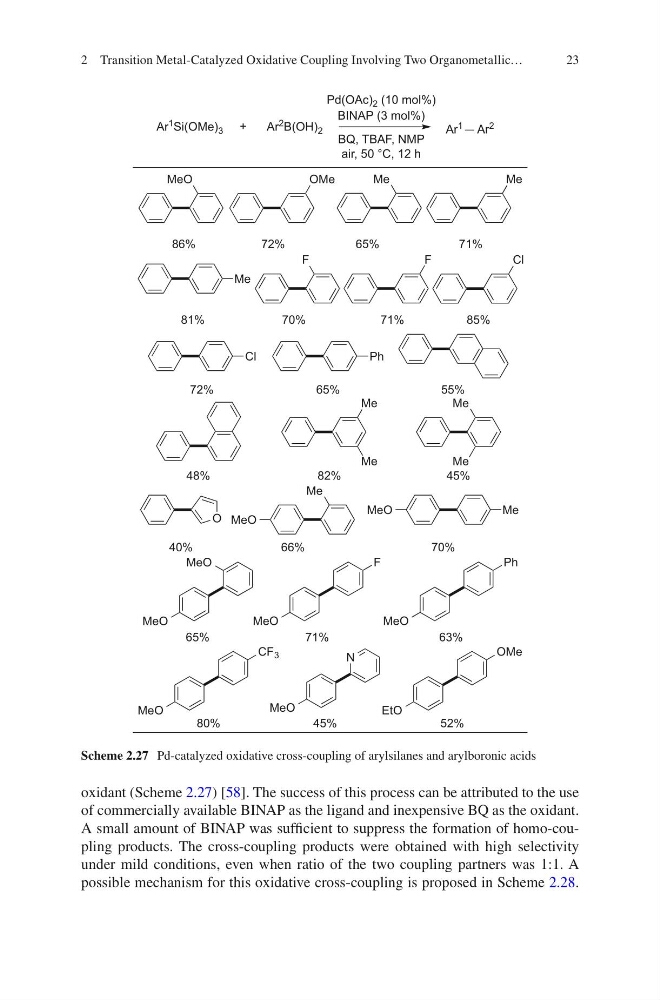
oxidant (Scheme 2.27) [58]. The success of this process can be attributed to the use
of commercially available BINAP as the ligand and inexpensive BQ as the oxidant.
A small amount of BINAP was sufficient to suppress the formation of homo-coupling products. The cross-coupling products were obtained with high selectivity
under mild conditions, even when ratio of the two coupling partners was 1:1. A
possible mechanism for this oxidative cross-coupling is proposed in Scheme 2.28.
Ar
1
Si(OMe) 3
Ar
2
B(OH) 2
+
Ar
1
Ar
2
Pd(OAc) 2 (10 mol%)
BINAP (3 mol%)
BQ, TBAF, NMP
air, 50 °C, 12 h
MeO
OMe
Me
Me
Me
F
F
Cl
Cl
Ph
Me
Me
Me
Me
O MeO
Me
MeO
Me
MeO
MeO
MeO
F
MeO
Ph
MeO
CF 3
N
MeO
EtO
OMe
86%
72%
65%
7 1%
81%
70%
71%
8 5%
72%
65%
5 5%
48%
82%
4 5%
40%
66%
70%
65%
71%
6 3%
80%
45%
5 2%
Scheme 2.27 Pd-catalyzed oxidative cross-coupling of arylsilanes and arylboronic acids
2 Transition Metal-Catalyzed Oxidative Coupling Involving Two Organometallic…
oxidant (Scheme 2.27) [58]. The success of this process can be attributed to the use
of commercially available BINAP as the ligand and inexpensive BQ as the oxidant.
A small amount of BINAP was sufficient to suppress the formation of homo-coupling products. The cross-coupling products were obtained with high selectivity
under mild conditions, even when ratio of the two coupling partners was 1:1. A
possible mechanism for this oxidative cross-coupling is proposed in Scheme 2.28.
Ar
1
Si(OMe) 3
Ar
2
B(OH) 2
+
Ar
1
Ar
2
Pd(OAc) 2 (10 mol%)
BINAP (3 mol%)
BQ, TBAF, NMP
air, 50 °C, 12 h
MeO
OMe
Me
Me
Me
F
F
Cl
Cl
Ph
Me
Me
Me
Me
O MeO
Me
MeO
Me
MeO
MeO
MeO
F
MeO
Ph
MeO
CF 3
N
MeO
EtO
OMe
86%
72%
65%
7 1%
81%
70%
71%
8 5%
72%
65%
5 5%
48%
82%
4 5%
40%
66%
70%
65%
71%
6 3%
80%
45%
5 2%
Scheme 2.27 Pd-catalyzed oxidative cross-coupling of arylsilanes and arylboronic acids
2 Transition Metal-Catalyzed Oxidative Coupling Involving Two Organometallic…