

21
transmetalation of the RO–Pd(II)–Cl. Therefore, the alkyl zinc reagents should
transmetalate only one of the enolate anion and chloride anion. In situ IR studies
have revealed that alkyl zinc reagents favor selective transmetalation of enolate
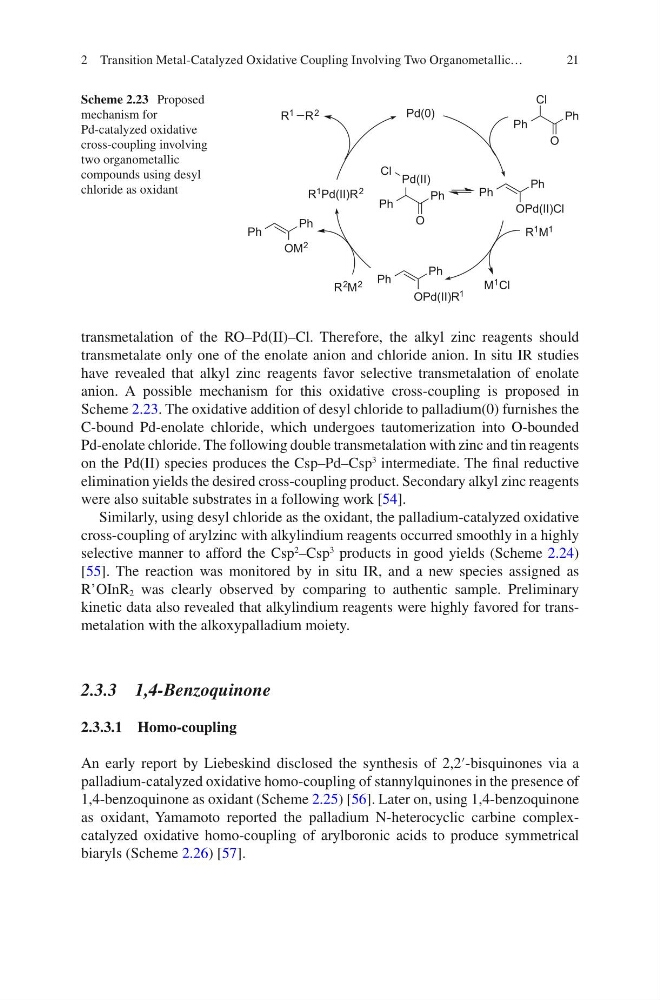
anion. A possible mechanism for this oxidative cross-coupling is proposed in
Scheme 2.23. The oxidative addition of desyl chloride to palladium(0) furnishes the
C-bound Pd-enolate chloride, which undergoes tautomerization into O-bounded
Pd-enolate chloride. The following double transmetalation with zinc and tin reagents
on the Pd(II) species produces the Csp–Pd–Csp
3
intermediate. The final reductive
elimination yields the desired cross-coupling product. Secondary alkyl zinc reagents
were also suitable substrates in a following work [54].
Similarly, using desyl chloride as the oxidant, the palladium-catalyzed oxidative
cross-coupling of arylzinc with alkylindium reagents occurred smoothly in a highly
selective manner to afford the Csp
2
–Csp
3
products in good yields (Scheme 2.24)
[55]. The reaction was monitored by in situ IR, and a new species assigned as
R’OInR 2 was clearly observed by comparing to authentic sample. Preliminary
kinetic data also revealed that alkylindium reagents were highly favored for transmetalation with the alkoxypalladium moiety.
2.3.3 1,4-Benzoquinone
2.3.3.1 Homo-coupling
An early report by Liebeskind disclosed the synthesis of 2,2′-bisquinones via a
palladium-catalyzed oxidative homo-coupling of stannylquinones in the presence of
1,4-benzoquinone as oxidant (Scheme 2.25) [56]. Later on, using 1,4-benzoquinone
as oxidant, Yamamoto reported the palladium N-heterocyclic carbine complexcatalyzed oxidative homo-coupling of arylboronic acids to produce symmetrical
biaryls (Scheme 2.26) [57].
Pd(0)
Ph
Pd(II)
O
Ph
Cl
Ph
OPd(II)Cl
Ph
R 1 Pd(II)R 2
Ph
OPd(II)R 1
Ph
Ph
Cl
O
Ph
R 1 M 1
R 2 M 2
R 1 R 2
M 1 Cl
Ph
OM 2
Ph
Scheme 2.23 Proposed
mechanism for
Pd-catalyzed oxidative
cross-coupling involving
two organometallic
compounds using desyl
chloride as oxidant
2 Transition Metal-Catalyzed Oxidative Coupling Involving Two Organometallic…
transmetalation of the RO–Pd(II)–Cl. Therefore, the alkyl zinc reagents should
transmetalate only one of the enolate anion and chloride anion. In situ IR studies
have revealed that alkyl zinc reagents favor selective transmetalation of enolate
anion. A possible mechanism for this oxidative cross-coupling is proposed in
Scheme 2.23. The oxidative addition of desyl chloride to palladium(0) furnishes the
C-bound Pd-enolate chloride, which undergoes tautomerization into O-bounded
Pd-enolate chloride. The following double transmetalation with zinc and tin reagents
on the Pd(II) species produces the Csp–Pd–Csp
3
intermediate. The final reductive
elimination yields the desired cross-coupling product. Secondary alkyl zinc reagents
were also suitable substrates in a following work [54].
Similarly, using desyl chloride as the oxidant, the palladium-catalyzed oxidative
cross-coupling of arylzinc with alkylindium reagents occurred smoothly in a highly
selective manner to afford the Csp
2
–Csp
3
products in good yields (Scheme 2.24)
[55]. The reaction was monitored by in situ IR, and a new species assigned as
R’OInR 2 was clearly observed by comparing to authentic sample. Preliminary
kinetic data also revealed that alkylindium reagents were highly favored for transmetalation with the alkoxypalladium moiety.
2.3.3 1,4-Benzoquinone
2.3.3.1 Homo-coupling
An early report by Liebeskind disclosed the synthesis of 2,2′-bisquinones via a
palladium-catalyzed oxidative homo-coupling of stannylquinones in the presence of
1,4-benzoquinone as oxidant (Scheme 2.25) [56]. Later on, using 1,4-benzoquinone
as oxidant, Yamamoto reported the palladium N-heterocyclic carbine complexcatalyzed oxidative homo-coupling of arylboronic acids to produce symmetrical
biaryls (Scheme 2.26) [57].
Pd(0)
Ph
Pd(II)
O
Ph
Cl
Ph
OPd(II)Cl
Ph
R 1 Pd(II)R 2
Ph
OPd(II)R 1
Ph
Ph
Cl
O
Ph
R 1 M 1
R 2 M 2
R 1 R 2
M 1 Cl
Ph
OM 2
Ph
Scheme 2.23 Proposed
mechanism for
Pd-catalyzed oxidative
cross-coupling involving
two organometallic
compounds using desyl
chloride as oxidant
2 Transition Metal-Catalyzed Oxidative Coupling Involving Two Organometallic…