

20
2.3.2.2 Cross-Coupling
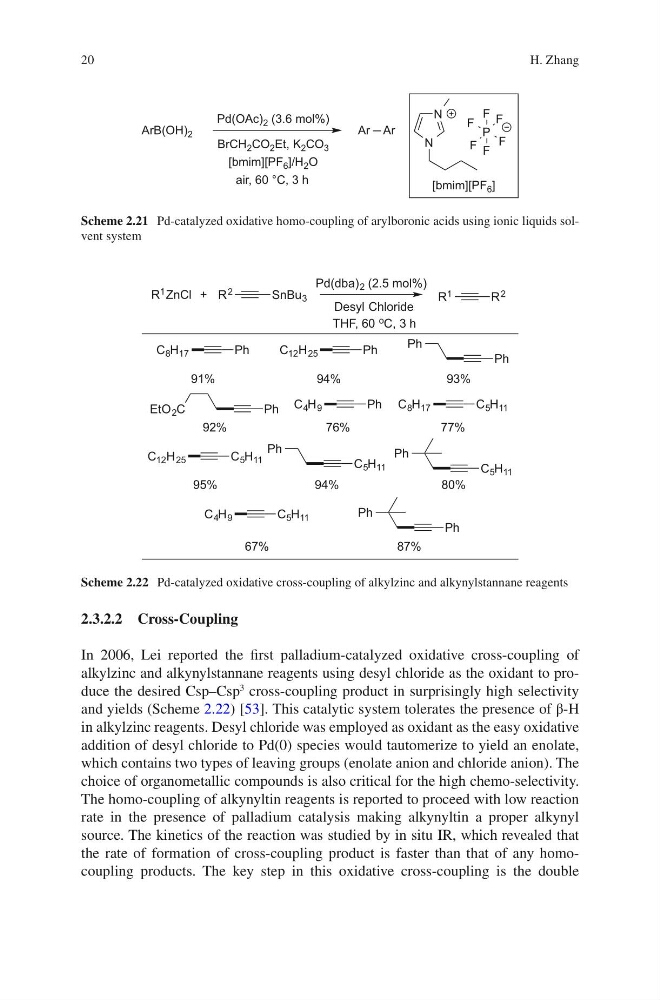
In 2006, Lei reported the first palladium-catalyzed oxidative cross-coupling of
alkylzinc and alkynylstannane reagents using desyl chloride as the oxidant to produce the desired Csp–Csp
3
cross-coupling product in surprisingly high selectivity
and yields (Scheme 2.22) [53]. This catalytic system tolerates the presence of β-H
in alkylzinc reagents. Desyl chloride was employed as oxidant as the easy oxidative
addition of desyl chloride to Pd(0) species would tautomerize to yield an enolate,
which contains two types of leaving groups (enolate anion and chloride anion). The
choice of organometallic compounds is also critical for the high chemo-selectivity.
The homo-coupling of alkynyltin reagents is reported to proceed with low reaction
rate in the presence of palladium catalysis making alkynyltin a proper alkynyl
source. The kinetics of the reaction was studied by in situ IR, which revealed that
the rate of formation of cross-coupling product is faster than that of any homocoupling products. The key step in this oxidative cross-coupling is the double
ArB(OH) 2
Pd(OAc) 2 (3.6 mol%)
BrCH 2 CO 2 Et, K 2 CO 3
[bmim][PF 6 ]/H 2 O
air, 60 °C, 3 h
Ar Ar
N
N
F
P
F
F
F
F
F
[bmim][PF 6 ]
Scheme 2.21 Pd-catalyzed oxidative homo-coupling of arylboronic acids using ionic liquids solvent system
R 1 ZnCl
R 2
SnBu 3
+
Pd(dba) 2 (2.5 mol%)
Desyl Chloride
THF, 60 o C, 3 h
R 1
R 2
C 8 H 17
Ph
C 12 H 25
Ph
Ph
Ph
Ph
EtO 2 C
C 4 H 9
Ph C 8 H 17
C 5 H 11
C 12 H 25
C 5 H 11
C 5 H 11
Ph
C 5 H 11
Ph
C 4 H 9
C 5 H 11
Ph
Ph
87%
91%
9 4%
93%
92%
7 6%
77%
95%
9 4%
80%
67%
Scheme 2.22 Pd-catalyzed oxidative cross-coupling of alkylzinc and alkynylstannane reagents
H. Zhang
2.3.2.2 Cross-Coupling
In 2006, Lei reported the first palladium-catalyzed oxidative cross-coupling of
alkylzinc and alkynylstannane reagents using desyl chloride as the oxidant to produce the desired Csp–Csp
3
cross-coupling product in surprisingly high selectivity
and yields (Scheme 2.22) [53]. This catalytic system tolerates the presence of β-H
in alkylzinc reagents. Desyl chloride was employed as oxidant as the easy oxidative
addition of desyl chloride to Pd(0) species would tautomerize to yield an enolate,
which contains two types of leaving groups (enolate anion and chloride anion). The
choice of organometallic compounds is also critical for the high chemo-selectivity.
The homo-coupling of alkynyltin reagents is reported to proceed with low reaction
rate in the presence of palladium catalysis making alkynyltin a proper alkynyl
source. The kinetics of the reaction was studied by in situ IR, which revealed that
the rate of formation of cross-coupling product is faster than that of any homocoupling products. The key step in this oxidative cross-coupling is the double
ArB(OH) 2
Pd(OAc) 2 (3.6 mol%)
BrCH 2 CO 2 Et, K 2 CO 3
[bmim][PF 6 ]/H 2 O
air, 60 °C, 3 h
Ar Ar
N
N
F
P
F
F
F
F
F
[bmim][PF 6 ]
Scheme 2.21 Pd-catalyzed oxidative homo-coupling of arylboronic acids using ionic liquids solvent system
R 1 ZnCl
R 2
SnBu 3
+
Pd(dba) 2 (2.5 mol%)
Desyl Chloride
THF, 60 o C, 3 h
R 1
R 2
C 8 H 17
Ph
C 12 H 25
Ph
Ph
Ph
Ph
EtO 2 C
C 4 H 9
Ph C 8 H 17
C 5 H 11
C 12 H 25
C 5 H 11
C 5 H 11
Ph
C 5 H 11
Ph
C 4 H 9
C 5 H 11
Ph
Ph
87%
91%
9 4%
93%
92%
7 6%
77%
95%
9 4%
80%
67%
Scheme 2.22 Pd-catalyzed oxidative cross-coupling of alkylzinc and alkynylstannane reagents
H. Zhang