

18
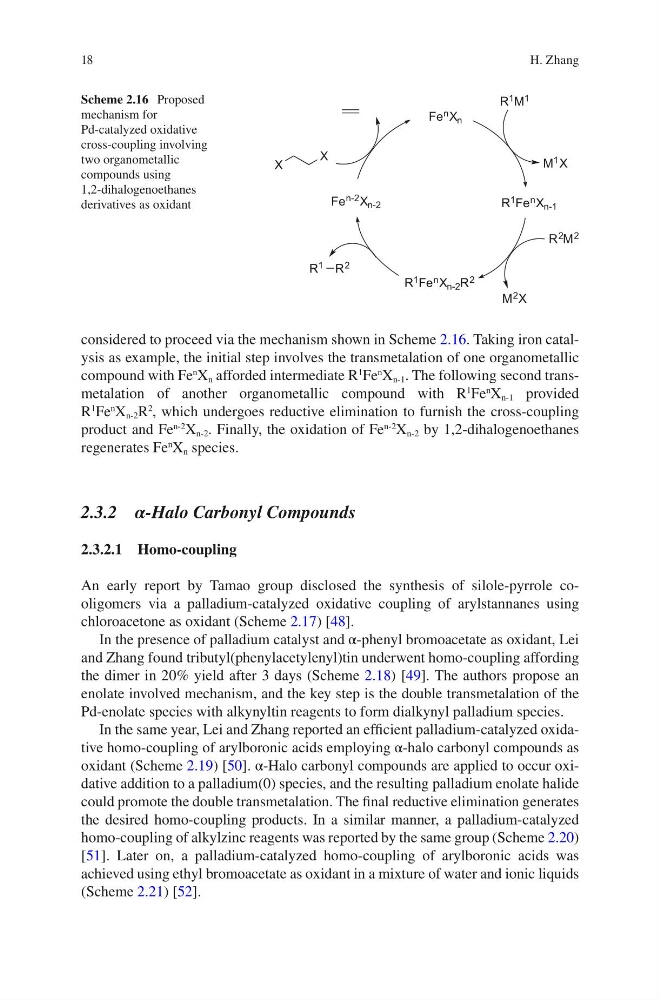
considered to proceed via the mechanism shown in Scheme 2.16. Taking iron catalysis as example, the initial step involves the transmetalation of one organometallic
compound with Fe
n
X n afforded intermediate R
1
Fe
n
X n-1 . The following second transmetalation of another organometallic compound with R
1
Fe
n
X n-1 provided
R
1
Fe
n
X n-2 R
2
, which undergoes reductive elimination to furnish the cross-coupling
product and Fe
n-2
X n-2 . Finally, the oxidation of Fe
n-2
X n-2 by 1,2-dihalogenoethanes
regenerates Fe
n
X n species.
2.3.2 α-Halo Carbonyl Compounds
2.3.2.1 Homo-coupling
An early report by Tamao group disclosed the synthesis of silole-pyrrole cooligomers via a palladium-catalyzed oxidative coupling of arylstannanes using
chloroacetone as oxidant (Scheme 2.17) [48].
In the presence of palladium catalyst and α-phenyl bromoacetate as oxidant, Lei
and Zhang found tributyl(phenylacetylenyl)tin underwent homo-coupling affording
the dimer in 20% yield after 3 days (Scheme 2.18) [49]. The authors propose an
enolate involved mechanism, and the key step is the double transmetalation of the
Pd-enolate species with alkynyltin reagents to form dialkynyl palladium species.
In the same year, Lei and Zhang reported an efficient palladium-catalyzed oxidative homo-coupling of arylboronic acids employing α-halo carbonyl compounds as
oxidant (Scheme 2.19) [50]. α-Halo carbonyl compounds are applied to occur oxidative addition to a palladium(0) species, and the resulting palladium enolate halide
could promote the double transmetalation. The final reductive elimination generates
the desired homo-coupling products. In a similar manner, a palladium-catalyzed
homo- coupling of alkylzinc reagents was reported by the same group (Scheme 2.20)
[51]. Later on, a palladium-catalyzed homo-coupling of arylboronic acids was
achieved using ethyl bromoacetate as oxidant in a mixture of water and ionic liquids
(Scheme 2.21) [52].
Fe n X n
R 1 Fe n X n-1
R 1 Fe n X n-2 R 2
Fe n-2 X n-2
R 1 M 1
M 1 X
R 2 M 2
M 2 X
R 1 R 2
X
X
Scheme 2.16 Proposed
mechanism for
Pd-catalyzed oxidative
cross-coupling involving
two organometallic
compounds using
1,2-dihalogenoethanes
derivatives as oxidant
H. Zhang
considered to proceed via the mechanism shown in Scheme 2.16. Taking iron catalysis as example, the initial step involves the transmetalation of one organometallic
compound with Fe
n
X n afforded intermediate R
1
Fe
n
X n-1 . The following second transmetalation of another organometallic compound with R
1
Fe
n
X n-1 provided
R
1
Fe
n
X n-2 R
2
, which undergoes reductive elimination to furnish the cross-coupling
product and Fe
n-2
X n-2 . Finally, the oxidation of Fe
n-2
X n-2 by 1,2-dihalogenoethanes
regenerates Fe
n
X n species.
2.3.2 α-Halo Carbonyl Compounds
2.3.2.1 Homo-coupling
An early report by Tamao group disclosed the synthesis of silole-pyrrole cooligomers via a palladium-catalyzed oxidative coupling of arylstannanes using
chloroacetone as oxidant (Scheme 2.17) [48].
In the presence of palladium catalyst and α-phenyl bromoacetate as oxidant, Lei
and Zhang found tributyl(phenylacetylenyl)tin underwent homo-coupling affording
the dimer in 20% yield after 3 days (Scheme 2.18) [49]. The authors propose an
enolate involved mechanism, and the key step is the double transmetalation of the
Pd-enolate species with alkynyltin reagents to form dialkynyl palladium species.
In the same year, Lei and Zhang reported an efficient palladium-catalyzed oxidative homo-coupling of arylboronic acids employing α-halo carbonyl compounds as
oxidant (Scheme 2.19) [50]. α-Halo carbonyl compounds are applied to occur oxidative addition to a palladium(0) species, and the resulting palladium enolate halide
could promote the double transmetalation. The final reductive elimination generates
the desired homo-coupling products. In a similar manner, a palladium-catalyzed
homo- coupling of alkylzinc reagents was reported by the same group (Scheme 2.20)
[51]. Later on, a palladium-catalyzed homo-coupling of arylboronic acids was
achieved using ethyl bromoacetate as oxidant in a mixture of water and ionic liquids
(Scheme 2.21) [52].
Fe n X n
R 1 Fe n X n-1
R 1 Fe n X n-2 R 2
Fe n-2 X n-2
R 1 M 1
M 1 X
R 2 M 2
M 2 X
R 1 R 2
X
X
Scheme 2.16 Proposed
mechanism for
Pd-catalyzed oxidative
cross-coupling involving
two organometallic
compounds using
1,2-dihalogenoethanes
derivatives as oxidant
H. Zhang