

17
2.3.1.2 Cross-Coupling
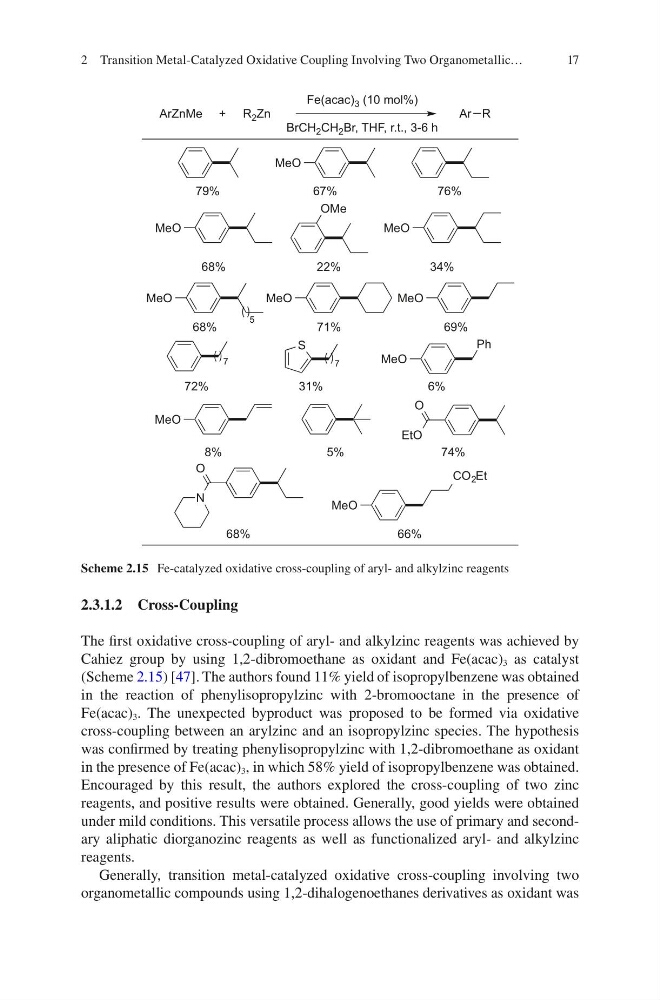
The first oxidative cross-coupling of aryl- and alkylzinc reagents was achieved by
Cahiez group by using 1,2-dibromoethane as oxidant and Fe(acac) 3 as catalyst
(Scheme 2.15) [47]. The authors found 11% yield of isopropylbenzene was obtained
in the reaction of phenylisopropylzinc with 2-bromooctane in the presence of
Fe(acac) 3 . The unexpected byproduct was proposed to be formed via oxidative
cross-coupling between an arylzinc and an isopropylzinc species. The hypothesis
was confirmed by treating phenylisopropylzinc with 1,2-dibromoethane as oxidant
in the presence of Fe(acac) 3 , in which 58% yield of isopropylbenzene was obtained.
Encouraged by this result, the authors explored the cross-coupling of two zinc
reagents, and positive results were obtained. Generally, good yields were obtained
under mild conditions. This versatile process allows the use of primary and secondary aliphatic diorganozinc reagents as well as functionalized aryl- and alkylzinc
reagents.
Generally, transition metal-catalyzed oxidative cross-coupling involving two
organometallic compounds using 1,2-dihalogenoethanes derivatives as oxidant was
Fe(acac) 3 (10 mol%)
BrCH 2 CH 2 Br, THF, r.t., 3-6 h
ArZnMe
R 2 Zn
+
A r R
MeO
MeO
OMe
MeO
MeO
5
MeO
MeO
7
S
7
MeO
Ph
MeO
EtO
O
N
O
MeO
CO 2 Et
79%
6 7%
76%
68%
2 2%
34%
68%
71%
69%
72%
3 1%
6%
8%
5%
74%
68%
6 6%
Scheme 2.15 Fe-catalyzed oxidative cross-coupling of aryl- and alkylzinc reagents
2 Transition Metal-Catalyzed Oxidative Coupling Involving Two Organometallic…
2.3.1.2 Cross-Coupling
The first oxidative cross-coupling of aryl- and alkylzinc reagents was achieved by
Cahiez group by using 1,2-dibromoethane as oxidant and Fe(acac) 3 as catalyst
(Scheme 2.15) [47]. The authors found 11% yield of isopropylbenzene was obtained
in the reaction of phenylisopropylzinc with 2-bromooctane in the presence of
Fe(acac) 3 . The unexpected byproduct was proposed to be formed via oxidative
cross-coupling between an arylzinc and an isopropylzinc species. The hypothesis
was confirmed by treating phenylisopropylzinc with 1,2-dibromoethane as oxidant
in the presence of Fe(acac) 3 , in which 58% yield of isopropylbenzene was obtained.
Encouraged by this result, the authors explored the cross-coupling of two zinc
reagents, and positive results were obtained. Generally, good yields were obtained
under mild conditions. This versatile process allows the use of primary and secondary aliphatic diorganozinc reagents as well as functionalized aryl- and alkylzinc
reagents.
Generally, transition metal-catalyzed oxidative cross-coupling involving two
organometallic compounds using 1,2-dihalogenoethanes derivatives as oxidant was
Fe(acac) 3 (10 mol%)
BrCH 2 CH 2 Br, THF, r.t., 3-6 h
ArZnMe
R 2 Zn
+
A r R
MeO
MeO
OMe
MeO
MeO
5
MeO
MeO
7
S
7
MeO
Ph
MeO
EtO
O
N
O
MeO
CO 2 Et
79%
6 7%
76%
68%
2 2%
34%
68%
71%
69%
72%
3 1%
6%
8%
5%
74%
68%
6 6%
Scheme 2.15 Fe-catalyzed oxidative cross-coupling of aryl- and alkylzinc reagents
2 Transition Metal-Catalyzed Oxidative Coupling Involving Two Organometallic…