

188
In 2017, Xu and co-workers reported a Cp 2 Fe-catalyzed C(sp
3
)-H and
C(sp
2
)-H bond dehydrogenative cross-coupling reaction using an undivided cell
equipped with a reticulated vitreous carbon anode and Pt plate cathode [33].
Various C3-fluorinated oxindole derivatives 123 with diverse functional groups,
such as -OH, -OTBS, -CH=CH 2 , and -C ≡ CH, were synthesized in high yield. It
is noteworthy that the in situ generation of the requisite oxidant and base as well
as LiCp as the additive plays important roles to improve the yield of C3-fluorinated
oxindole derivatives 123 (Scheme 5.48). A mechanism involving functionalized
monofluoroalkyl radical intermediate generation by electrochemical activation
of C-H bonds has been proposed.
Lei’s group developed an electrocatalytic intramolecular oxidative annulation of
N-aryl enamines 124 via C(sp
2
)-H functionalization to provide substituted indole
derivatives 125. This reaction proceeded in an undivided cell with Pt plate anode
and cathode under a constant current of 7 mA at room temperature [34]
(Scheme 5.49). Indole derivatives 125 were synthesized in yields of 56%–96%
without any oxidant or transition metal. Notably, KI not only acted as the electrolyte
but also participated as an electron transfer mediator in the redox process of this
oxidative annulation.
The mechanism proposed for this reaction involves the in situ generation of a
hyperiodide intermediate (I
+
) from iodide ions through two anodic oxidation steps.
Then, an N-iodo intermediate was generated by the reaction of the N-aryl enamine
with I
+
. Following sequential intramolecular radical addition, oxidation, and deprotonation processes, the final product indole was formed [34] (Scheme 5.50).
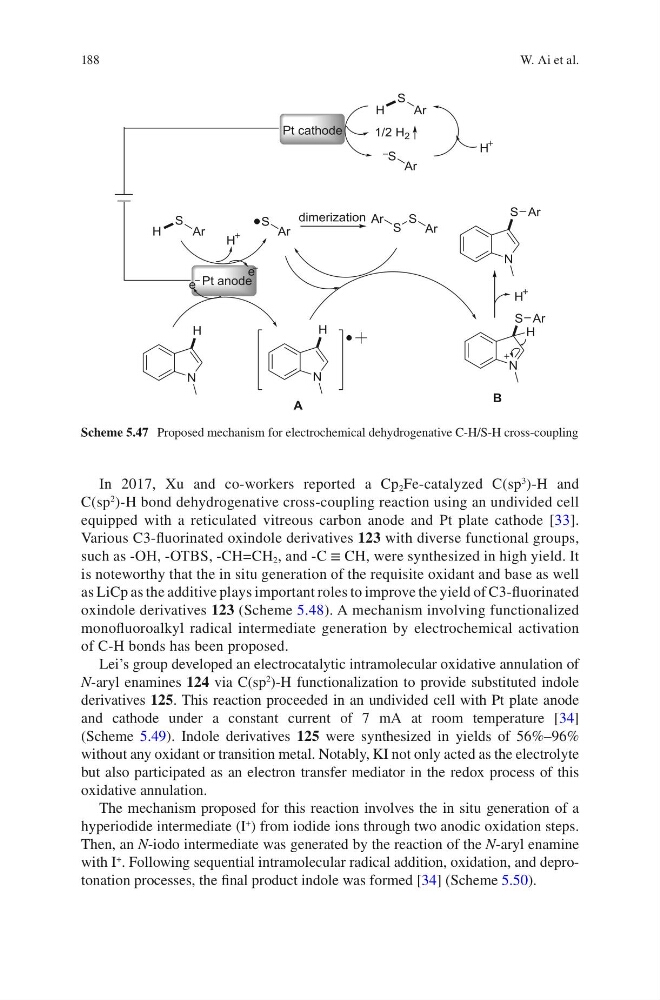
Scheme 5.47 Proposed mechanism for electrochemical dehydrogenative C-H/S-H cross-coupling
W. Ai et al.
In 2017, Xu and co-workers reported a Cp 2 Fe-catalyzed C(sp
3
)-H and
C(sp
2
)-H bond dehydrogenative cross-coupling reaction using an undivided cell
equipped with a reticulated vitreous carbon anode and Pt plate cathode [33].
Various C3-fluorinated oxindole derivatives 123 with diverse functional groups,
such as -OH, -OTBS, -CH=CH 2 , and -C ≡ CH, were synthesized in high yield. It
is noteworthy that the in situ generation of the requisite oxidant and base as well
as LiCp as the additive plays important roles to improve the yield of C3-fluorinated
oxindole derivatives 123 (Scheme 5.48). A mechanism involving functionalized
monofluoroalkyl radical intermediate generation by electrochemical activation
of C-H bonds has been proposed.
Lei’s group developed an electrocatalytic intramolecular oxidative annulation of
N-aryl enamines 124 via C(sp
2
)-H functionalization to provide substituted indole
derivatives 125. This reaction proceeded in an undivided cell with Pt plate anode
and cathode under a constant current of 7 mA at room temperature [34]
(Scheme 5.49). Indole derivatives 125 were synthesized in yields of 56%–96%
without any oxidant or transition metal. Notably, KI not only acted as the electrolyte
but also participated as an electron transfer mediator in the redox process of this
oxidative annulation.
The mechanism proposed for this reaction involves the in situ generation of a
hyperiodide intermediate (I
+
) from iodide ions through two anodic oxidation steps.
Then, an N-iodo intermediate was generated by the reaction of the N-aryl enamine
with I
+
. Following sequential intramolecular radical addition, oxidation, and deprotonation processes, the final product indole was formed [34] (Scheme 5.50).
Scheme 5.47 Proposed mechanism for electrochemical dehydrogenative C-H/S-H cross-coupling
W. Ai et al.