

187
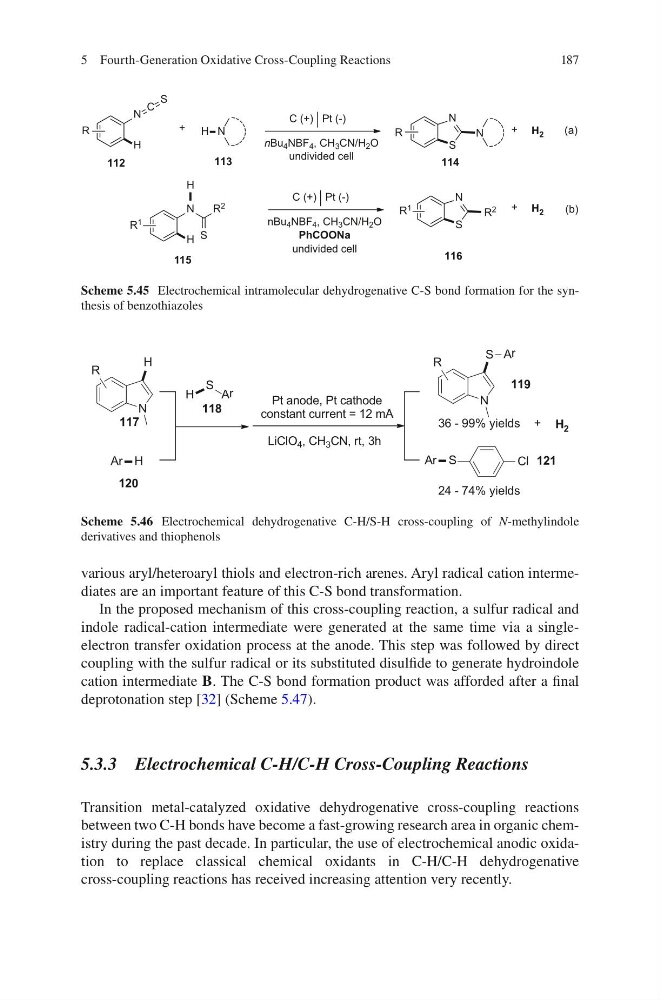
various aryl/heteroaryl thiols and electron-rich arenes. Aryl radical cation intermediates are an important feature of this C-S bond transformation.
In the proposed mechanism of this cross-coupling reaction, a sulfur radical and
indole radical-cation intermediate were generated at the same time via a singleelectron transfer oxidation process at the anode. This step was followed by direct
coupling with the sulfur radical or its substituted disulfide to generate hydroindole
cation intermediate B. The C-S bond formation product was afforded after a final
deprotonation step [32] (Scheme 5.47).
5.3.3 Electrochemical C-H/C-H Cross-Coupling Reactions
Transition metal-catalyzed oxidative dehydrogenative cross-coupling reactions
between two C-H bonds have become a fast-growing research area in organic chemistry during the past decade. In particular, the use of electrochemical anodic oxidation to replace classical chemical oxidants in C-H/C-H dehydrogenative
cross-coupling reactions has received increasing attention very recently.
N
H
C
S
+
N
H
C (+) Pt (-)
nBu 4 NBF 4 , CH 3 CN/H 2 O
undivided cell
R
S
N
N
R
N
R 2
S
H
H
R 1
C (+) Pt (-)
nBu 4 NBF 4 , CH 3 CN/H 2 O
PhCOONa
undivided cell
S
N
R 2
R 1
(a)
(b)
+ H 2
+ H 2
112
113
114
115
116
Scheme 5.45 Electrochemical intramolecular dehydrogenative C-S bond formation for the synthesis of benzothiazoles
N
H
R
Ar H
H
S Ar
Pt anode, Pt cathode
constant current = 12 mA
LiClO 4 , CH 3 CN, rt, 3h
N
S
R
Ar
Ar S
Cl
24 - 74% yields
36 - 99% yields + H 2
117
118
119
120
121
Scheme 5.46 Electrochemical dehydrogenative C-H/S-H cross-coupling of N-methylindole
derivatives and thiophenols
5 Fourth-Generation Oxidative Cross-Coupling Reactions
various aryl/heteroaryl thiols and electron-rich arenes. Aryl radical cation intermediates are an important feature of this C-S bond transformation.
In the proposed mechanism of this cross-coupling reaction, a sulfur radical and
indole radical-cation intermediate were generated at the same time via a singleelectron transfer oxidation process at the anode. This step was followed by direct
coupling with the sulfur radical or its substituted disulfide to generate hydroindole
cation intermediate B. The C-S bond formation product was afforded after a final
deprotonation step [32] (Scheme 5.47).
5.3.3 Electrochemical C-H/C-H Cross-Coupling Reactions
Transition metal-catalyzed oxidative dehydrogenative cross-coupling reactions
between two C-H bonds have become a fast-growing research area in organic chemistry during the past decade. In particular, the use of electrochemical anodic oxidation to replace classical chemical oxidants in C-H/C-H dehydrogenative
cross-coupling reactions has received increasing attention very recently.
N
H
C
S
+
N
H
C (+) Pt (-)
nBu 4 NBF 4 , CH 3 CN/H 2 O
undivided cell
R
S
N
N
R
N
R 2
S
H
H
R 1
C (+) Pt (-)
nBu 4 NBF 4 , CH 3 CN/H 2 O
PhCOONa
undivided cell
S
N
R 2
R 1
(a)
(b)
+ H 2
+ H 2
112
113
114
115
116
Scheme 5.45 Electrochemical intramolecular dehydrogenative C-S bond formation for the synthesis of benzothiazoles
N
H
R
Ar H
H
S Ar
Pt anode, Pt cathode
constant current = 12 mA
LiClO 4 , CH 3 CN, rt, 3h
N
S
R
Ar
Ar S
Cl
24 - 74% yields
36 - 99% yields + H 2
117
118
119
120
121
Scheme 5.46 Electrochemical dehydrogenative C-H/S-H cross-coupling of N-methylindole
derivatives and thiophenols
5 Fourth-Generation Oxidative Cross-Coupling Reactions