

170
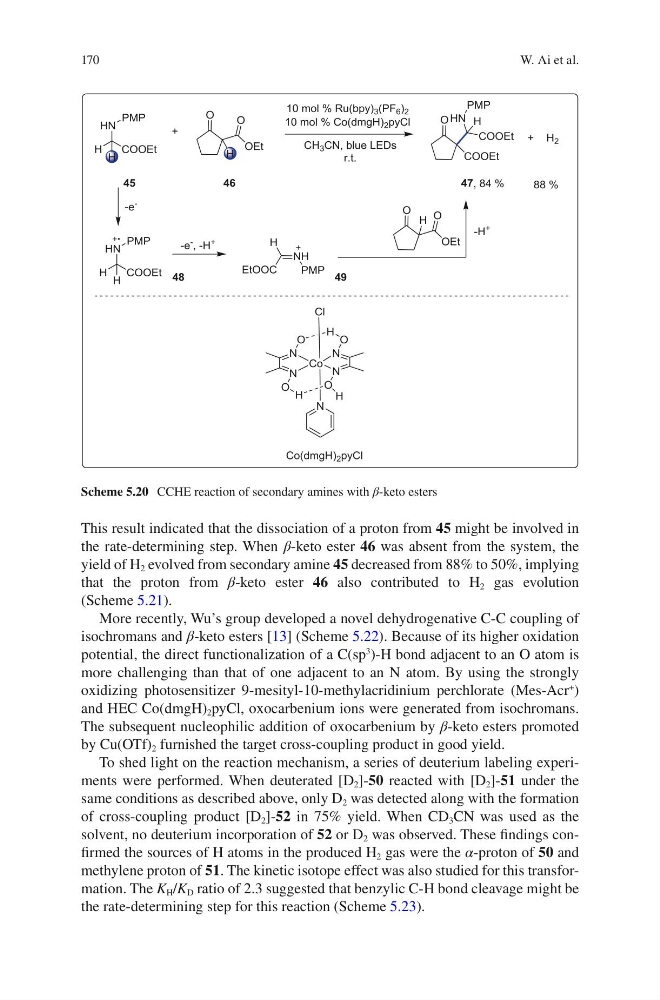
This result indicated that the dissociation of a proton from 45 might be involved in
the rate-determining step. When β-keto ester 46 was absent from the system, the
yield of H 2 evolved from secondary amine 45 decreased from 88% to 50%, implying
that the proton from β-keto ester 46 also contributed to H 2 gas evolution
(Scheme 5.21).
More recently, Wu’s group developed a novel dehydrogenative C-C coupling of
isochromans and β-keto esters [13] (Scheme 5.22). Because of its higher oxidation
potential, the direct functionalization of a C(sp
3
)-H bond adjacent to an O atom is
more challenging than that of one adjacent to an N atom. By using the strongly
oxidizing photosensitizer 9-mesityl-10-methylacridinium perchlorate (Mes-Acr
+
)
and HEC Co(dmgH) 2 pyCl, oxocarbenium ions were generated from isochromans.
The subsequent nucleophilic addition of oxocarbenium by β-keto esters promoted
by Cu(OTf) 2 furnished the target cross-coupling product in good yield.
To shed light on the reaction mechanism, a series of deuterium labeling experiments were performed. When deuterated [D 2 ]-50 reacted with [D 2 ]-51 under the
same conditions as described above, only D 2 was detected along with the formation
of cross-coupling product [D 2 ]-52 in 75% yield. When CD 3 CN was used as the
solvent, no deuterium incorporation of 52 or D 2 was observed. These findings confirmed the sources of H atoms in the produced H 2 gas were the α-proton of 50 and
methylene proton of 51. The kinetic isotope effect was also studied for this transformation. The K H /K D ratio of 2.3 suggested that benzylic C-H bond cleavage might be
the rate-determining step for this reaction (Scheme 5.23).
Scheme 5.20 CCHE reaction of secondary amines with β-keto esters
W. Ai et al.
This result indicated that the dissociation of a proton from 45 might be involved in
the rate-determining step. When β-keto ester 46 was absent from the system, the
yield of H 2 evolved from secondary amine 45 decreased from 88% to 50%, implying
that the proton from β-keto ester 46 also contributed to H 2 gas evolution
(Scheme 5.21).
More recently, Wu’s group developed a novel dehydrogenative C-C coupling of
isochromans and β-keto esters [13] (Scheme 5.22). Because of its higher oxidation
potential, the direct functionalization of a C(sp
3
)-H bond adjacent to an O atom is
more challenging than that of one adjacent to an N atom. By using the strongly
oxidizing photosensitizer 9-mesityl-10-methylacridinium perchlorate (Mes-Acr
+
)
and HEC Co(dmgH) 2 pyCl, oxocarbenium ions were generated from isochromans.
The subsequent nucleophilic addition of oxocarbenium by β-keto esters promoted
by Cu(OTf) 2 furnished the target cross-coupling product in good yield.
To shed light on the reaction mechanism, a series of deuterium labeling experiments were performed. When deuterated [D 2 ]-50 reacted with [D 2 ]-51 under the
same conditions as described above, only D 2 was detected along with the formation
of cross-coupling product [D 2 ]-52 in 75% yield. When CD 3 CN was used as the
solvent, no deuterium incorporation of 52 or D 2 was observed. These findings confirmed the sources of H atoms in the produced H 2 gas were the α-proton of 50 and
methylene proton of 51. The kinetic isotope effect was also studied for this transformation. The K H /K D ratio of 2.3 suggested that benzylic C-H bond cleavage might be
the rate-determining step for this reaction (Scheme 5.23).
Scheme 5.20 CCHE reaction of secondary amines with β-keto esters
W. Ai et al.