

169
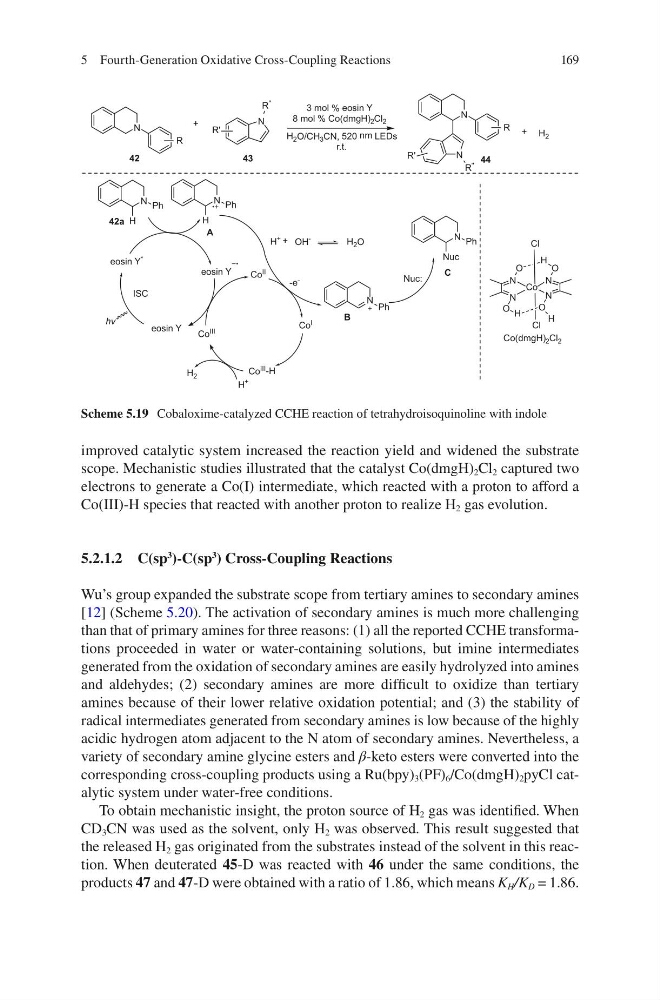
improved catalytic system increased the reaction yield and widened the substrate
scope. Mechanistic studies illustrated that the catalyst Co(dmgH) 2 Cl 2 captured two
electrons to generate a Co(I) intermediate, which reacted with a proton to afford a
Co(III)-H species that reacted with another proton to realize H 2 gas evolution.
5.2.1.2 C(sp
3
)-C(sp
3
) Cross-Coupling Reactions
Wu’s group expanded the substrate scope from tertiary amines to secondary amines
[12] (Scheme 5.20). The activation of secondary amines is much more challenging
than that of primary amines for three reasons: (1) all the reported CCHE transformations proceeded in water or water-containing solutions, but imine intermediates
generated from the oxidation of secondary amines are easily hydrolyzed into amines
and aldehydes; (2) secondary amines are more difficult to oxidize than tertiary
amines because of their lower relative oxidation potential; and (3) the stability of
radical intermediates generated from secondary amines is low because of the highly
acidic hydrogen atom adjacent to the N atom of secondary amines. Nevertheless, a
variety of secondary amine glycine esters and β-keto esters were converted into the
corresponding cross-coupling products using a Ru(bpy) 3 (PF) 6 /Co(dmgH) 2 pyCl catalytic system under water-free conditions.
To obtain mechanistic insight, the proton source of H 2 gas was identified. When
CD 3 CN was used as the solvent, only H 2 was observed. This result suggested that
the released H 2 gas originated from the substrates instead of the solvent in this reaction. When deuterated 45-D was reacted with 46 under the same conditions, the
products 47 and 47-D were obtained with a ratio of 1.86, which means K H /K D = 1.86.
N
R
+
N
R ''
R'
3 mol % eosin Y
8 mol % Co(dmgH) 2 Cl 2
H 2 O/CH 3 CN, 520 nm LEDs
r.t.
N
R
N
R ''
R'
+ H 2
42
43
44
eosin Y
eosin Y
eosin Y *
hv
Co
III -H
Co
II
Co
III
-e -
Nuc:
H
+
H 2
ISC
Co
I
N Ph
H
N Ph
H
N Ph
N Ph
Nuc
H
+ + OH
-
H 2 O
42a
N
N
Co
N
N
O
O
H
O H
O
H
Cl
Cl
Co(dmgH) 2 Cl 2
A
B
C
Scheme 5.19 Cobaloxime-catalyzed CCHE reaction of tetrahydroisoquinoline with indole
5 Fourth-Generation Oxidative Cross-Coupling Reactions
improved catalytic system increased the reaction yield and widened the substrate
scope. Mechanistic studies illustrated that the catalyst Co(dmgH) 2 Cl 2 captured two
electrons to generate a Co(I) intermediate, which reacted with a proton to afford a
Co(III)-H species that reacted with another proton to realize H 2 gas evolution.
5.2.1.2 C(sp
3
)-C(sp
3
) Cross-Coupling Reactions
Wu’s group expanded the substrate scope from tertiary amines to secondary amines
[12] (Scheme 5.20). The activation of secondary amines is much more challenging
than that of primary amines for three reasons: (1) all the reported CCHE transformations proceeded in water or water-containing solutions, but imine intermediates
generated from the oxidation of secondary amines are easily hydrolyzed into amines
and aldehydes; (2) secondary amines are more difficult to oxidize than tertiary
amines because of their lower relative oxidation potential; and (3) the stability of
radical intermediates generated from secondary amines is low because of the highly
acidic hydrogen atom adjacent to the N atom of secondary amines. Nevertheless, a
variety of secondary amine glycine esters and β-keto esters were converted into the
corresponding cross-coupling products using a Ru(bpy) 3 (PF) 6 /Co(dmgH) 2 pyCl catalytic system under water-free conditions.
To obtain mechanistic insight, the proton source of H 2 gas was identified. When
CD 3 CN was used as the solvent, only H 2 was observed. This result suggested that
the released H 2 gas originated from the substrates instead of the solvent in this reaction. When deuterated 45-D was reacted with 46 under the same conditions, the
products 47 and 47-D were obtained with a ratio of 1.86, which means K H /K D = 1.86.
N
R
+
N
R ''
R'
3 mol % eosin Y
8 mol % Co(dmgH) 2 Cl 2
H 2 O/CH 3 CN, 520 nm LEDs
r.t.
N
R
N
R ''
R'
+ H 2
42
43
44
eosin Y
eosin Y
eosin Y *
hv
Co
III -H
Co
II
Co
III
-e -
Nuc:
H
+
H 2
ISC
Co
I
N Ph
H
N Ph
H
N Ph
N Ph
Nuc
H
+ + OH
-
H 2 O
42a
N
N
Co
N
N
O
O
H
O H
O
H
Cl
Cl
Co(dmgH) 2 Cl 2
A
B
C
Scheme 5.19 Cobaloxime-catalyzed CCHE reaction of tetrahydroisoquinoline with indole
5 Fourth-Generation Oxidative Cross-Coupling Reactions