

158
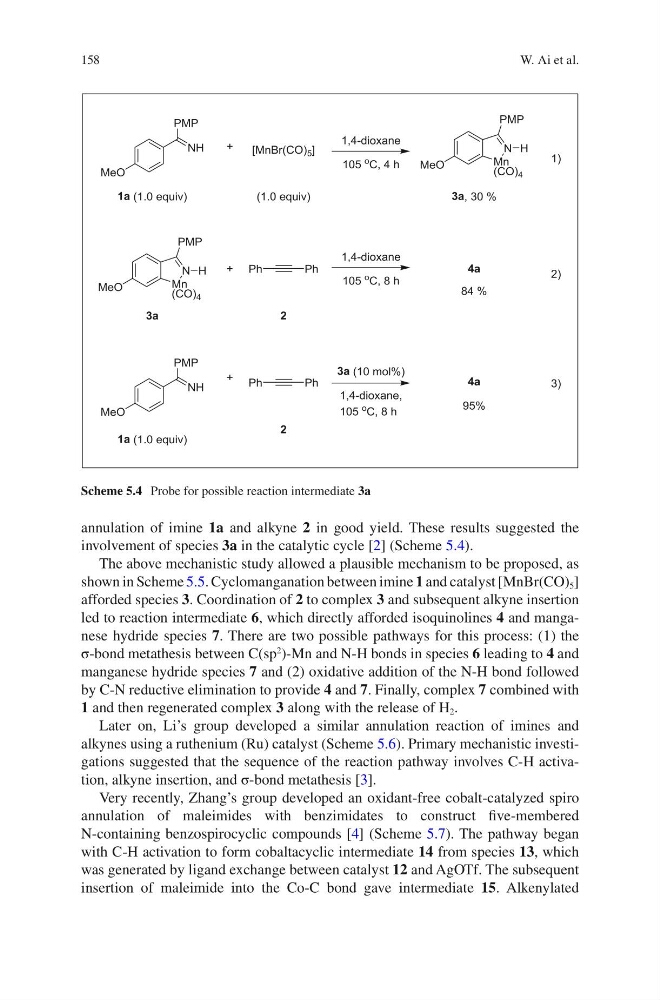
annulation of imine 1a and alkyne 2 in good yield. These results suggested the
involvement of species 3a in the catalytic cycle [2] (Scheme 5.4).
The above mechanistic study allowed a plausible mechanism to be proposed, as
shown in Scheme 5.5. Cyclomanganation between imine 1 and catalyst [MnBr(CO) 5 ]
afforded species 3. Coordination of 2 to complex 3 and subsequent alkyne insertion
led to reaction intermediate 6, which directly afforded isoquinolines 4 and manganese hydride species 7. There are two possible pathways for this process: (1) the
σ-bond metathesis between C(sp
2
)-Mn and N-H bonds in species 6 leading to 4 and
manganese hydride species 7 and (2) oxidative addition of the N-H bond followed
by C-N reductive elimination to provide 4 and 7. Finally, complex 7 combined with
1 and then regenerated complex 3 along with the release of H 2 .
Later on, Li’s group developed a similar annulation reaction of imines and
alkynes using a ruthenium (Ru) catalyst (Scheme 5.6). Primary mechanistic investigations suggested that the sequence of the reaction pathway involves C-H activation, alkyne insertion, and σ-bond metathesis [3].
Very recently, Zhang’s group developed an oxidant-free cobalt-catalyzed spiro
annulation of maleimides with benzimidates to construct five-membered
N-containing benzospirocyclic compounds [4] (Scheme 5.7). The pathway began
with C-H activation to form cobaltacyclic intermediate 14 from species 13, which
was generated by ligand exchange between catalyst 12 and AgOTf. The subsequent
insertion of maleimide into the Co-C bond gave intermediate 15. Alkenylated
Scheme 5.4 Probe for possible reaction intermediate 3a
W. Ai et al.
annulation of imine 1a and alkyne 2 in good yield. These results suggested the
involvement of species 3a in the catalytic cycle [2] (Scheme 5.4).
The above mechanistic study allowed a plausible mechanism to be proposed, as
shown in Scheme 5.5. Cyclomanganation between imine 1 and catalyst [MnBr(CO) 5 ]
afforded species 3. Coordination of 2 to complex 3 and subsequent alkyne insertion
led to reaction intermediate 6, which directly afforded isoquinolines 4 and manganese hydride species 7. There are two possible pathways for this process: (1) the
σ-bond metathesis between C(sp
2
)-Mn and N-H bonds in species 6 leading to 4 and
manganese hydride species 7 and (2) oxidative addition of the N-H bond followed
by C-N reductive elimination to provide 4 and 7. Finally, complex 7 combined with
1 and then regenerated complex 3 along with the release of H 2 .
Later on, Li’s group developed a similar annulation reaction of imines and
alkynes using a ruthenium (Ru) catalyst (Scheme 5.6). Primary mechanistic investigations suggested that the sequence of the reaction pathway involves C-H activation, alkyne insertion, and σ-bond metathesis [3].
Very recently, Zhang’s group developed an oxidant-free cobalt-catalyzed spiro
annulation of maleimides with benzimidates to construct five-membered
N-containing benzospirocyclic compounds [4] (Scheme 5.7). The pathway began
with C-H activation to form cobaltacyclic intermediate 14 from species 13, which
was generated by ligand exchange between catalyst 12 and AgOTf. The subsequent
insertion of maleimide into the Co-C bond gave intermediate 15. Alkenylated
Scheme 5.4 Probe for possible reaction intermediate 3a
W. Ai et al.