

147
4.4.4.3 Oxidative C-P Bond Formation Through Annulations
An example of oxidative C-P coupling through direct annulations toward phosphorylated oxindoles has been established (Scheme 4.71) [54]. In this work, silver-catalyzed carbon-phosphorus functionalization of alkenes can be achieved in moderate
to good yields using AgNO 3 as catalyst and Mg(NO 3 ) 2 as the oxidant. And the
mechanism is proposed that this transformation goes through radical process based
on the radical-trapping experiments employing TEMPO (2,2,6,6-tetramethyl-1piperidinyloxy) as the radical-trapping reagent. This reaction may proceed by a
pathway involving a silver-promoted generation of the phosphoryl radical as the key
intermediate.
A modified method for oxidative carbon-phosphorus coupling under transitionmetal- free conditions using K 2 S 2 O 8 as oxidant can be realized (Scheme 4.72) [55].
Various phosphorylated oxindoles can be synthesized in good to excellent yields
exhibiting good functional group tolerance, such as Bn, Ts, CN, etc. And the role of
K 2 S 2 O 8 is to oxidize HPOPh 2 to generate the phosphoryl radical to initiate the radical reactions.
Li group developed a direct approach to synthesize a series of phosphonate functionalized chroman-4-ones through oxidative radical C-P coupling process at mild
temperature (35 °C) (Scheme 4.73) [56]. This reaction produces various phosphonate functionalized chroman-4-ones in moderate yields using AgSbF 6 as catalyst
and K 2 S 2 O 8 as oxidant. And this transformation is proposed going through radical
process. The cascade transformation proceeds through an intramolecular addition of
an in situ generated acyl radical onto the alkene, followed by a selective radicalradical cross-coupling to afford the final product.
O
HP R
R
K 2 S 2 O 8
O
P R
R
N
H
N
O
N
H
N
O
HR 2
P OH
N
H
H
N
O
R 2
P O
K 2 S 2 O 8
N
H
N
O
R 2
P O
A
B
C
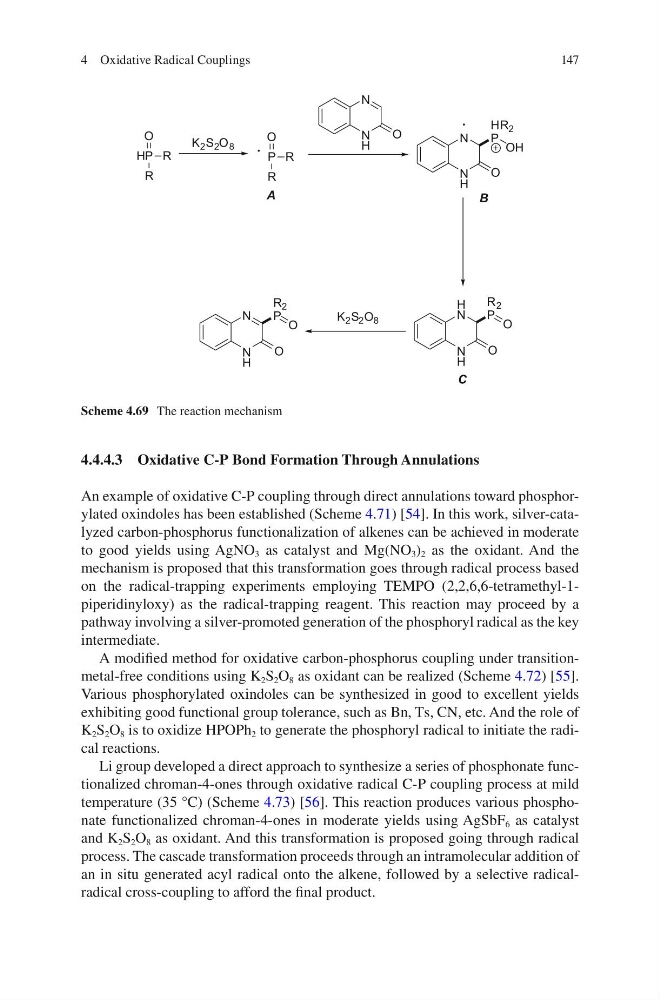
Scheme 4.69 The reaction mechanism
4 Oxidative Radical Couplings
4.4.4.3 Oxidative C-P Bond Formation Through Annulations
An example of oxidative C-P coupling through direct annulations toward phosphorylated oxindoles has been established (Scheme 4.71) [54]. In this work, silver-catalyzed carbon-phosphorus functionalization of alkenes can be achieved in moderate
to good yields using AgNO 3 as catalyst and Mg(NO 3 ) 2 as the oxidant. And the
mechanism is proposed that this transformation goes through radical process based
on the radical-trapping experiments employing TEMPO (2,2,6,6-tetramethyl-1piperidinyloxy) as the radical-trapping reagent. This reaction may proceed by a
pathway involving a silver-promoted generation of the phosphoryl radical as the key
intermediate.
A modified method for oxidative carbon-phosphorus coupling under transitionmetal- free conditions using K 2 S 2 O 8 as oxidant can be realized (Scheme 4.72) [55].
Various phosphorylated oxindoles can be synthesized in good to excellent yields
exhibiting good functional group tolerance, such as Bn, Ts, CN, etc. And the role of
K 2 S 2 O 8 is to oxidize HPOPh 2 to generate the phosphoryl radical to initiate the radical reactions.
Li group developed a direct approach to synthesize a series of phosphonate functionalized chroman-4-ones through oxidative radical C-P coupling process at mild
temperature (35 °C) (Scheme 4.73) [56]. This reaction produces various phosphonate functionalized chroman-4-ones in moderate yields using AgSbF 6 as catalyst
and K 2 S 2 O 8 as oxidant. And this transformation is proposed going through radical
process. The cascade transformation proceeds through an intramolecular addition of
an in situ generated acyl radical onto the alkene, followed by a selective radicalradical cross-coupling to afford the final product.
O
HP R
R
K 2 S 2 O 8
O
P R
R
N
H
N
O
N
H
N
O
HR 2
P OH
N
H
H
N
O
R 2
P O
K 2 S 2 O 8
N
H
N
O
R 2
P O
A
B
C
Scheme 4.69 The reaction mechanism
4 Oxidative Radical Couplings