

146
R
1
O
HP
3.0 equiv K 2 S 2 O 8
CH 3 CN, 100 °C
R
R
+
N
N
R
2
O
H
R 1
N
N
R
2
O
POR 2
N
H
N
O
POMe 2
92%
N
H
N
O
POEt 2
85%
N
H
N
O
POBn 2
80%
N
N
O
POMe 2
91%
N
N
O
POMe 2
78%
N
N
O
POMe 2
92%
CO 2 Et
Bn
N
N
O
POPh 2
55%
N
N
O
POPh 2
57%
N
H
N
O
POPh 2
61%
CO 2 Et
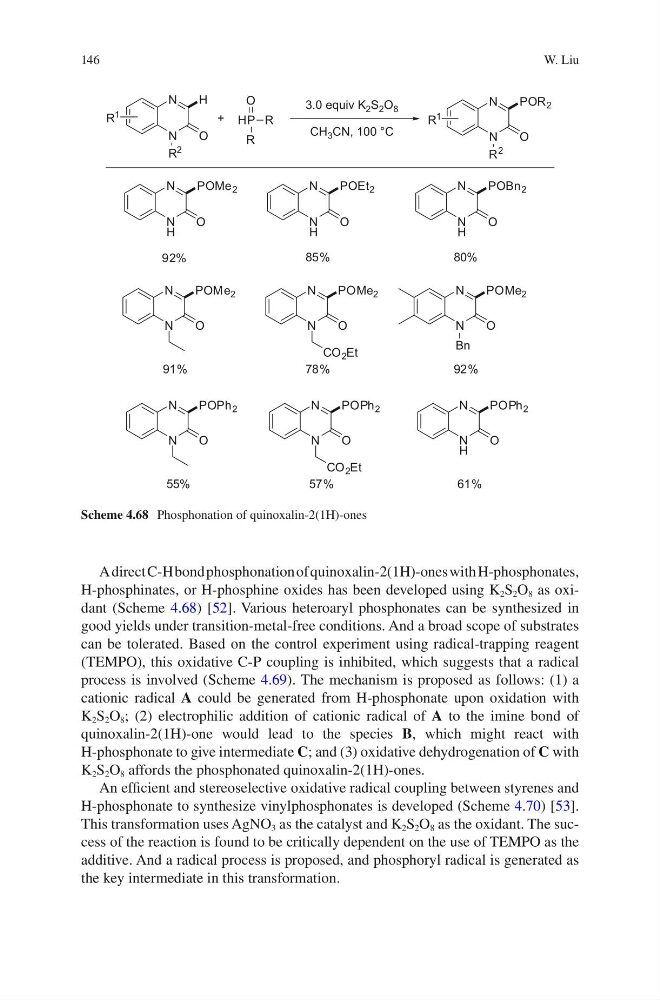
Scheme 4.68 Phosphonation of quinoxalin-2(1H)-ones
A direct C-H bond phosphonation of quinoxalin-2(1H)-ones with H-phosphonates,
H-phosphinates, or H-phosphine oxides has been developed using K 2 S 2 O 8 as oxidant (Scheme 4.68) [52]. Various heteroaryl phosphonates can be synthesized in
good yields under transition-metal-free conditions. And a broad scope of substrates
can be tolerated. Based on the control experiment using radical-trapping reagent
(TEMPO), this oxidative C-P coupling is inhibited, which suggests that a radical
process is involved (Scheme 4.69). The mechanism is proposed as follows: (1) a
cationic radical A could be generated from H-phosphonate upon oxidation with
K 2 S 2 O 8 ; (2) electrophilic addition of cationic radical of A to the imine bond of
quinoxalin- 2(1H)-one would lead to the species B, which might react with
H-phosphonate to give intermediate C; and (3) oxidative dehydrogenation of C with
K 2 S 2 O 8 affords the phosphonated quinoxalin-2(1H)-ones.
An efficient and stereoselective oxidative radical coupling between styrenes and
H-phosphonate to synthesize vinylphosphonates is developed (Scheme 4.70) [53].
This transformation uses AgNO 3 as the catalyst and K 2 S 2 O 8 as the oxidant. The success of the reaction is found to be critically dependent on the use of TEMPO as the
additive. And a radical process is proposed, and phosphoryl radical is generated as
the key intermediate in this transformation.
W. Liu
R
1
O
HP
3.0 equiv K 2 S 2 O 8
CH 3 CN, 100 °C
R
R
+
N
N
R
2
O
H
R 1
N
N
R
2
O
POR 2
N
H
N
O
POMe 2
92%
N
H
N
O
POEt 2
85%
N
H
N
O
POBn 2
80%
N
N
O
POMe 2
91%
N
N
O
POMe 2
78%
N
N
O
POMe 2
92%
CO 2 Et
Bn
N
N
O
POPh 2
55%
N
N
O
POPh 2
57%
N
H
N
O
POPh 2
61%
CO 2 Et
Scheme 4.68 Phosphonation of quinoxalin-2(1H)-ones
A direct C-H bond phosphonation of quinoxalin-2(1H)-ones with H-phosphonates,
H-phosphinates, or H-phosphine oxides has been developed using K 2 S 2 O 8 as oxidant (Scheme 4.68) [52]. Various heteroaryl phosphonates can be synthesized in
good yields under transition-metal-free conditions. And a broad scope of substrates
can be tolerated. Based on the control experiment using radical-trapping reagent
(TEMPO), this oxidative C-P coupling is inhibited, which suggests that a radical
process is involved (Scheme 4.69). The mechanism is proposed as follows: (1) a
cationic radical A could be generated from H-phosphonate upon oxidation with
K 2 S 2 O 8 ; (2) electrophilic addition of cationic radical of A to the imine bond of
quinoxalin- 2(1H)-one would lead to the species B, which might react with
H-phosphonate to give intermediate C; and (3) oxidative dehydrogenation of C with
K 2 S 2 O 8 affords the phosphonated quinoxalin-2(1H)-ones.
An efficient and stereoselective oxidative radical coupling between styrenes and
H-phosphonate to synthesize vinylphosphonates is developed (Scheme 4.70) [53].
This transformation uses AgNO 3 as the catalyst and K 2 S 2 O 8 as the oxidant. The success of the reaction is found to be critically dependent on the use of TEMPO as the
additive. And a radical process is proposed, and phosphoryl radical is generated as
the key intermediate in this transformation.
W. Liu