

143
4.4.4 Oxidative C-P Coupling
4.4.4.1 Oxidative C(sp3)-P Bond Formation
Phosphorylated aromatic compounds can be found in a wide range of nucleotides,
pharmaceuticals, and phosphine-containing ligands. Therefore, the development of
efficient methods for construction of C-P bond is highly desirable.
Considering the C-H bond adjacent to a nitrogen atom is more active, a selective
phosphonation of amino carbonyl compounds to afford imidoyl phosphonates is
developed by copper catalysis through C-H/P-H oxidative cross coupling
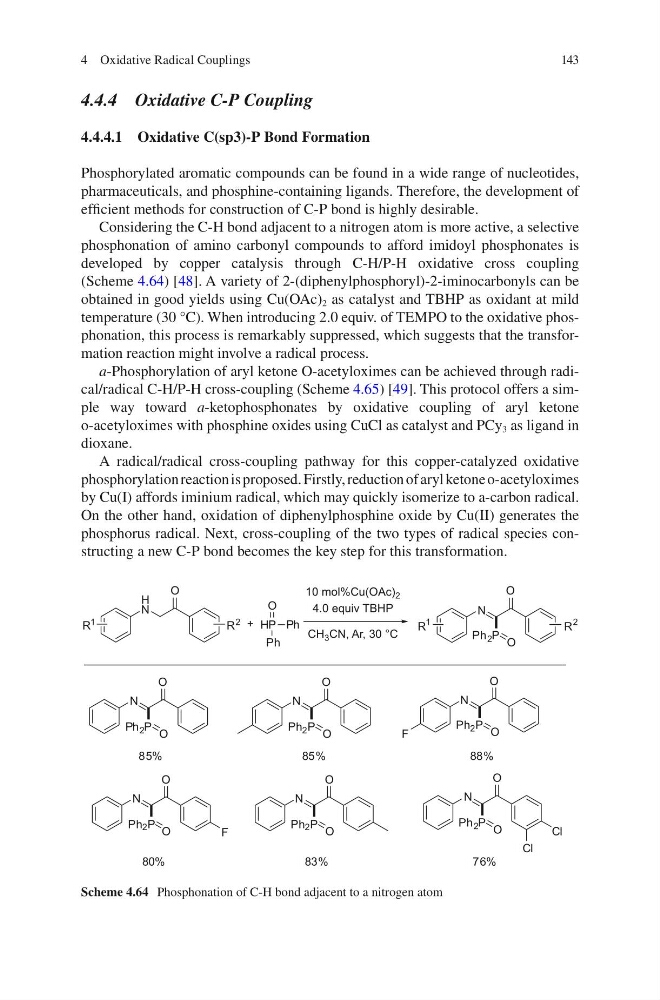
(Scheme 4.64) [48]. A variety of 2-(diphenylphosphoryl)-2-iminocarbonyls can be
obtained in good yields using Cu(OAc) 2 as catalyst and TBHP as oxidant at mild
temperature (30 °C). When introducing 2.0 equiv. of TEMPO to the oxidative phosphonation, this process is remarkably suppressed, which suggests that the transformation reaction might involve a radical process.
a-Phosphorylation of aryl ketone O-acetyloximes can be achieved through radical/radical C-H/P-H cross-coupling (Scheme 4.65) [49]. This protocol offers a simple way toward a-ketophosphonates by oxidative coupling of aryl ketone
o- acetyloximes with phosphine oxides using CuCl as catalyst and PCy 3 as ligand in
dioxane.
A radical/radical cross-coupling pathway for this copper-catalyzed oxidative
phosphorylation reaction is proposed. Firstly, reduction of aryl ketone o- acetyloximes
by Cu(I) affords iminium radical, which may quickly isomerize to a-carbon radical.
On the other hand, oxidation of diphenylphosphine oxide by Cu(II) generates the
phosphorus radical. Next, cross-coupling of the two types of radical species constructing a new C-P bond becomes the key step for this transformation.
H
N
O
R
1
R
2
O
HP
10 mol%Cu(OAc) 2
4.0 equiv TBHP
Ph
Ph
+
CH 3 CN, Ar, 30 °C
N
O
R
1
R
2
Ph 2 P O
N
O
Ph 2 P O
85%
N
O
Ph 2 P O
85%
N
O
Ph 2 P O
88%
F
N
O
Ph 2 P O
80%
N
O
Ph 2 P O
83%
N
O
Ph 2 P O
76%
F
Cl
Cl
Scheme 4.64 Phosphonation of C-H bond adjacent to a nitrogen atom
4 Oxidative Radical Couplings
4.4.4 Oxidative C-P Coupling
4.4.4.1 Oxidative C(sp3)-P Bond Formation
Phosphorylated aromatic compounds can be found in a wide range of nucleotides,
pharmaceuticals, and phosphine-containing ligands. Therefore, the development of
efficient methods for construction of C-P bond is highly desirable.
Considering the C-H bond adjacent to a nitrogen atom is more active, a selective
phosphonation of amino carbonyl compounds to afford imidoyl phosphonates is
developed by copper catalysis through C-H/P-H oxidative cross coupling
(Scheme 4.64) [48]. A variety of 2-(diphenylphosphoryl)-2-iminocarbonyls can be
obtained in good yields using Cu(OAc) 2 as catalyst and TBHP as oxidant at mild
temperature (30 °C). When introducing 2.0 equiv. of TEMPO to the oxidative phosphonation, this process is remarkably suppressed, which suggests that the transformation reaction might involve a radical process.
a-Phosphorylation of aryl ketone O-acetyloximes can be achieved through radical/radical C-H/P-H cross-coupling (Scheme 4.65) [49]. This protocol offers a simple way toward a-ketophosphonates by oxidative coupling of aryl ketone
o- acetyloximes with phosphine oxides using CuCl as catalyst and PCy 3 as ligand in
dioxane.
A radical/radical cross-coupling pathway for this copper-catalyzed oxidative
phosphorylation reaction is proposed. Firstly, reduction of aryl ketone o- acetyloximes
by Cu(I) affords iminium radical, which may quickly isomerize to a-carbon radical.
On the other hand, oxidation of diphenylphosphine oxide by Cu(II) generates the
phosphorus radical. Next, cross-coupling of the two types of radical species constructing a new C-P bond becomes the key step for this transformation.
H
N
O
R
1
R
2
O
HP
10 mol%Cu(OAc) 2
4.0 equiv TBHP
Ph
Ph
+
CH 3 CN, Ar, 30 °C
N
O
R
1
R
2
Ph 2 P O
N
O
Ph 2 P O
85%
N
O
Ph 2 P O
85%
N
O
Ph 2 P O
88%
F
N
O
Ph 2 P O
80%
N
O
Ph 2 P O
83%
N
O
Ph 2 P O
76%
F
Cl
Cl
Scheme 4.64 Phosphonation of C-H bond adjacent to a nitrogen atom
4 Oxidative Radical Couplings