

142
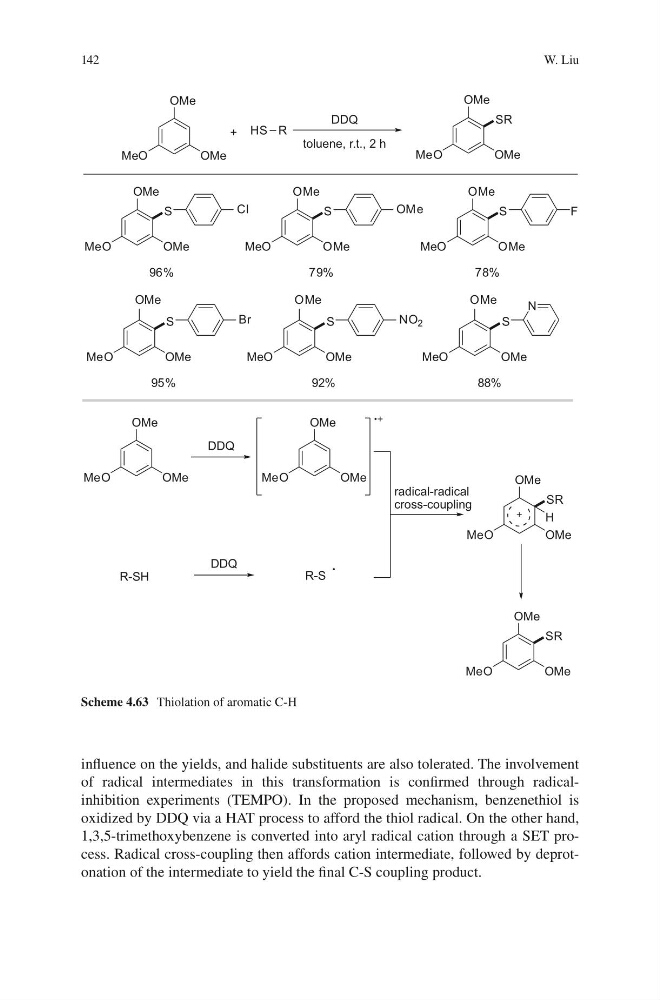
influence on the yields, and halide substituents are also tolerated. The involvement
of radical intermediates in this transformation is confirmed through radicalinhibition experiments (TEMPO). In the proposed mechanism, benzenethiol is
oxidized by DDQ via a HAT process to afford the thiol radical. On the other hand,
1,3,5-trimethoxybenzene is converted into aryl radical cation through a SET process. Radical cross-coupling then affords cation intermediate, followed by deprotonation of the intermediate to yield the final C-S coupling product.
OMe
OMe
MeO
+ HS R
DDQ
toluene, r.t., 2 h
OMe
OMe
MeO
SR
OMe
OMe
MeO
DDQ
OMe
OMe
MeO
R-SH
R-S
radical-radical
cross-coupling
OMe
OMe
MeO
SR
H
OMe
OMe
MeO
SR
DDQ
OMe
OMe
MeO
S
Cl
96%
OMe
OMe
MeO
S
OMe
79%
OMe
OMe
MeO
S
F
78%
OMe
OMe
MeO
S
Br
95%
OMe
OMe
MeO
S
92%
OMe
OMe
MeO
S
N
88%
NO 2
Scheme 4.63 Thiolation of aromatic C-H
W. Liu
influence on the yields, and halide substituents are also tolerated. The involvement
of radical intermediates in this transformation is confirmed through radicalinhibition experiments (TEMPO). In the proposed mechanism, benzenethiol is
oxidized by DDQ via a HAT process to afford the thiol radical. On the other hand,
1,3,5-trimethoxybenzene is converted into aryl radical cation through a SET process. Radical cross-coupling then affords cation intermediate, followed by deprotonation of the intermediate to yield the final C-S coupling product.
OMe
OMe
MeO
+ HS R
DDQ
toluene, r.t., 2 h
OMe
OMe
MeO
SR
OMe
OMe
MeO
DDQ
OMe
OMe
MeO
R-SH
R-S
radical-radical
cross-coupling
OMe
OMe
MeO
SR
H
OMe
OMe
MeO
SR
DDQ
OMe
OMe
MeO
S
Cl
96%
OMe
OMe
MeO
S
OMe
79%
OMe
OMe
MeO
S
F
78%
OMe
OMe
MeO
S
Br
95%
OMe
OMe
MeO
S
92%
OMe
OMe
MeO
S
N
88%
NO 2
Scheme 4.63 Thiolation of aromatic C-H
W. Liu