

133
4.4.1 Oxidative C-N Coupling
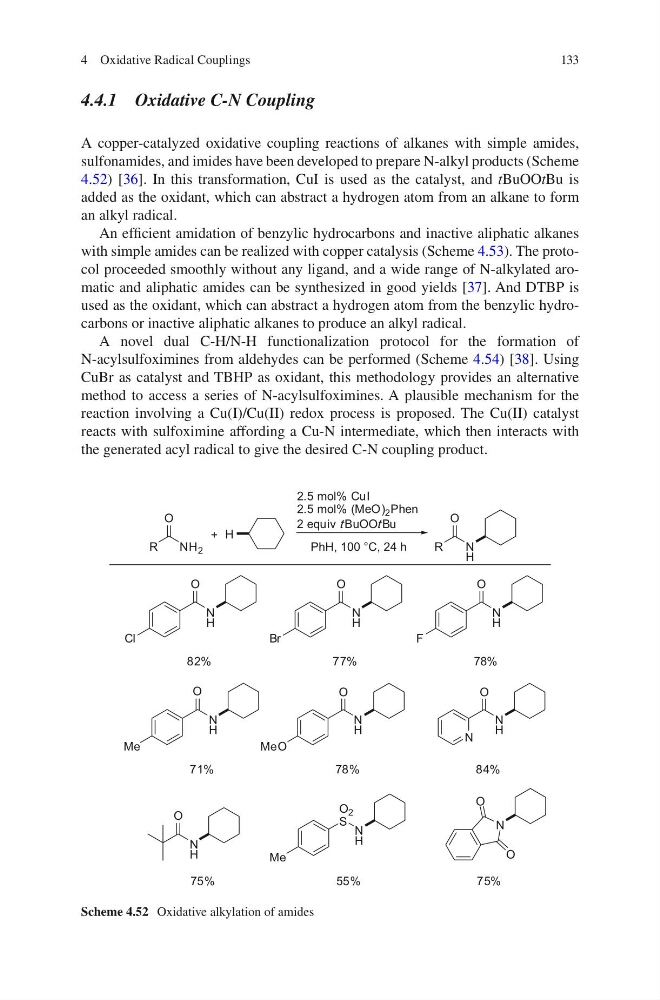
A copper-catalyzed oxidative coupling reactions of alkanes with simple amides,
sulfonamides, and imides have been developed to prepare N-alkyl products (Scheme
4.52) [36]. In this transformation, CuI is used as the catalyst, and tBuOOtBu is
added as the oxidant, which can abstract a hydrogen atom from an alkane to form
an alkyl radical.
An efficient amidation of benzylic hydrocarbons and inactive aliphatic alkanes
with simple amides can be realized with copper catalysis (Scheme 4.53). The protocol proceeded smoothly without any ligand, and a wide range of N-alkylated aromatic and aliphatic amides can be synthesized in good yields [37]. And DTBP is
used as the oxidant, which can abstract a hydrogen atom from the benzylic hydrocarbons or inactive aliphatic alkanes to produce an alkyl radical.
A novel dual C-H/N-H functionalization protocol for the formation of
N-acylsulfoximines from aldehydes can be performed (Scheme 4.54) [38]. Using
CuBr as catalyst and TBHP as oxidant, this methodology provides an alternative
method to access a series of N-acylsulfoximines. A plausible mechanism for the
reaction involving a Cu(I)/Cu(II) redox process is proposed. The Cu(II) catalyst
reacts with sulfoximine affording a Cu-N intermediate, which then interacts with
the generated acyl radical to give the desired C-N coupling product.
2.5 mol% CuI
2.5 mol% (MeO) 2 Phen
2 equiv t BuOOt Bu
PhH, 100 °C, 24 h
R
NH 2
O
+ H
R
N
H
O
N
H
O
Cl
82%
N
H
O
Br
77%
N
H
O
F
78%
N
H
O
Me
71%
N
H
O
MeO
78%
N
H
O
N
84%
N
H
O
75%
N
H
O 2
S
Me
55%
N
75%
O
O
Scheme 4.52 Oxidative alkylation of amides
4 Oxidative Radical Couplings
4.4.1 Oxidative C-N Coupling
A copper-catalyzed oxidative coupling reactions of alkanes with simple amides,
sulfonamides, and imides have been developed to prepare N-alkyl products (Scheme
4.52) [36]. In this transformation, CuI is used as the catalyst, and tBuOOtBu is
added as the oxidant, which can abstract a hydrogen atom from an alkane to form
an alkyl radical.
An efficient amidation of benzylic hydrocarbons and inactive aliphatic alkanes
with simple amides can be realized with copper catalysis (Scheme 4.53). The protocol proceeded smoothly without any ligand, and a wide range of N-alkylated aromatic and aliphatic amides can be synthesized in good yields [37]. And DTBP is
used as the oxidant, which can abstract a hydrogen atom from the benzylic hydrocarbons or inactive aliphatic alkanes to produce an alkyl radical.
A novel dual C-H/N-H functionalization protocol for the formation of
N-acylsulfoximines from aldehydes can be performed (Scheme 4.54) [38]. Using
CuBr as catalyst and TBHP as oxidant, this methodology provides an alternative
method to access a series of N-acylsulfoximines. A plausible mechanism for the
reaction involving a Cu(I)/Cu(II) redox process is proposed. The Cu(II) catalyst
reacts with sulfoximine affording a Cu-N intermediate, which then interacts with
the generated acyl radical to give the desired C-N coupling product.
2.5 mol% CuI
2.5 mol% (MeO) 2 Phen
2 equiv t BuOOt Bu
PhH, 100 °C, 24 h
R
NH 2
O
+ H
R
N
H
O
N
H
O
Cl
82%
N
H
O
Br
77%
N
H
O
F
78%
N
H
O
Me
71%
N
H
O
MeO
78%
N
H
O
N
84%
N
H
O
75%
N
H
O 2
S
Me
55%
N
75%
O
O
Scheme 4.52 Oxidative alkylation of amides
4 Oxidative Radical Couplings