

128
N
H O
MeCN/H 2 O
50 °C
N
O
OH
O
R 2
O
R 1
R
1
R
2
O
O
H
2 equiv K 2 S 2 O 8
N
O
O
O
N
O
O
O
N
O
OH
Ph
O
Ph
OH
90%
90%
5 5%
+
2 equiv
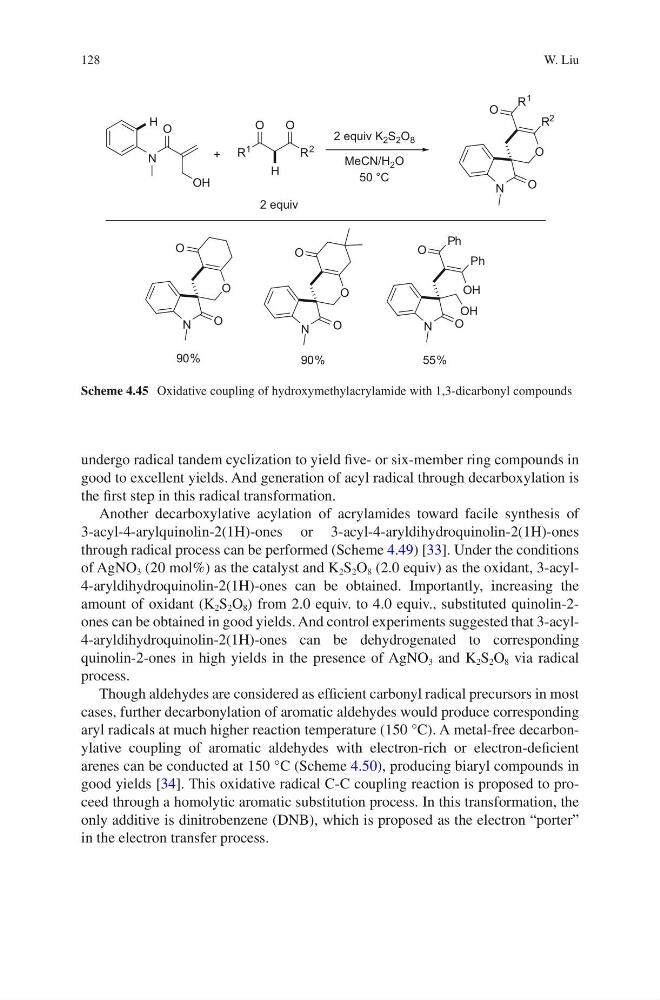
Scheme 4.45 Oxidative coupling of hydroxymethylacrylamide with 1,3-dicarbonyl compounds
undergo radical tandem cyclization to yield five- or six-member ring compounds in
good to excellent yields. And generation of acyl radical through decarboxylation is
the first step in this radical transformation.
Another decarboxylative acylation of acrylamides toward facile synthesis of
3-acyl-4-arylquinolin-2(1H)-ones or 3-acyl-4-aryldihydroquinolin-2(1H)-ones
through radical process can be performed (Scheme 4.49) [33]. Under the conditions
of AgNO 3 (20 mol%) as the catalyst and K 2 S 2 O 8 (2.0 equiv) as the oxidant, 3-acyl4-aryldihydroquinolin-2(1H)-ones can be obtained. Importantly, increasing the
amount of oxidant (K 2 S 2 O 8 ) from 2.0 equiv. to 4.0 equiv., substituted quinolin- 2ones can be obtained in good yields. And control experiments suggested that 3-acyl4-aryldihydroquinolin-2(1H)-ones can be dehydrogenated to corresponding
quinolin-2-ones in high yields in the presence of AgNO 3 and K 2 S 2 O 8 via radical
process.
Though aldehydes are considered as efficient carbonyl radical precursors in most
cases, further decarbonylation of aromatic aldehydes would produce corresponding
aryl radicals at much higher reaction temperature (150 °C). A metal-free decarbonylative coupling of aromatic aldehydes with electron-rich or electron-deficient
arenes can be conducted at 150 °C (Scheme 4.50), producing biaryl compounds in
good yields [34]. This oxidative radical C-C coupling reaction is proposed to proceed through a homolytic aromatic substitution process. In this transformation, the
only additive is dinitrobenzene (DNB), which is proposed as the electron “porter”
in the electron transfer process.
W. Liu
N
H O
MeCN/H 2 O
50 °C
N
O
OH
O
R 2
O
R 1
R
1
R
2
O
O
H
2 equiv K 2 S 2 O 8
N
O
O
O
N
O
O
O
N
O
OH
Ph
O
Ph
OH
90%
90%
5 5%
+
2 equiv
Scheme 4.45 Oxidative coupling of hydroxymethylacrylamide with 1,3-dicarbonyl compounds
undergo radical tandem cyclization to yield five- or six-member ring compounds in
good to excellent yields. And generation of acyl radical through decarboxylation is
the first step in this radical transformation.
Another decarboxylative acylation of acrylamides toward facile synthesis of
3-acyl-4-arylquinolin-2(1H)-ones or 3-acyl-4-aryldihydroquinolin-2(1H)-ones
through radical process can be performed (Scheme 4.49) [33]. Under the conditions
of AgNO 3 (20 mol%) as the catalyst and K 2 S 2 O 8 (2.0 equiv) as the oxidant, 3-acyl4-aryldihydroquinolin-2(1H)-ones can be obtained. Importantly, increasing the
amount of oxidant (K 2 S 2 O 8 ) from 2.0 equiv. to 4.0 equiv., substituted quinolin- 2ones can be obtained in good yields. And control experiments suggested that 3-acyl4-aryldihydroquinolin-2(1H)-ones can be dehydrogenated to corresponding
quinolin-2-ones in high yields in the presence of AgNO 3 and K 2 S 2 O 8 via radical
process.
Though aldehydes are considered as efficient carbonyl radical precursors in most
cases, further decarbonylation of aromatic aldehydes would produce corresponding
aryl radicals at much higher reaction temperature (150 °C). A metal-free decarbonylative coupling of aromatic aldehydes with electron-rich or electron-deficient
arenes can be conducted at 150 °C (Scheme 4.50), producing biaryl compounds in
good yields [34]. This oxidative radical C-C coupling reaction is proposed to proceed through a homolytic aromatic substitution process. In this transformation, the
only additive is dinitrobenzene (DNB), which is proposed as the electron “porter”
in the electron transfer process.
W. Liu