

122
catalyzed by Cu 2 O, providing alkyl-substituted phenanthridines in moderate yields
(Scheme 4.38). The proposed radical mechanism for this free-radical addition/cyclization cascade reaction is that the initial formed simple alcohol radical adds to
2-aryl phenyl isonitrile and undergoes intramolecular cyclization.
Moreover, oxidative radical C-C coupling can proceed between 2-aryl phenyl
isonitrile and dioxane under transition-metal-free conditions, providing alkylsubstituted phenanthridines in moderate to good yields (Scheme 4.39). Notably, this
radical C-C coupling only required 1.0 equiv. of tert-butyl benzoperoxoate (TBPB)
as the oxidant. And this radical transformation involved 2-isocyanobiaryls insertion
with 1,4-dioxane as the key step.
Oxidative radical C-C coupling reactions can be extended to tandem reactions to
construct oxindole structures (Scheme 4.40). The mechanism for this free-radical
addition/cyclization cascade reaction can be proposed as follows:
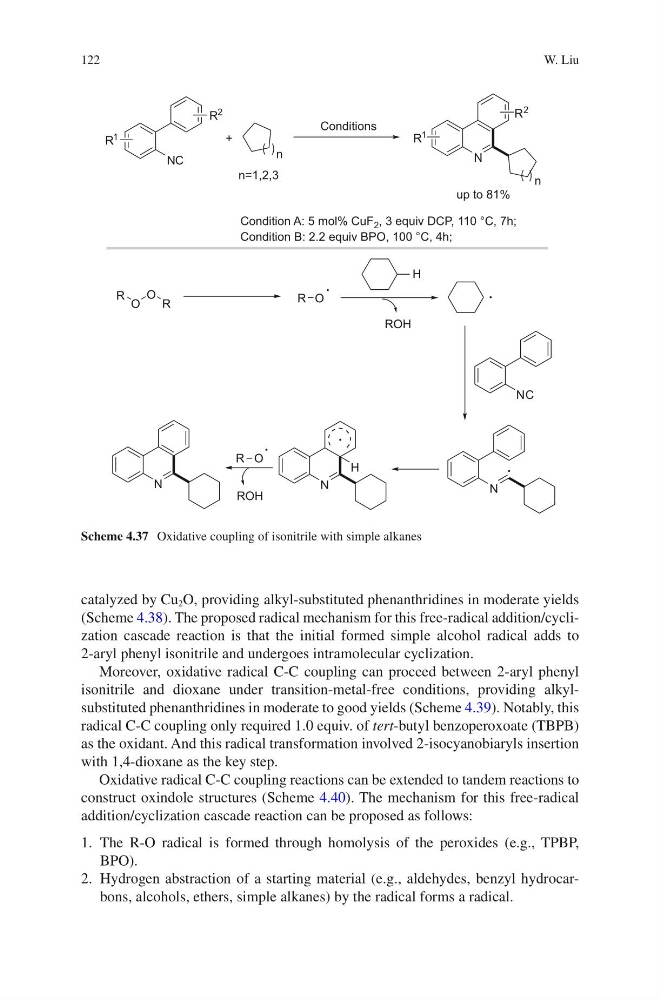
1. The R-O radical is formed through homolysis of the peroxides (e.g., TPBP,
BPO).
2. Hydrogen abstraction of a starting material (e.g., aldehydes, benzyl hydrocarbons, alcohols, ethers, simple alkanes) by the radical forms a radical.
R
1
R
2
NC
+
n
Conditions
R 1
R 2
N
n
n=1,2,3
Condition A: 5 mol% CuF 2 , 3 equiv DCP, 110 °C, 7h;
Condition B: 2.2 equiv BPO, 100 °C, 4h;
up to 81%
O
R
O
R
R O
ROH
H
NC
N
N
H
N
ROH
R O
Scheme 4.37 Oxidative coupling of isonitrile with simple alkanes
W. Liu
catalyzed by Cu 2 O, providing alkyl-substituted phenanthridines in moderate yields
(Scheme 4.38). The proposed radical mechanism for this free-radical addition/cyclization cascade reaction is that the initial formed simple alcohol radical adds to
2-aryl phenyl isonitrile and undergoes intramolecular cyclization.
Moreover, oxidative radical C-C coupling can proceed between 2-aryl phenyl
isonitrile and dioxane under transition-metal-free conditions, providing alkylsubstituted phenanthridines in moderate to good yields (Scheme 4.39). Notably, this
radical C-C coupling only required 1.0 equiv. of tert-butyl benzoperoxoate (TBPB)
as the oxidant. And this radical transformation involved 2-isocyanobiaryls insertion
with 1,4-dioxane as the key step.
Oxidative radical C-C coupling reactions can be extended to tandem reactions to
construct oxindole structures (Scheme 4.40). The mechanism for this free-radical
addition/cyclization cascade reaction can be proposed as follows:
1. The R-O radical is formed through homolysis of the peroxides (e.g., TPBP,
BPO).
2. Hydrogen abstraction of a starting material (e.g., aldehydes, benzyl hydrocarbons, alcohols, ethers, simple alkanes) by the radical forms a radical.
R
1
R
2
NC
+
n
Conditions
R 1
R 2
N
n
n=1,2,3
Condition A: 5 mol% CuF 2 , 3 equiv DCP, 110 °C, 7h;
Condition B: 2.2 equiv BPO, 100 °C, 4h;
up to 81%
O
R
O
R
R O
ROH
H
NC
N
N
H
N
ROH
R O
Scheme 4.37 Oxidative coupling of isonitrile with simple alkanes
W. Liu