

121
as the catalyst and dicumyl peroxide (DCP) as the oxidant/radical initiator, oxidative radical C-C coupling can undergo between 2-aryl phenyl isonitrile and simple
alkanes (e.g., cyclopentane, cyclohexane, cycloheptane, and cyclooctane) at 110 °C,
providing alkyl-substituted phenanthridines in moderate to good yields. Without
copper catalyst, transition-metal-free conditions can be also achieved for this strategy when benzoyl peroxide (BPO) was used as the oxidant/radical initiator at
100 °C.
The proposed mechanism for this free-radical addition/cyclization cascade
reaction is also presented. Initially, the R-O radical is formed through homolysis of
the peroxides (e.g., DCP or BPO). Hydrogen abstraction of a cyclohexane by the
radical forms a cyclohexyl radical. Next, the addition of the cyclohexyl radical to
isonitrile produces another radical intermediate. Subsequently, the intramolecular
radical cyclization of intermediate takes place to afford radical intermediate. Finally,
the R-O abstracts one H from intermediate to produce the phenanthridine product.
Moreover, oxidative radical C-C coupling can proceed between 2-aryl phenyl
isonitrile and simple alcohols (e.g., ethanol, isopropanol, and cyclohexanol)
A
Ar
OMe
OMe
MeO
DDQ
OMe
OMe
MeO
R
B
OMe
OMe
MeO
R
Ar
HDDQ
C
OMe
OMe
MeO
R
Ar
- H
+
OMe
OMe
MeO
R
Ar
Path A
Path B
OMe
OMe
MeO
Friedel-Crafts alkylation
OMe
OMe
MeO
Ar
MeO
OMe
MeO
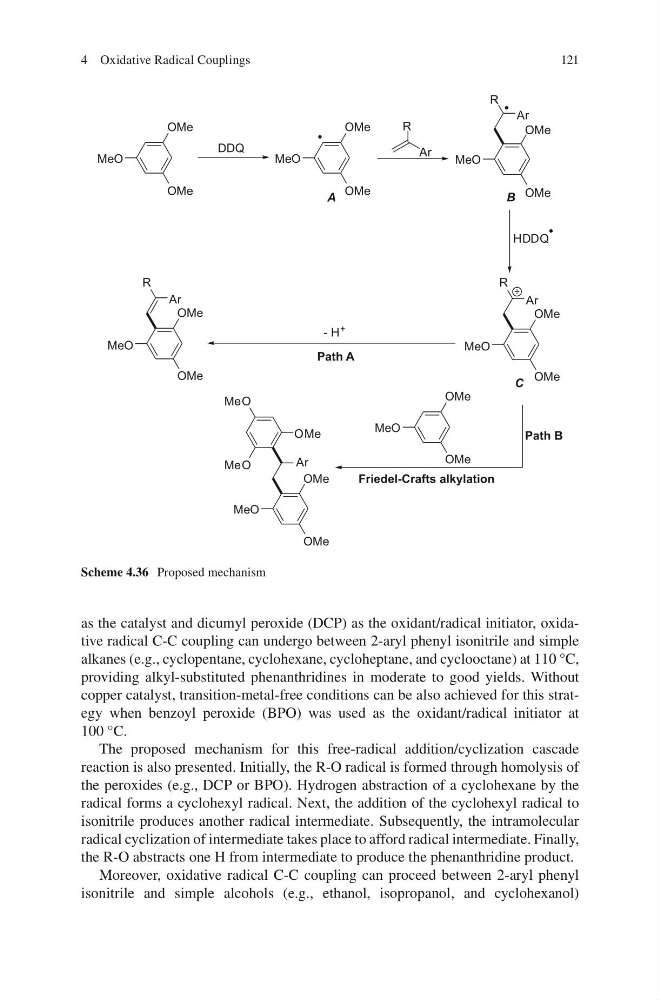
Scheme 4.36 Proposed mechanism
4 Oxidative Radical Couplings
as the catalyst and dicumyl peroxide (DCP) as the oxidant/radical initiator, oxidative radical C-C coupling can undergo between 2-aryl phenyl isonitrile and simple
alkanes (e.g., cyclopentane, cyclohexane, cycloheptane, and cyclooctane) at 110 °C,
providing alkyl-substituted phenanthridines in moderate to good yields. Without
copper catalyst, transition-metal-free conditions can be also achieved for this strategy when benzoyl peroxide (BPO) was used as the oxidant/radical initiator at
100 °C.
The proposed mechanism for this free-radical addition/cyclization cascade
reaction is also presented. Initially, the R-O radical is formed through homolysis of
the peroxides (e.g., DCP or BPO). Hydrogen abstraction of a cyclohexane by the
radical forms a cyclohexyl radical. Next, the addition of the cyclohexyl radical to
isonitrile produces another radical intermediate. Subsequently, the intramolecular
radical cyclization of intermediate takes place to afford radical intermediate. Finally,
the R-O abstracts one H from intermediate to produce the phenanthridine product.
Moreover, oxidative radical C-C coupling can proceed between 2-aryl phenyl
isonitrile and simple alcohols (e.g., ethanol, isopropanol, and cyclohexanol)
A
Ar
OMe
OMe
MeO
DDQ
OMe
OMe
MeO
R
B
OMe
OMe
MeO
R
Ar
HDDQ
C
OMe
OMe
MeO
R
Ar
- H
+
OMe
OMe
MeO
R
Ar
Path A
Path B
OMe
OMe
MeO
Friedel-Crafts alkylation
OMe
OMe
MeO
Ar
MeO
OMe
MeO
Scheme 4.36 Proposed mechanism
4 Oxidative Radical Couplings