

118
transformation based on the control experiments using AlCl 3 as a catalyst in the
same reaction.
And a radical mechanism can be proposed in Scheme 4.36. An electron-rich
arene is oxidized firstly to produce the aryl radical A in the presence of DDQ oxidant. Then, radical addition of the aryl radical A to an alkene produces the radical
intermediate B. This radical species is subsequently oxidized by losing one electron
and affords the cationic intermediate C. Then, there are two optional pathways for
the cationic species. When the R group involved in C is an aryl, a deprotonation
process yields the desired triaryl-ethylene product. If the R group is an H atom, a
Friedel-Crafts alkylation process occurs between C and electron-rich arene, and the
double arylation products are obtained. The steric hindrance of the R group might
be the key reason for the two selective products.
up to 97% yields
10 mol% CuI
20 mol% KI
2.0 equiv DTBP
120 °C, 24 h
O
X
H +
O
X
X = CH 2 , O
O
87%
79%
O
81%
O
O
61% (E/Z)
O
O
OMe
94% (E/Z)
OMe
O
83% (E/Z)
Br
O
Cl
O
78% (E/Z)
CF 3
83% (E/Z)
F
O
F
O
O
89%
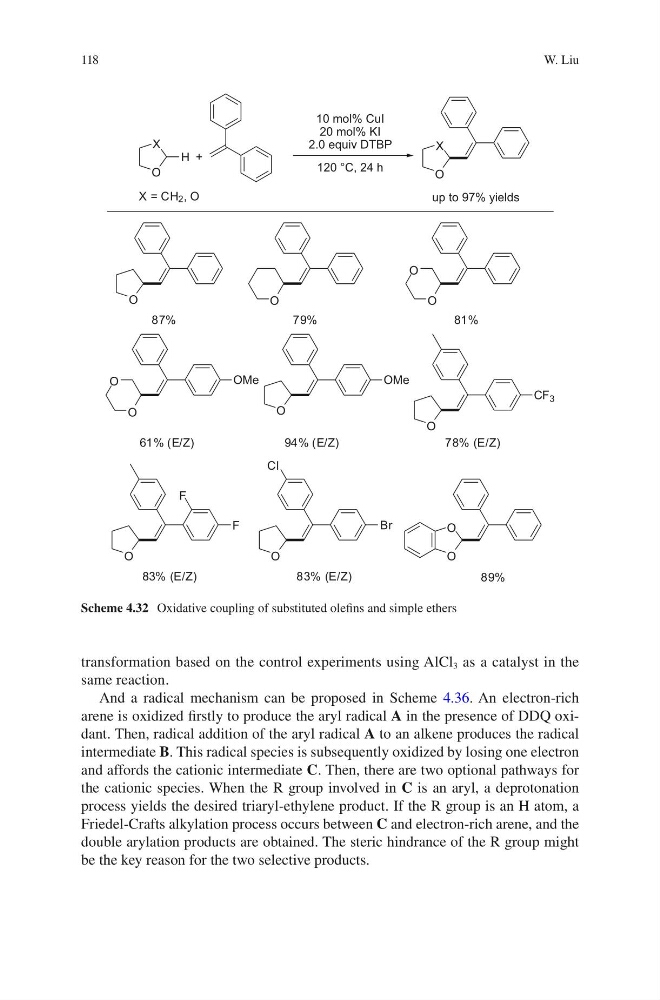
Scheme 4.32 Oxidative coupling of substituted olefins and simple ethers
W. Liu
transformation based on the control experiments using AlCl 3 as a catalyst in the
same reaction.
And a radical mechanism can be proposed in Scheme 4.36. An electron-rich
arene is oxidized firstly to produce the aryl radical A in the presence of DDQ oxidant. Then, radical addition of the aryl radical A to an alkene produces the radical
intermediate B. This radical species is subsequently oxidized by losing one electron
and affords the cationic intermediate C. Then, there are two optional pathways for
the cationic species. When the R group involved in C is an aryl, a deprotonation
process yields the desired triaryl-ethylene product. If the R group is an H atom, a
Friedel-Crafts alkylation process occurs between C and electron-rich arene, and the
double arylation products are obtained. The steric hindrance of the R group might
be the key reason for the two selective products.
up to 97% yields
10 mol% CuI
20 mol% KI
2.0 equiv DTBP
120 °C, 24 h
O
X
H +
O
X
X = CH 2 , O
O
87%
79%
O
81%
O
O
61% (E/Z)
O
O
OMe
94% (E/Z)
OMe
O
83% (E/Z)
Br
O
Cl
O
78% (E/Z)
CF 3
83% (E/Z)
F
O
F
O
O
89%
Scheme 4.32 Oxidative coupling of substituted olefins and simple ethers
W. Liu