

117
An efficient synthesis of unsymmetrical biphenols via the oxidative crosscoupling of two different phenols in the presence of K 2 S 2 O 8 and Bu 4 N
+
·HSO 3
−
in
CF 3 COOH can be achieved (Scheme 4.33) [22]. By using Bu 4 N
+
·HSO 3
−
as an ionic
salt, the homo-coupling of phenols is depressed. In this oxidative coupling, K 2 S 2 O 8
generates the SO 4 anion radical. Then, the SO 4 anion radical abstracts hydrogen
from phenols in the presence of CF 3 COOH, providing a cationic phenol radical
intermediate. Finally, the nucleophilic addition of another phenol molecule into cationic intermediate provides the unsymmetrical biphenols.
Oxidative radical coupling of alkenes with aldehydes can be performed in the
presence of 20 mol% of CuCl 2 , providing α,β-unsaturated ketones as the final products (Scheme 4.34) [23]. In this transformation, excess aldehydes (5 equiv) were
required for complete conversion of alkenes without adding any other solvents.
Many functional groups, such as F, Cl, and OAc, can be well tolerated under such
mild conditions.
An oxidative C-H/C-H cross-coupling reaction between electron-rich arenes
(1,3,5-trimethoxybenzene as the only suitable substrate) and alkenes can be realized using FeCl 3 as the catalyst and DDQ as the oxidant (Scheme 4.35) [24].
Oxidative coupling between 1,3,5-trimethoxybenzene and diarylethylenes produced the desired triarylethylenes in good yields at 80 °C. Double arylation products could be obtained when styrene derivatives were used as the radical acceptors.
In this transformation, FeCl 3 was proposed acting as a Lewis acid to promote this
10 mol% FeCl 2
1.2 equiv DTBP
100 °C, 24 h, N 2
Ph
R
1
H +
R
2
OAc
Ph
R
1
O
R 2
8 equiv
O
Cl
63%
O
MeO
45%
O
77%
O
65%
Me
O
70%
Br
O
59%
CO 2 Et
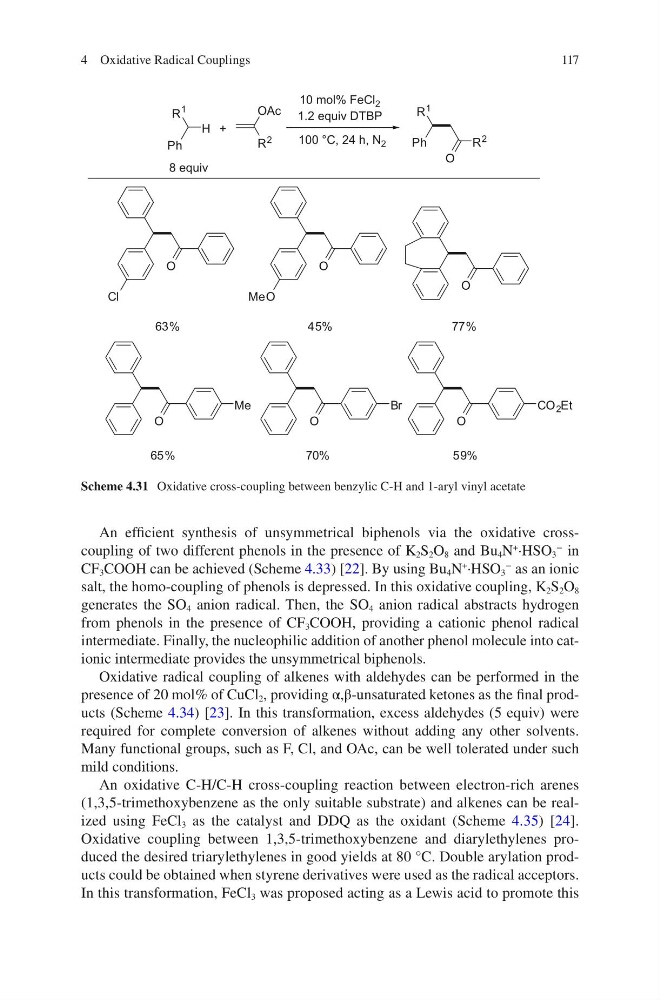
Scheme 4.31 Oxidative cross-coupling between benzylic C-H and 1-aryl vinyl acetate
4 Oxidative Radical Couplings
An efficient synthesis of unsymmetrical biphenols via the oxidative crosscoupling of two different phenols in the presence of K 2 S 2 O 8 and Bu 4 N
+
·HSO 3
−
in
CF 3 COOH can be achieved (Scheme 4.33) [22]. By using Bu 4 N
+
·HSO 3
−
as an ionic
salt, the homo-coupling of phenols is depressed. In this oxidative coupling, K 2 S 2 O 8
generates the SO 4 anion radical. Then, the SO 4 anion radical abstracts hydrogen
from phenols in the presence of CF 3 COOH, providing a cationic phenol radical
intermediate. Finally, the nucleophilic addition of another phenol molecule into cationic intermediate provides the unsymmetrical biphenols.
Oxidative radical coupling of alkenes with aldehydes can be performed in the
presence of 20 mol% of CuCl 2 , providing α,β-unsaturated ketones as the final products (Scheme 4.34) [23]. In this transformation, excess aldehydes (5 equiv) were
required for complete conversion of alkenes without adding any other solvents.
Many functional groups, such as F, Cl, and OAc, can be well tolerated under such
mild conditions.
An oxidative C-H/C-H cross-coupling reaction between electron-rich arenes
(1,3,5-trimethoxybenzene as the only suitable substrate) and alkenes can be realized using FeCl 3 as the catalyst and DDQ as the oxidant (Scheme 4.35) [24].
Oxidative coupling between 1,3,5-trimethoxybenzene and diarylethylenes produced the desired triarylethylenes in good yields at 80 °C. Double arylation products could be obtained when styrene derivatives were used as the radical acceptors.
In this transformation, FeCl 3 was proposed acting as a Lewis acid to promote this
10 mol% FeCl 2
1.2 equiv DTBP
100 °C, 24 h, N 2
Ph
R
1
H +
R
2
OAc
Ph
R
1
O
R 2
8 equiv
O
Cl
63%
O
MeO
45%
O
77%
O
65%
Me
O
70%
Br
O
59%
CO 2 Et
Scheme 4.31 Oxidative cross-coupling between benzylic C-H and 1-aryl vinyl acetate
4 Oxidative Radical Couplings