

115
A copper-catalyzed method for the oxidative radical C-C coupling of vinylarenes
with cyclic ethers can be achieved under aerobic conditions via the activation of the
Csp3-H bond adjacent to an oxygen atom (Scheme 4.30) [19]. This transformation
exhibits excellent regioselectivity and good functional group tolerance to afford the
oxyalkylated products of vinylarenes.
Oxidative cross-coupling between benzylic C-H and 1-aryl vinyl acetate can be
also achieved by cheap Fe-catalyst (Scheme 4.31) [20]. Using 10 mol% FeCl 2 as
catalyst and 1.2 equiv. of DTBP as oxidant, excess amount of benzylic substrates
(e.g., diphenyl methane) can couple with functionalized olefins (e.g., vinyl acetate)
in good yields to afford aryl ketone compounds.
Different substituted olefins and simple ethers could be cross-coupled well to
generate the corresponding alkenylation products via oxidative radical reactions
(Scheme 4.32) [21]. In the presence of 10 mol% CuI, 20 mol% KI, and DTBP,
simple ethers (e.g., THF, 1,4-dioxane) can generate corresponding alkyl radicals
and can be added to substituted olefins to produce alkenylated products. Because
of the two different elimination patterns, two isomers (E/Z) can be obtained in
most cases.
+
upt o 75%
20 mol% Cu(ClO 4 ) 2
5 mol% BP
3 equiv tBuOOBz
r.t.- 60
o
C
Ar
R 1
H
O
O
R 2
R 3
H
O
O
R 2
R 3
Ar
R 1
O
O
Ph
Ph
Me
Cl
56%
O
O
Ph
Ph
66%
O
O
Ph
51%
Ph
Ph
O
5 equiv.
+
65%
20 mol% Cu(ClO 4 ) 2
5 mol% BP
3 equiv tBuOOBz
60 o C
Ar
Me
D
O
O
Ph
Ph
H
O
O
Ph
Ph
Ar
(H)D
5 equiv.
D
+
Ar
Me
H
5 equiv.
H
Me
K H /K D = 1.6
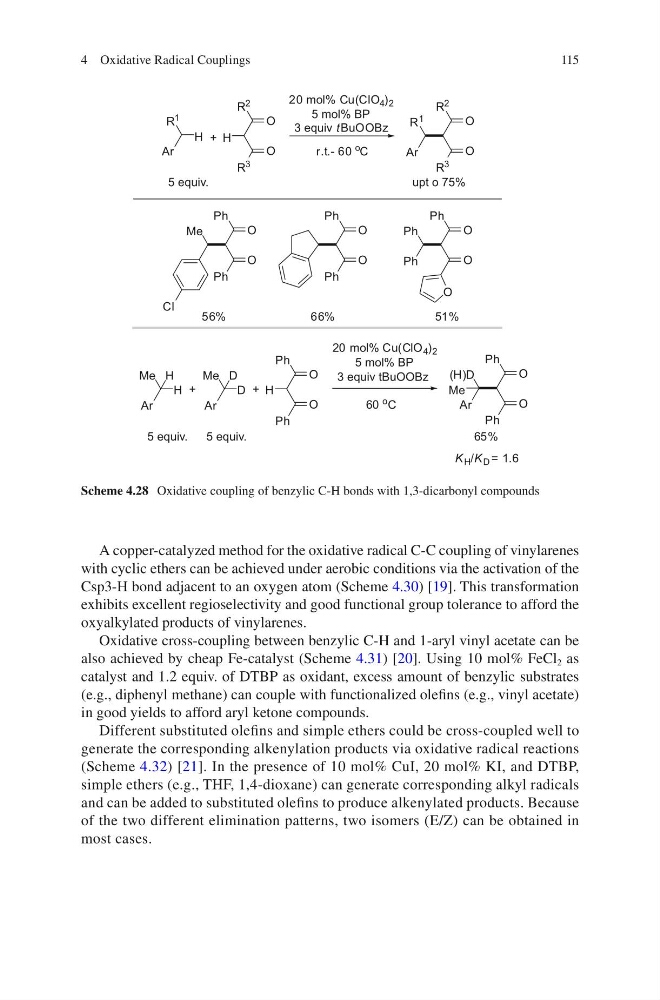
Scheme 4.28 Oxidative coupling of benzylic C-H bonds with 1,3-dicarbonyl compounds
4 Oxidative Radical Couplings
A copper-catalyzed method for the oxidative radical C-C coupling of vinylarenes
with cyclic ethers can be achieved under aerobic conditions via the activation of the
Csp3-H bond adjacent to an oxygen atom (Scheme 4.30) [19]. This transformation
exhibits excellent regioselectivity and good functional group tolerance to afford the
oxyalkylated products of vinylarenes.
Oxidative cross-coupling between benzylic C-H and 1-aryl vinyl acetate can be
also achieved by cheap Fe-catalyst (Scheme 4.31) [20]. Using 10 mol% FeCl 2 as
catalyst and 1.2 equiv. of DTBP as oxidant, excess amount of benzylic substrates
(e.g., diphenyl methane) can couple with functionalized olefins (e.g., vinyl acetate)
in good yields to afford aryl ketone compounds.
Different substituted olefins and simple ethers could be cross-coupled well to
generate the corresponding alkenylation products via oxidative radical reactions
(Scheme 4.32) [21]. In the presence of 10 mol% CuI, 20 mol% KI, and DTBP,
simple ethers (e.g., THF, 1,4-dioxane) can generate corresponding alkyl radicals
and can be added to substituted olefins to produce alkenylated products. Because
of the two different elimination patterns, two isomers (E/Z) can be obtained in
most cases.
+
upt o 75%
20 mol% Cu(ClO 4 ) 2
5 mol% BP
3 equiv tBuOOBz
r.t.- 60
o
C
Ar
R 1
H
O
O
R 2
R 3
H
O
O
R 2
R 3
Ar
R 1
O
O
Ph
Ph
Me
Cl
56%
O
O
Ph
Ph
66%
O
O
Ph
51%
Ph
Ph
O
5 equiv.
+
65%
20 mol% Cu(ClO 4 ) 2
5 mol% BP
3 equiv tBuOOBz
60 o C
Ar
Me
D
O
O
Ph
Ph
H
O
O
Ph
Ph
Ar
(H)D
5 equiv.
D
+
Ar
Me
H
5 equiv.
H
Me
K H /K D = 1.6
Scheme 4.28 Oxidative coupling of benzylic C-H bonds with 1,3-dicarbonyl compounds
4 Oxidative Radical Couplings