

114
4.1.3 Coupling of C sp3 -H with C sp3 -H Bonds
Benzylic compounds are suitable substrates for the oxidative radical couplings due
to the activity of benzylic C-H. The benzylic radical can be formed easily in the
presence of peroxides and couple with another C sp3 -H bonds.
Oxidative cross-coupling between benzylic C-H bonds and 1,3-dicarbonyl compounds can be achieved under copper catalysis in the presence of a tBuOOBz oxidant at mild temperature (60 °C or room temperature) (Scheme 4.28) [17]. In this
transformation, bathophenanthroline (BP) was required as ligand. A primary intramolecular kinetic isotope effect (k H /k D = 1.6) was observed for the diphenylmethane
partner, which suggested that benzylic C-H bond cleavage is not the rate-limited
step, and the author proposed four steps involved in this transformation: (1) oneelectron oxidation of Cu(I) to form Cu(II)-Obz species, (2) hydrogen abstraction of
benzylic C-H bonds to generate benzylic radical, (3) C-H bond oxygenation with
Cu(II)-Obz species, and (4) nucleophilic substitution with 1,3-dicarbonyl compounds to generate the final product.
Unactive alkane compounds are also suitable substrates in oxidative coupling of
Csp3-H with Csp3-H bonds. Radicals derived from simple unfunctionalized alkanes
(e.g., cycloalkanes) can undergo selective oxidative C-C bond formation, though
reaction temperature was required to increase to above 100 °C and unfunctionalized
alkanes were used as substrate and solvent. In this transformation, Fe-catalyzed
alkylation of activated methylenes (20 equiv.) with 1,3-dicarbonyl compounds using
simple cycloalkanes as the coupling partners in the presence of di-tert- butylperoxide
(tBuOOtBu) (Scheme 4.29) [18]. In this transformation, this oxidative C-C coupling reaction involves one-electron oxidation, hydrogen abstraction, and addition/
single electron transfer as the three key steps.
A
B
Ph CH 3
TBP
Ph CH 2
R
O
Ph
R
O
Ph
Ph
Cu(II)
Cu(I)
C
R
O
Ph
Ph
R
O
Ph
Ph
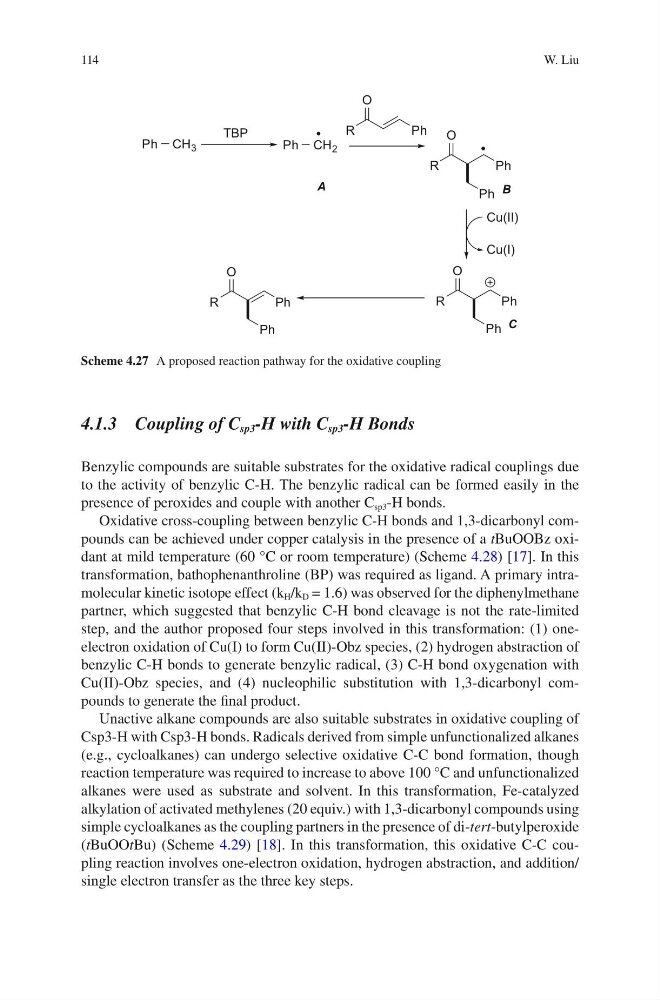
Scheme 4.27 A proposed reaction pathway for the oxidative coupling
W. Liu
4.1.3 Coupling of C sp3 -H with C sp3 -H Bonds
Benzylic compounds are suitable substrates for the oxidative radical couplings due
to the activity of benzylic C-H. The benzylic radical can be formed easily in the
presence of peroxides and couple with another C sp3 -H bonds.
Oxidative cross-coupling between benzylic C-H bonds and 1,3-dicarbonyl compounds can be achieved under copper catalysis in the presence of a tBuOOBz oxidant at mild temperature (60 °C or room temperature) (Scheme 4.28) [17]. In this
transformation, bathophenanthroline (BP) was required as ligand. A primary intramolecular kinetic isotope effect (k H /k D = 1.6) was observed for the diphenylmethane
partner, which suggested that benzylic C-H bond cleavage is not the rate-limited
step, and the author proposed four steps involved in this transformation: (1) oneelectron oxidation of Cu(I) to form Cu(II)-Obz species, (2) hydrogen abstraction of
benzylic C-H bonds to generate benzylic radical, (3) C-H bond oxygenation with
Cu(II)-Obz species, and (4) nucleophilic substitution with 1,3-dicarbonyl compounds to generate the final product.
Unactive alkane compounds are also suitable substrates in oxidative coupling of
Csp3-H with Csp3-H bonds. Radicals derived from simple unfunctionalized alkanes
(e.g., cycloalkanes) can undergo selective oxidative C-C bond formation, though
reaction temperature was required to increase to above 100 °C and unfunctionalized
alkanes were used as substrate and solvent. In this transformation, Fe-catalyzed
alkylation of activated methylenes (20 equiv.) with 1,3-dicarbonyl compounds using
simple cycloalkanes as the coupling partners in the presence of di-tert- butylperoxide
(tBuOOtBu) (Scheme 4.29) [18]. In this transformation, this oxidative C-C coupling reaction involves one-electron oxidation, hydrogen abstraction, and addition/
single electron transfer as the three key steps.
A
B
Ph CH 3
TBP
Ph CH 2
R
O
Ph
R
O
Ph
Ph
Cu(II)
Cu(I)
C
R
O
Ph
Ph
R
O
Ph
Ph
Scheme 4.27 A proposed reaction pathway for the oxidative coupling
W. Liu