

Non-covalent Interactions in Selected Transition Metal Complexes
67
This chapter covers selected contributions which allowed to determine how various non-covalent interactions including controversial homopolar dihydrogen contacts X–H•••H–X and other types of chemical bonds affect the stability and other
properties of selected transition metal complexes. In order to shed light on the bonding situations, various methods/descriptors will be applied including the quantum
theory of atoms in molecules (QTAIM) [46], interacting quantum atoms (IQA)
energy decomposition scheme [47], non-covalent Interactions (NCI) method [48],
and (ETS-NOCV) energy decomposition scheme [49].
2 Methods
2.1 ETS-NOCV Charge and Energy Decomposition Scheme
The ETS-NOCV consists of the ETS energy decomposition scheme and NOCV
method which allows for partitioning orbital charge delocalization term into chemically meaningful constituents (σ, π, δ, etc.) [49].
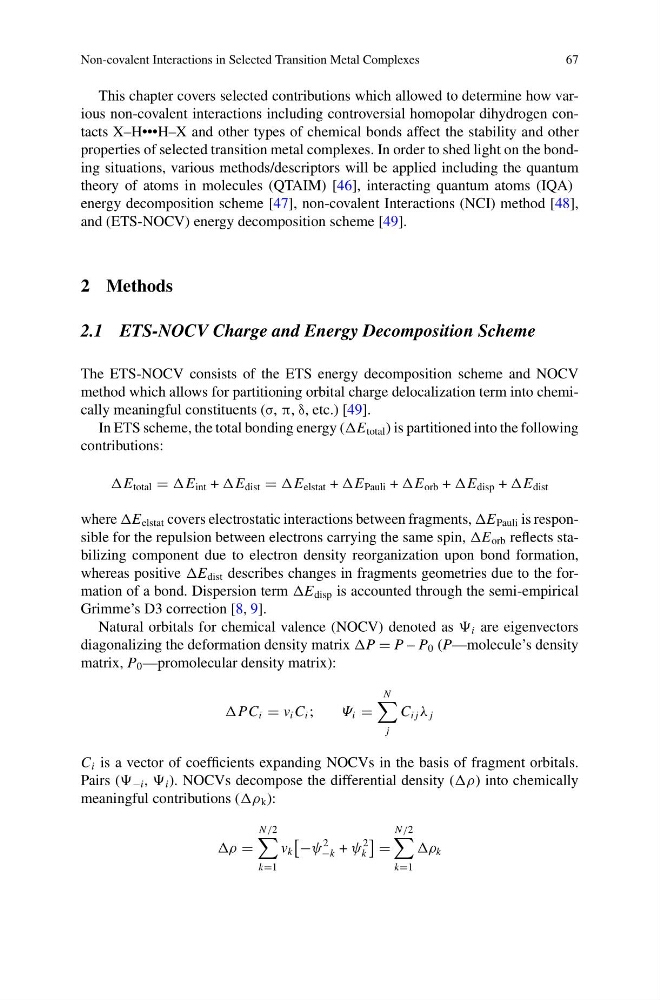
In ETS scheme, the total bonding energy (E total ) is partitioned into the following
contributions:
E total E int + E dist E elstat + E Pauli + E orb + E disp + E dist
where E elstat covers electrostatic interactions between fragments, E Pauli is responsible for the repulsion between electrons carrying the same spin, E orb reflects stabilizing component due to electron density reorganization upon bond formation,
whereas positive E dist describes changes in fragments geometries due to the formation of a bond. Dispersion term E disp is accounted through the semi-empirical
Grimme’s D3 correction [8, 9].
Natural orbitals for chemical valence (NOCV) denoted as i are eigenvectors
diagonalizing the deformation density matrix P P – P 0 (P—molecule’s density
matrix, P 0 —promolecular density matrix):
PC i v i C i ;
Ψ i
N
j
C i j λ j
C i is a vector of coefficients expanding NOCVs in the basis of fragment orbitals.
Pairs ( −i , i ). NOCVs decompose the differential density (ρ) into chemically
meaningful contributions (ρ k ):
ρ
N /2
k1
v k
−ψ
2
−k + ψ
2
k
N /2
k1
ρ k
67
This chapter covers selected contributions which allowed to determine how various non-covalent interactions including controversial homopolar dihydrogen contacts X–H•••H–X and other types of chemical bonds affect the stability and other
properties of selected transition metal complexes. In order to shed light on the bonding situations, various methods/descriptors will be applied including the quantum
theory of atoms in molecules (QTAIM) [46], interacting quantum atoms (IQA)
energy decomposition scheme [47], non-covalent Interactions (NCI) method [48],
and (ETS-NOCV) energy decomposition scheme [49].
2 Methods
2.1 ETS-NOCV Charge and Energy Decomposition Scheme
The ETS-NOCV consists of the ETS energy decomposition scheme and NOCV
method which allows for partitioning orbital charge delocalization term into chemically meaningful constituents (σ, π, δ, etc.) [49].
In ETS scheme, the total bonding energy (E total ) is partitioned into the following
contributions:
E total E int + E dist E elstat + E Pauli + E orb + E disp + E dist
where E elstat covers electrostatic interactions between fragments, E Pauli is responsible for the repulsion between electrons carrying the same spin, E orb reflects stabilizing component due to electron density reorganization upon bond formation,
whereas positive E dist describes changes in fragments geometries due to the formation of a bond. Dispersion term E disp is accounted through the semi-empirical
Grimme’s D3 correction [8, 9].
Natural orbitals for chemical valence (NOCV) denoted as i are eigenvectors
diagonalizing the deformation density matrix P P – P 0 (P—molecule’s density
matrix, P 0 —promolecular density matrix):
PC i v i C i ;
Ψ i
N
j
C i j λ j
C i is a vector of coefficients expanding NOCVs in the basis of fragment orbitals.
Pairs ( −i , i ). NOCVs decompose the differential density (ρ) into chemically
meaningful contributions (ρ k ):
ρ
N /2
k1
v k
−ψ
2
−k + ψ
2
k
N /2
k1
ρ k