

Anisotropic Magnetic Spin Interactions of Transition Metal …
47
Table 1 Comparison of calculated g-tensor principal values with experiment for Ni(mnt)
−
2
Deviation from experiment
g x
g y
g z
g i(exp-calc) in ppt
Experimental a
2.14
2.04
1.99
Calculated
SO self-consistently
BP86
2.103
2.037
1.985
37, 3, 5
B3LYP
2.124
2.067
1.997
16, −27, −4
B3LYP*
2.120
2.057
1.994
20, −17, −4
B3LYP**
2.114
2.049
1.991
26, −9, −1
PBE0
2.143
2.081
2.003
−3, −41, −13
SO perturbative
BP86
2.106
2.039
1.987
34, 1, 3
B3LYP
2.126
2.070
1.996
14, −30, −6
B3LYP*
2.127
2.061
2.003
13, −21, −13
B3LYP**
2.118
2.052
1.995
22, −12, −5
PBE0
2.160
2.087
2.002
−20, −47, −12
WF multireference b
CAS(13, 14)
2.583
2.067
1.983
−443, −27, 7
NEVPT2(13, 14) 2.487
2.076
1.991
−347, −36, −1
a From [72]
b From [73]
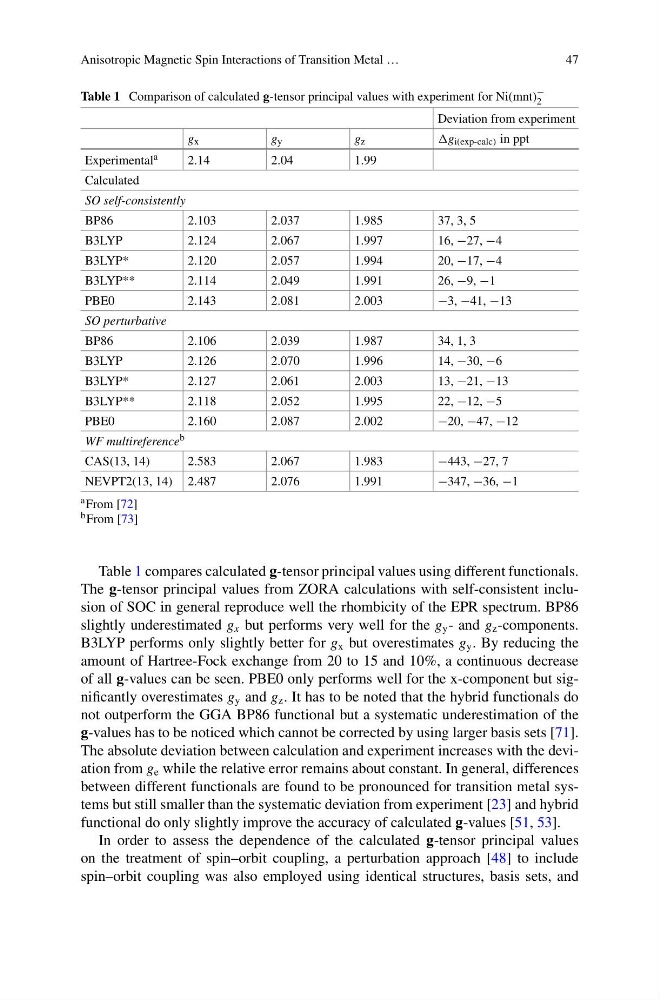
Table 1 compares calculated g-tensor principal values using different functionals.
The g-tensor principal values from ZORA calculations with self-consistent inclusion of SOC in general reproduce well the rhombicity of the EPR spectrum. BP86
slightly underestimated g x but performs very well for the g y - and g z -components.
B3LYP performs only slightly better for g x but overestimates g y . By reducing the
amount of Hartree-Fock exchange from 20 to 15 and 10%, a continuous decrease
of all g-values can be seen. PBE0 only performs well for the x-component but significantly overestimates g y and g z . It has to be noted that the hybrid functionals do
not outperform the GGA BP86 functional but a systematic underestimation of the
g-values has to be noticed which cannot be corrected by using larger basis sets [71].
The absolute deviation between calculation and experiment increases with the deviation from g e while the relative error remains about constant. In general, differences
between different functionals are found to be pronounced for transition metal systems but still smaller than the systematic deviation from experiment [23] and hybrid
functional do only slightly improve the accuracy of calculated g-values [51, 53].
In order to assess the dependence of the calculated g-tensor principal values
on the treatment of spin–orbit coupling, a perturbation approach [48] to include
spin–orbit coupling was also employed using identical structures, basis sets, and
47
Table 1 Comparison of calculated g-tensor principal values with experiment for Ni(mnt)
−
2
Deviation from experiment
g x
g y
g z
g i(exp-calc) in ppt
Experimental a
2.14
2.04
1.99
Calculated
SO self-consistently
BP86
2.103
2.037
1.985
37, 3, 5
B3LYP
2.124
2.067
1.997
16, −27, −4
B3LYP*
2.120
2.057
1.994
20, −17, −4
B3LYP**
2.114
2.049
1.991
26, −9, −1
PBE0
2.143
2.081
2.003
−3, −41, −13
SO perturbative
BP86
2.106
2.039
1.987
34, 1, 3
B3LYP
2.126
2.070
1.996
14, −30, −6
B3LYP*
2.127
2.061
2.003
13, −21, −13
B3LYP**
2.118
2.052
1.995
22, −12, −5
PBE0
2.160
2.087
2.002
−20, −47, −12
WF multireference b
CAS(13, 14)
2.583
2.067
1.983
−443, −27, 7
NEVPT2(13, 14) 2.487
2.076
1.991
−347, −36, −1
a From [72]
b From [73]
Table 1 compares calculated g-tensor principal values using different functionals.
The g-tensor principal values from ZORA calculations with self-consistent inclusion of SOC in general reproduce well the rhombicity of the EPR spectrum. BP86
slightly underestimated g x but performs very well for the g y - and g z -components.
B3LYP performs only slightly better for g x but overestimates g y . By reducing the
amount of Hartree-Fock exchange from 20 to 15 and 10%, a continuous decrease
of all g-values can be seen. PBE0 only performs well for the x-component but significantly overestimates g y and g z . It has to be noted that the hybrid functionals do
not outperform the GGA BP86 functional but a systematic underestimation of the
g-values has to be noticed which cannot be corrected by using larger basis sets [71].
The absolute deviation between calculation and experiment increases with the deviation from g e while the relative error remains about constant. In general, differences
between different functionals are found to be pronounced for transition metal systems but still smaller than the systematic deviation from experiment [23] and hybrid
functional do only slightly improve the accuracy of calculated g-values [51, 53].
In order to assess the dependence of the calculated g-tensor principal values
on the treatment of spin–orbit coupling, a perturbation approach [48] to include
spin–orbit coupling was also employed using identical structures, basis sets, and