

Anisotropic Magnetic Spin Interactions of Transition Metal …
45
4 Structural Information from the Anisotropy of Magnetic
Interactions
4.1 EPR Studies on Single Crystals
In the laboratory axes system, the g-tensor can be obtained by measuring the electron
Zeeman splitting as a function of the angle of the applied field and the crystallographic
axes of a single crystal.
The full g-tensor can be measured from the angular variations of g 2 in three
mutually perpendicular planes of a single crystal
g
2
g
2
xx l
2
xx + g
2
yy l
2
yy + g
2
zz l
2
zz
(9)
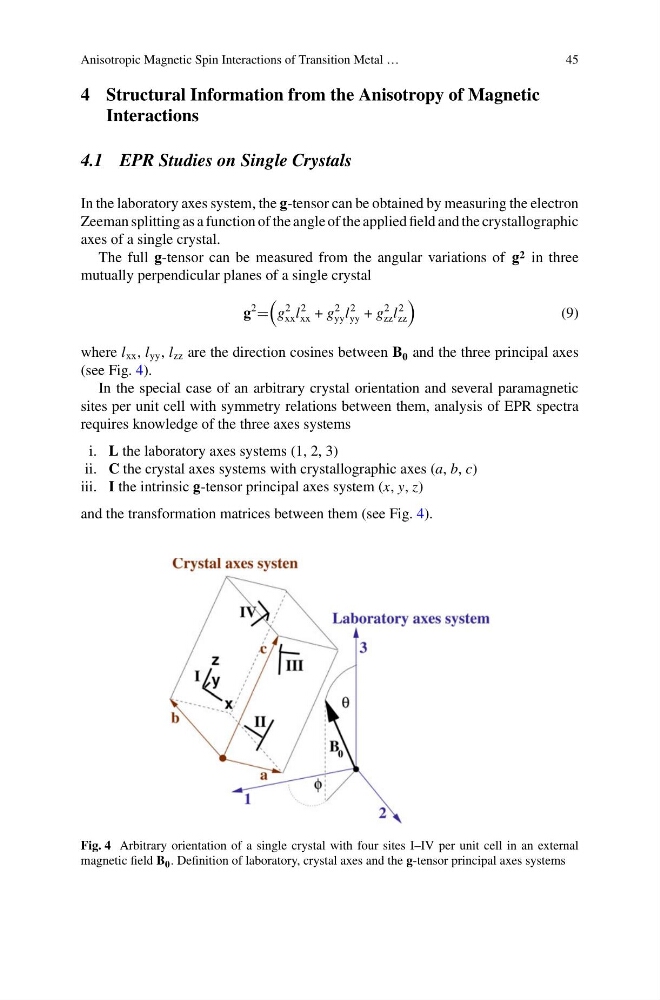
where l xx , l yy , l zz are the direction cosines between B 0 and the three principal axes
(see Fig. 4).
In the special case of an arbitrary crystal orientation and several paramagnetic
sites per unit cell with symmetry relations between them, analysis of EPR spectra
requires knowledge of the three axes systems
i. L the laboratory axes systems (1, 2, 3)
ii. C the crystal axes systems with crystallographic axes (a, b, c)
iii. I the intrinsic g-tensor principal axes system (x, y, z)
and the transformation matrices between them (see Fig. 4).
Fig. 4 Arbitrary orientation of a single crystal with four sites I–IV per unit cell in an external
magnetic field B 0 . Definition of laboratory, crystal axes and the g-tensor principal axes systems
45
4 Structural Information from the Anisotropy of Magnetic
Interactions
4.1 EPR Studies on Single Crystals
In the laboratory axes system, the g-tensor can be obtained by measuring the electron
Zeeman splitting as a function of the angle of the applied field and the crystallographic
axes of a single crystal.
The full g-tensor can be measured from the angular variations of g 2 in three
mutually perpendicular planes of a single crystal
g
2
g
2
xx l
2
xx + g
2
yy l
2
yy + g
2
zz l
2
zz
(9)
where l xx , l yy , l zz are the direction cosines between B 0 and the three principal axes
(see Fig. 4).
In the special case of an arbitrary crystal orientation and several paramagnetic
sites per unit cell with symmetry relations between them, analysis of EPR spectra
requires knowledge of the three axes systems
i. L the laboratory axes systems (1, 2, 3)
ii. C the crystal axes systems with crystallographic axes (a, b, c)
iii. I the intrinsic g-tensor principal axes system (x, y, z)
and the transformation matrices between them (see Fig. 4).
Fig. 4 Arbitrary orientation of a single crystal with four sites I–IV per unit cell in an external
magnetic field B 0 . Definition of laboratory, crystal axes and the g-tensor principal axes systems