

518
T. Borowski and M. Szaleniec
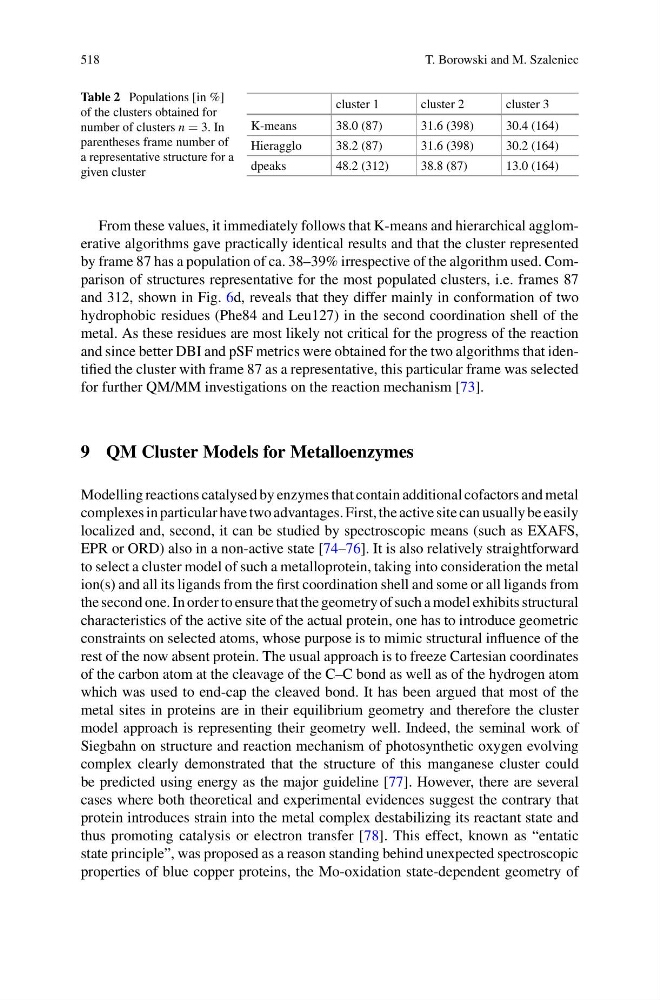
Table 2 Populations [in %]
of the clusters obtained for
number of clusters n 3. In
parentheses frame number of
a representative structure for a
given cluster
cluster 1
cluster 2
cluster 3
K-means
38.0 (87)
31.6 (398)
30.4 (164)
Hieragglo
38.2 (87)
31.6 (398)
30.2 (164)
dpeaks
48.2 (312)
38.8 (87)
13.0 (164)
From these values, it immediately follows that K-means and hierarchical agglomerative algorithms gave practically identical results and that the cluster represented
by frame 87 has a population of ca. 38–39% irrespective of the algorithm used. Comparison of structures representative for the most populated clusters, i.e. frames 87
and 312, shown in Fig. 6d, reveals that they differ mainly in conformation of two
hydrophobic residues (Phe84 and Leu127) in the second coordination shell of the
metal. As these residues are most likely not critical for the progress of the reaction
and since better DBI and pSF metrics were obtained for the two algorithms that identified the cluster with frame 87 as a representative, this particular frame was selected
for further QM/MM investigations on the reaction mechanism [73].
9 QM Cluster Models for Metalloenzymes
Modelling reactions catalysed by enzymes that contain additional cofactors and metal
complexes in particular have two advantages. First, the active site can usually be easily
localized and, second, it can be studied by spectroscopic means (such as EXAFS,
EPR or ORD) also in a non-active state [74–76]. It is also relatively straightforward
to select a cluster model of such a metalloprotein, taking into consideration the metal
ion(s) and all its ligands from the first coordination shell and some or all ligands from
the second one. In order to ensure that the geometry of such a model exhibits structural
characteristics of the active site of the actual protein, one has to introduce geometric
constraints on selected atoms, whose purpose is to mimic structural influence of the
rest of the now absent protein. The usual approach is to freeze Cartesian coordinates
of the carbon atom at the cleavage of the C–C bond as well as of the hydrogen atom
which was used to end-cap the cleaved bond. It has been argued that most of the
metal sites in proteins are in their equilibrium geometry and therefore the cluster
model approach is representing their geometry well. Indeed, the seminal work of
Siegbahn on structure and reaction mechanism of photosynthetic oxygen evolving
complex clearly demonstrated that the structure of this manganese cluster could
be predicted using energy as the major guideline [77]. However, there are several
cases where both theoretical and experimental evidences suggest the contrary that
protein introduces strain into the metal complex destabilizing its reactant state and
thus promoting catalysis or electron transfer [78]. This effect, known as “entatic
state principle”, was proposed as a reason standing behind unexpected spectroscopic
properties of blue copper proteins, the Mo-oxidation state-dependent geometry of
T. Borowski and M. Szaleniec
Table 2 Populations [in %]
of the clusters obtained for
number of clusters n 3. In
parentheses frame number of
a representative structure for a
given cluster
cluster 1
cluster 2
cluster 3
K-means
38.0 (87)
31.6 (398)
30.4 (164)
Hieragglo
38.2 (87)
31.6 (398)
30.2 (164)
dpeaks
48.2 (312)
38.8 (87)
13.0 (164)
From these values, it immediately follows that K-means and hierarchical agglomerative algorithms gave practically identical results and that the cluster represented
by frame 87 has a population of ca. 38–39% irrespective of the algorithm used. Comparison of structures representative for the most populated clusters, i.e. frames 87
and 312, shown in Fig. 6d, reveals that they differ mainly in conformation of two
hydrophobic residues (Phe84 and Leu127) in the second coordination shell of the
metal. As these residues are most likely not critical for the progress of the reaction
and since better DBI and pSF metrics were obtained for the two algorithms that identified the cluster with frame 87 as a representative, this particular frame was selected
for further QM/MM investigations on the reaction mechanism [73].
9 QM Cluster Models for Metalloenzymes
Modelling reactions catalysed by enzymes that contain additional cofactors and metal
complexes in particular have two advantages. First, the active site can usually be easily
localized and, second, it can be studied by spectroscopic means (such as EXAFS,
EPR or ORD) also in a non-active state [74–76]. It is also relatively straightforward
to select a cluster model of such a metalloprotein, taking into consideration the metal
ion(s) and all its ligands from the first coordination shell and some or all ligands from
the second one. In order to ensure that the geometry of such a model exhibits structural
characteristics of the active site of the actual protein, one has to introduce geometric
constraints on selected atoms, whose purpose is to mimic structural influence of the
rest of the now absent protein. The usual approach is to freeze Cartesian coordinates
of the carbon atom at the cleavage of the C–C bond as well as of the hydrogen atom
which was used to end-cap the cleaved bond. It has been argued that most of the
metal sites in proteins are in their equilibrium geometry and therefore the cluster
model approach is representing their geometry well. Indeed, the seminal work of
Siegbahn on structure and reaction mechanism of photosynthetic oxygen evolving
complex clearly demonstrated that the structure of this manganese cluster could
be predicted using energy as the major guideline [77]. However, there are several
cases where both theoretical and experimental evidences suggest the contrary that
protein introduces strain into the metal complex destabilizing its reactant state and
thus promoting catalysis or electron transfer [78]. This effect, known as “entatic
state principle”, was proposed as a reason standing behind unexpected spectroscopic
properties of blue copper proteins, the Mo-oxidation state-dependent geometry of