

512
T. Borowski and M. Szaleniec
Fig. 3 Residues in
cytochrome C (PDB: 1CNG)
active site that undergo
significant shift of pK a due
to interaction with Fe-heme
prosthetic group
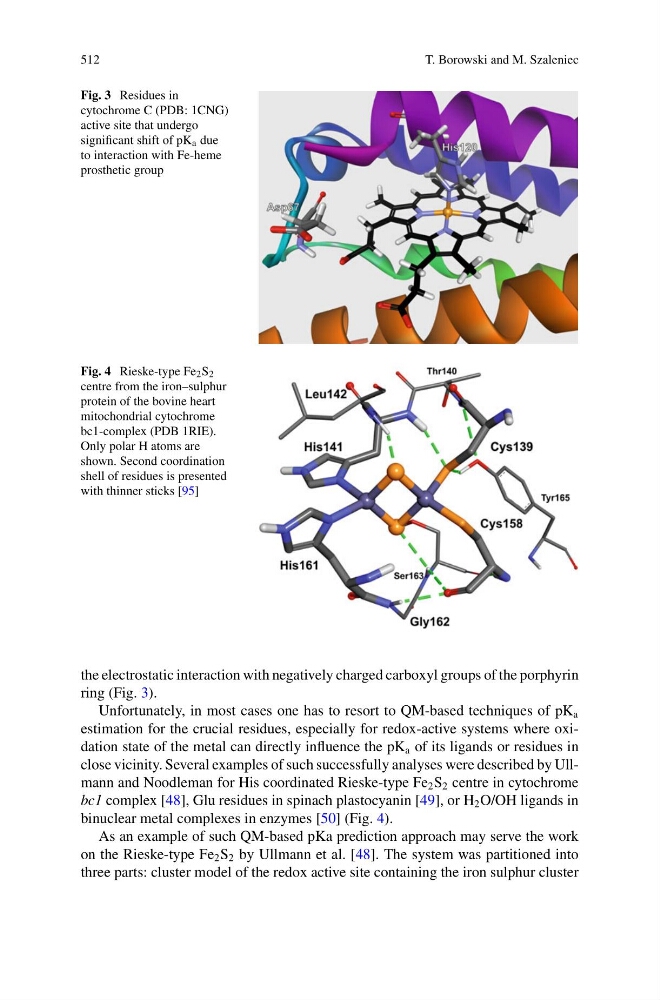
Fig. 4 Rieske-type Fe 2 S 2
centre from the iron–sulphur
protein of the bovine heart
mitochondrial cytochrome
bc1-complex (PDB 1RIE).
Only polar H atoms are
shown. Second coordination
shell of residues is presented
with thinner sticks [95]
the electrostatic interaction with negatively charged carboxyl groups of the porphyrin
ring (Fig. 3).
Unfortunately, in most cases one has to resort to QM-based techniques of pK a
estimation for the crucial residues, especially for redox-active systems where oxidation state of the metal can directly influence the pK a of its ligands or residues in
close vicinity. Several examples of such successfully analyses were described by Ullmann and Noodleman for His coordinated Rieske-type Fe 2 S 2 centre in cytochrome
bc1 complex [48], Glu residues in spinach plastocyanin [49], or H 2 O/OH ligands in
binuclear metal complexes in enzymes [50] (Fig. 4).
As an example of such QM-based pKa prediction approach may serve the work
on the Rieske-type Fe 2 S 2 by Ullmann et al. [48]. The system was partitioned into
three parts: cluster model of the redox active site containing the iron sulphur cluster
T. Borowski and M. Szaleniec
Fig. 3 Residues in
cytochrome C (PDB: 1CNG)
active site that undergo
significant shift of pK a due
to interaction with Fe-heme
prosthetic group
Fig. 4 Rieske-type Fe 2 S 2
centre from the iron–sulphur
protein of the bovine heart
mitochondrial cytochrome
bc1-complex (PDB 1RIE).
Only polar H atoms are
shown. Second coordination
shell of residues is presented
with thinner sticks [95]
the electrostatic interaction with negatively charged carboxyl groups of the porphyrin
ring (Fig. 3).
Unfortunately, in most cases one has to resort to QM-based techniques of pK a
estimation for the crucial residues, especially for redox-active systems where oxidation state of the metal can directly influence the pK a of its ligands or residues in
close vicinity. Several examples of such successfully analyses were described by Ullmann and Noodleman for His coordinated Rieske-type Fe 2 S 2 centre in cytochrome
bc1 complex [48], Glu residues in spinach plastocyanin [49], or H 2 O/OH ligands in
binuclear metal complexes in enzymes [50] (Fig. 4).
As an example of such QM-based pKa prediction approach may serve the work
on the Rieske-type Fe 2 S 2 by Ullmann et al. [48]. The system was partitioned into
three parts: cluster model of the redox active site containing the iron sulphur cluster