

496
T. Marinoet al.
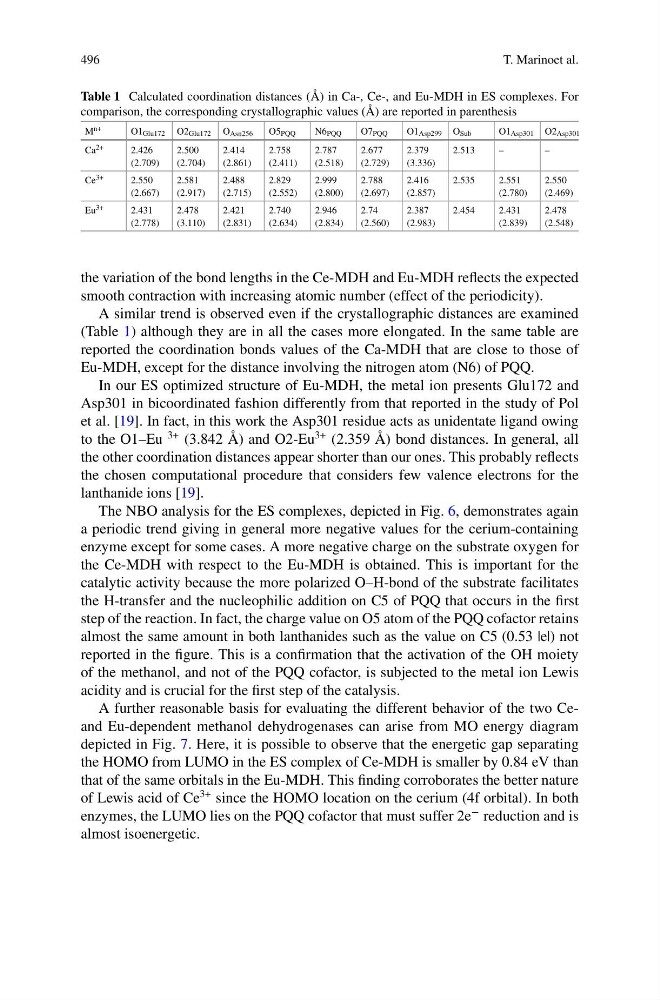
Table 1 Calculated coordination distances (Å) in Ca-, Ce-, and Eu-MDH in ES complexes. For
comparison, the corresponding crystallographic values (Å) are reported in parenthesis
M n+
O1Glu172 O2Glu172 OAsn256
O5PQQ
N6PQQ
O7PQQ
O1Asp299 OSub
O1Asp301 O2Asp301
Ca 2+
2.426
(2.709)
2.500
(2.704)
2.414
(2.861)
2.758
(2.411)
2.787
(2.518)
2.677
(2.729)
2.379
(3.336)
2.513
–
–
Ce 3+
2.550
(2.667)
2.581
(2.917)
2.488
(2.715)
2.829
(2.552)
2.999
(2.800)
2.788
(2.697)
2.416
(2.857)
2.535
2.551
(2.780)
2.550
(2.469)
Eu 3+
2.431
(2.778)
2.478
(3.110)
2.421
(2.831)
2.740
(2.634)
2.946
(2.834)
2.74
(2.560)
2.387
(2.983)
2.454
2.431
(2.839)
2.478
(2.548)
the variation of the bond lengths in the Ce-MDH and Eu-MDH reflects the expected
smooth contraction with increasing atomic number (effect of the periodicity).
A similar trend is observed even if the crystallographic distances are examined
(Table 1) although they are in all the cases more elongated. In the same table are
reported the coordination bonds values of the Ca-MDH that are close to those of
Eu-MDH, except for the distance involving the nitrogen atom (N6) of PQQ.
In our ES optimized structure of Eu-MDH, the metal ion presents Glu172 and
Asp301 in bicoordinated fashion differently from that reported in the study of Pol
et al. [19]. In fact, in this work the Asp301 residue acts as unidentate ligand owing
to the O1–Eu
3+ (3.842 Å) and O2-Eu
3+ (2.359 Å) bond distances. In general, all
the other coordination distances appear shorter than our ones. This probably reflects
the chosen computational procedure that considers few valence electrons for the
lanthanide ions [19].
The NBO analysis for the ES complexes, depicted in Fig. 6, demonstrates again
a periodic trend giving in general more negative values for the cerium-containing
enzyme except for some cases. A more negative charge on the substrate oxygen for
the Ce-MDH with respect to the Eu-MDH is obtained. This is important for the
catalytic activity because the more polarized O–H-bond of the substrate facilitates
the H-transfer and the nucleophilic addition on C5 of PQQ that occurs in the first
step of the reaction. In fact, the charge value on O5 atom of the PQQ cofactor retains
almost the same amount in both lanthanides such as the value on C5 (0.53 |e|) not
reported in the figure. This is a confirmation that the activation of the OH moiety
of the methanol, and not of the PQQ cofactor, is subjected to the metal ion Lewis
acidity and is crucial for the first step of the catalysis.
A further reasonable basis for evaluating the different behavior of the two Ceand Eu-dependent methanol dehydrogenases can arise from MO energy diagram
depicted in Fig. 7. Here, it is possible to observe that the energetic gap separating
the HOMO from LUMO in the ES complex of Ce-MDH is smaller by 0.84 eV than
that of the same orbitals in the Eu-MDH. This finding corroborates the better nature
of Lewis acid of Ce
3+ since the HOMO location on the cerium (4f orbital). In both
enzymes, the LUMO lies on the PQQ cofactor that must suffer 2e
− reduction and is
almost isoenergetic.
T. Marinoet al.
Table 1 Calculated coordination distances (Å) in Ca-, Ce-, and Eu-MDH in ES complexes. For
comparison, the corresponding crystallographic values (Å) are reported in parenthesis
M n+
O1Glu172 O2Glu172 OAsn256
O5PQQ
N6PQQ
O7PQQ
O1Asp299 OSub
O1Asp301 O2Asp301
Ca 2+
2.426
(2.709)
2.500
(2.704)
2.414
(2.861)
2.758
(2.411)
2.787
(2.518)
2.677
(2.729)
2.379
(3.336)
2.513
–
–
Ce 3+
2.550
(2.667)
2.581
(2.917)
2.488
(2.715)
2.829
(2.552)
2.999
(2.800)
2.788
(2.697)
2.416
(2.857)
2.535
2.551
(2.780)
2.550
(2.469)
Eu 3+
2.431
(2.778)
2.478
(3.110)
2.421
(2.831)
2.740
(2.634)
2.946
(2.834)
2.74
(2.560)
2.387
(2.983)
2.454
2.431
(2.839)
2.478
(2.548)
the variation of the bond lengths in the Ce-MDH and Eu-MDH reflects the expected
smooth contraction with increasing atomic number (effect of the periodicity).
A similar trend is observed even if the crystallographic distances are examined
(Table 1) although they are in all the cases more elongated. In the same table are
reported the coordination bonds values of the Ca-MDH that are close to those of
Eu-MDH, except for the distance involving the nitrogen atom (N6) of PQQ.
In our ES optimized structure of Eu-MDH, the metal ion presents Glu172 and
Asp301 in bicoordinated fashion differently from that reported in the study of Pol
et al. [19]. In fact, in this work the Asp301 residue acts as unidentate ligand owing
to the O1–Eu
3+ (3.842 Å) and O2-Eu
3+ (2.359 Å) bond distances. In general, all
the other coordination distances appear shorter than our ones. This probably reflects
the chosen computational procedure that considers few valence electrons for the
lanthanide ions [19].
The NBO analysis for the ES complexes, depicted in Fig. 6, demonstrates again
a periodic trend giving in general more negative values for the cerium-containing
enzyme except for some cases. A more negative charge on the substrate oxygen for
the Ce-MDH with respect to the Eu-MDH is obtained. This is important for the
catalytic activity because the more polarized O–H-bond of the substrate facilitates
the H-transfer and the nucleophilic addition on C5 of PQQ that occurs in the first
step of the reaction. In fact, the charge value on O5 atom of the PQQ cofactor retains
almost the same amount in both lanthanides such as the value on C5 (0.53 |e|) not
reported in the figure. This is a confirmation that the activation of the OH moiety
of the methanol, and not of the PQQ cofactor, is subjected to the metal ion Lewis
acidity and is crucial for the first step of the catalysis.
A further reasonable basis for evaluating the different behavior of the two Ceand Eu-dependent methanol dehydrogenases can arise from MO energy diagram
depicted in Fig. 7. Here, it is possible to observe that the energetic gap separating
the HOMO from LUMO in the ES complex of Ce-MDH is smaller by 0.84 eV than
that of the same orbitals in the Eu-MDH. This finding corroborates the better nature
of Lewis acid of Ce
3+ since the HOMO location on the cerium (4f orbital). In both
enzymes, the LUMO lies on the PQQ cofactor that must suffer 2e
− reduction and is
almost isoenergetic.