

Applications of Computational Chemistry to Selected Problems …
481
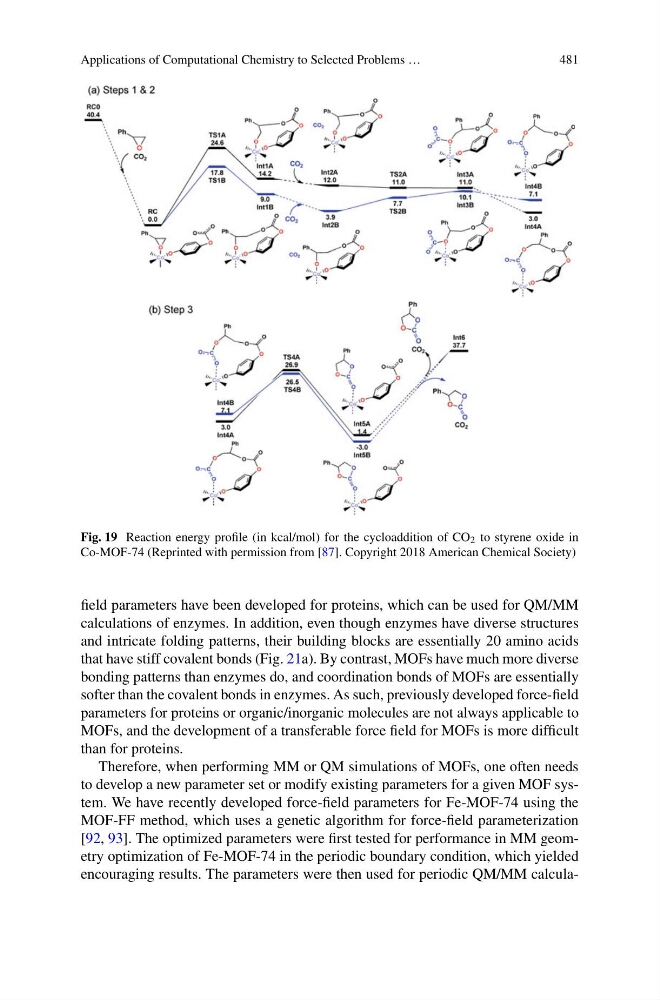
Fig. 19 Reaction energy profile (in kcal/mol) for the cycloaddition of CO 2 to styrene oxide in
Co-MOF-74 (Reprinted with permission from [87]. Copyright 2018 American Chemical Society)
field parameters have been developed for proteins, which can be used for QM/MM
calculations of enzymes. In addition, even though enzymes have diverse structures
and intricate folding patterns, their building blocks are essentially 20 amino acids
that have stiff covalent bonds (Fig. 21a). By contrast, MOFs have much more diverse
bonding patterns than enzymes do, and coordination bonds of MOFs are essentially
softer than the covalent bonds in enzymes. As such, previously developed force-field
parameters for proteins or organic/inorganic molecules are not always applicable to
MOFs, and the development of a transferable force field for MOFs is more difficult
than for proteins.
Therefore, when performing MM or QM simulations of MOFs, one often needs
to develop a new parameter set or modify existing parameters for a given MOF system. We have recently developed force-field parameters for Fe-MOF-74 using the
MOF-FF method, which uses a genetic algorithm for force-field parameterization
[92, 93]. The optimized parameters were first tested for performance in MM geometry optimization of Fe-MOF-74 in the periodic boundary condition, which yielded
encouraging results. The parameters were then used for periodic QM/MM calcula-
481
Fig. 19 Reaction energy profile (in kcal/mol) for the cycloaddition of CO 2 to styrene oxide in
Co-MOF-74 (Reprinted with permission from [87]. Copyright 2018 American Chemical Society)
field parameters have been developed for proteins, which can be used for QM/MM
calculations of enzymes. In addition, even though enzymes have diverse structures
and intricate folding patterns, their building blocks are essentially 20 amino acids
that have stiff covalent bonds (Fig. 21a). By contrast, MOFs have much more diverse
bonding patterns than enzymes do, and coordination bonds of MOFs are essentially
softer than the covalent bonds in enzymes. As such, previously developed force-field
parameters for proteins or organic/inorganic molecules are not always applicable to
MOFs, and the development of a transferable force field for MOFs is more difficult
than for proteins.
Therefore, when performing MM or QM simulations of MOFs, one often needs
to develop a new parameter set or modify existing parameters for a given MOF system. We have recently developed force-field parameters for Fe-MOF-74 using the
MOF-FF method, which uses a genetic algorithm for force-field parameterization
[92, 93]. The optimized parameters were first tested for performance in MM geometry optimization of Fe-MOF-74 in the periodic boundary condition, which yielded
encouraging results. The parameters were then used for periodic QM/MM calcula-