

Molecular Electrochemistry of Coordination Compounds …
419
2.4 Effect of Second Coordination Sphere and H-Bonding
Changes on Reduction Potential
The environment surrounding the transition metal complex beyond the primary ligand
may have a profound effect on its redox potential, particularly in biological systems
[41]. Of particular significance may be varying the geometric structural parameters
and non-covalent interactions in the secondary coordination sphere, like hydrogen,
halogen, chalcogen and similar types of bonding with primary ligands. They may be
pronounced specifically in enzymes, but there are more and more examples reported
in simpler systems.
Glaser and co-workers [42] reported on the influence of hydrogen bonds on the
reduction potential of Cu
II in an extended salen-like framework. They compared
E 1/2 values of an unsubstituted [L H Cu
II ] complex with its analogue, [(H 2 L OH )Cu
II ],
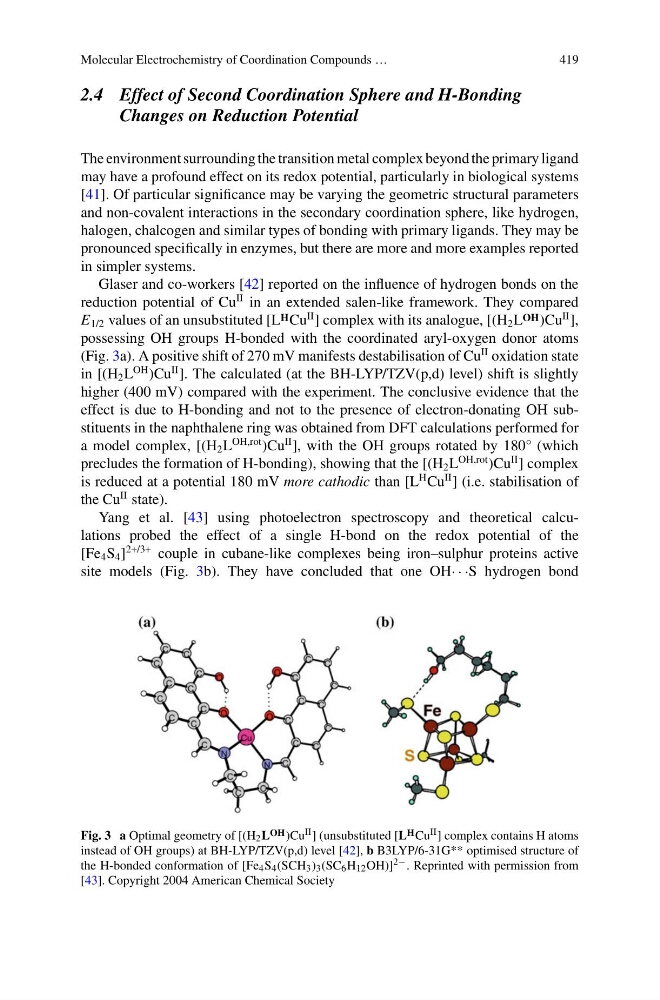
possessing OH groups H-bonded with the coordinated aryl-oxygen donor atoms
(Fig. 3a). A positive shift of 270 mV manifests destabilisation of Cu
II oxidation state
in [(H 2 L
OH )Cu
II ]. The calculated (at the BH-LYP/TZV(p,d) level) shift is slightly
higher (400 mV) compared with the experiment. The conclusive evidence that the
effect is due to H-bonding and not to the presence of electron-donating OH substituents in the naphthalene ring was obtained from DFT calculations performed for
a model complex, [(H 2 L
OH,rot )Cu
II ], with the OH groups rotated by 180° (which
precludes the formation of H-bonding), showing that the [(H 2 L
OH,rot )Cu
II ] complex
is reduced at a potential 180 mV more cathodic than [L
H Cu
II ] (i.e. stabilisation of
the Cu
II state).
Yang et al. [43] using photoelectron spectroscopy and theoretical calculations probed the effect of a single H-bond on the redox potential of the
[Fe 4 S 4 ]
2+/3+ couple in cubane-like complexes being iron–sulphur proteins active
site models (Fig. 3b). They have concluded that one OH· · ·S hydrogen bond
Fig. 3 a Optimal geometry of [(H 2 L OH )Cu II ] (unsubstituted [L H Cu II ] complex contains H atoms
instead of OH groups) at BH-LYP/TZV(p,d) level [42], b B3LYP/6-31G** optimised structure of
the H-bonded conformation of [Fe 4 S 4 (SCH 3 ) 3 (SC 6 H 12 OH)] 2− . Reprinted with permission from
[43]. Copyright 2004 American Chemical Society
419
2.4 Effect of Second Coordination Sphere and H-Bonding
Changes on Reduction Potential
The environment surrounding the transition metal complex beyond the primary ligand
may have a profound effect on its redox potential, particularly in biological systems
[41]. Of particular significance may be varying the geometric structural parameters
and non-covalent interactions in the secondary coordination sphere, like hydrogen,
halogen, chalcogen and similar types of bonding with primary ligands. They may be
pronounced specifically in enzymes, but there are more and more examples reported
in simpler systems.
Glaser and co-workers [42] reported on the influence of hydrogen bonds on the
reduction potential of Cu
II in an extended salen-like framework. They compared
E 1/2 values of an unsubstituted [L H Cu
II ] complex with its analogue, [(H 2 L OH )Cu
II ],
possessing OH groups H-bonded with the coordinated aryl-oxygen donor atoms
(Fig. 3a). A positive shift of 270 mV manifests destabilisation of Cu
II oxidation state
in [(H 2 L
OH )Cu
II ]. The calculated (at the BH-LYP/TZV(p,d) level) shift is slightly
higher (400 mV) compared with the experiment. The conclusive evidence that the
effect is due to H-bonding and not to the presence of electron-donating OH substituents in the naphthalene ring was obtained from DFT calculations performed for
a model complex, [(H 2 L
OH,rot )Cu
II ], with the OH groups rotated by 180° (which
precludes the formation of H-bonding), showing that the [(H 2 L
OH,rot )Cu
II ] complex
is reduced at a potential 180 mV more cathodic than [L
H Cu
II ] (i.e. stabilisation of
the Cu
II state).
Yang et al. [43] using photoelectron spectroscopy and theoretical calculations probed the effect of a single H-bond on the redox potential of the
[Fe 4 S 4 ]
2+/3+ couple in cubane-like complexes being iron–sulphur proteins active
site models (Fig. 3b). They have concluded that one OH· · ·S hydrogen bond
Fig. 3 a Optimal geometry of [(H 2 L OH )Cu II ] (unsubstituted [L H Cu II ] complex contains H atoms
instead of OH groups) at BH-LYP/TZV(p,d) level [42], b B3LYP/6-31G** optimised structure of
the H-bonded conformation of [Fe 4 S 4 (SCH 3 ) 3 (SC 6 H 12 OH)] 2− . Reprinted with permission from
[43]. Copyright 2004 American Chemical Society