

418
P. P. Roma´ nczyk and S. S. Kurek
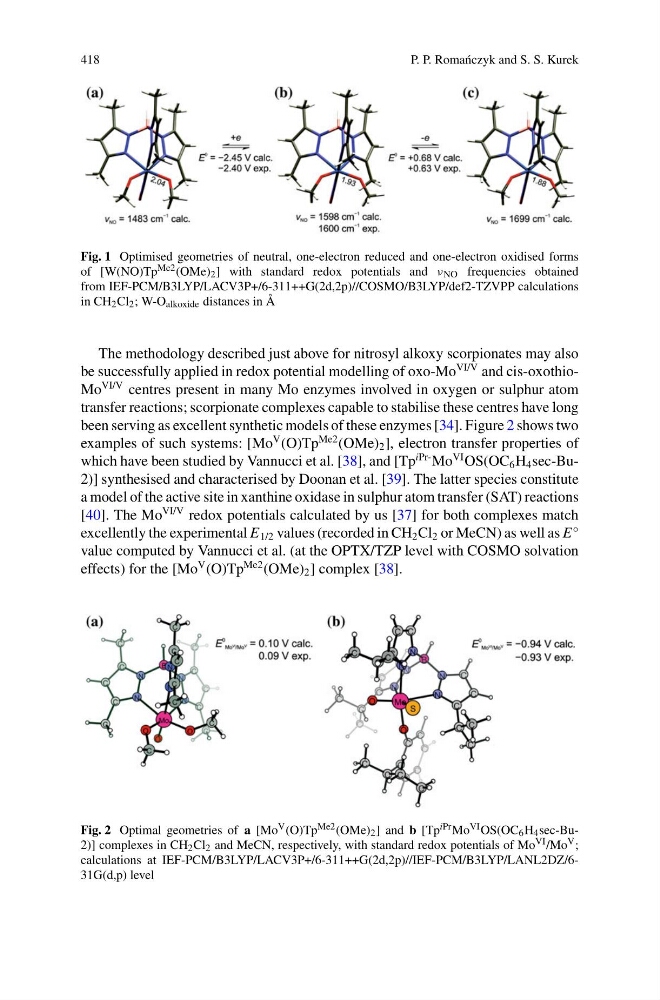
Fig. 1 Optimised geometries of neutral, one-electron reduced and one-electron oxidised forms
of [W(NO)Tp Me2 (OMe) 2 ] with standard redox potentials and ν NO frequencies obtained
from IEF-PCM/B3LYP/LACV3P+/6-311++G(2d,2p)//COSMO/B3LYP/def2-TZVPP calculations
in CH 2 Cl 2 ; W-O alkoxide distances in Å
The methodology described just above for nitrosyl alkoxy scorpionates may also
be successfully applied in redox potential modelling of oxo-Mo
VI/V and cis-oxothioMo
VI/V centres present in many Mo enzymes involved in oxygen or sulphur atom
transfer reactions; scorpionate complexes capable to stabilise these centres have long
been serving as excellent synthetic models of these enzymes [34]. Figure 2 shows two
examples of such systems: [Mo
V (O)Tp
Me2 (OMe) 2 ], electron transfer properties of
which have been studied by Vannucci et al. [38], and [Tp
iPr- Mo
VI OS(OC 6 H 4 sec-Bu2)] synthesised and characterised by Doonan et al. [39]. The latter species constitute
a model of the active site in xanthine oxidase in sulphur atom transfer (SAT) reactions
[40]. The Mo
VI/V redox potentials calculated by us [37] for both complexes match
excellently the experimental E 1/2 values (recorded in CH 2 Cl 2 or MeCN) as well as E°
value computed by Vannucci et al. (at the OPTX/TZP level with COSMO solvation
effects) for the [Mo
V (O)Tp
Me2 (OMe) 2 ] complex [38].
Fig. 2 Optimal geometries of a [Mo V (O)Tp Me2 (OMe) 2 ] and b [Tp iPr Mo VI OS(OC 6 H 4 sec-Bu2)] complexes in CH 2 Cl 2 and MeCN, respectively, with standard redox potentials of Mo VI /Mo V ;
calculations at IEF-PCM/B3LYP/LACV3P+/6-311++G(2d,2p)//IEF-PCM/B3LYP/LANL2DZ/631G(d,p) level
P. P. Roma´ nczyk and S. S. Kurek
Fig. 1 Optimised geometries of neutral, one-electron reduced and one-electron oxidised forms
of [W(NO)Tp Me2 (OMe) 2 ] with standard redox potentials and ν NO frequencies obtained
from IEF-PCM/B3LYP/LACV3P+/6-311++G(2d,2p)//COSMO/B3LYP/def2-TZVPP calculations
in CH 2 Cl 2 ; W-O alkoxide distances in Å
The methodology described just above for nitrosyl alkoxy scorpionates may also
be successfully applied in redox potential modelling of oxo-Mo
VI/V and cis-oxothioMo
VI/V centres present in many Mo enzymes involved in oxygen or sulphur atom
transfer reactions; scorpionate complexes capable to stabilise these centres have long
been serving as excellent synthetic models of these enzymes [34]. Figure 2 shows two
examples of such systems: [Mo
V (O)Tp
Me2 (OMe) 2 ], electron transfer properties of
which have been studied by Vannucci et al. [38], and [Tp
iPr- Mo
VI OS(OC 6 H 4 sec-Bu2)] synthesised and characterised by Doonan et al. [39]. The latter species constitute
a model of the active site in xanthine oxidase in sulphur atom transfer (SAT) reactions
[40]. The Mo
VI/V redox potentials calculated by us [37] for both complexes match
excellently the experimental E 1/2 values (recorded in CH 2 Cl 2 or MeCN) as well as E°
value computed by Vannucci et al. (at the OPTX/TZP level with COSMO solvation
effects) for the [Mo
V (O)Tp
Me2 (OMe) 2 ] complex [38].
Fig. 2 Optimal geometries of a [Mo V (O)Tp Me2 (OMe) 2 ] and b [Tp iPr Mo VI OS(OC 6 H 4 sec-Bu2)] complexes in CH 2 Cl 2 and MeCN, respectively, with standard redox potentials of Mo VI /Mo V ;
calculations at IEF-PCM/B3LYP/LACV3P+/6-311++G(2d,2p)//IEF-PCM/B3LYP/LANL2DZ/631G(d,p) level