

368
W. Piskorz and F. Zasada
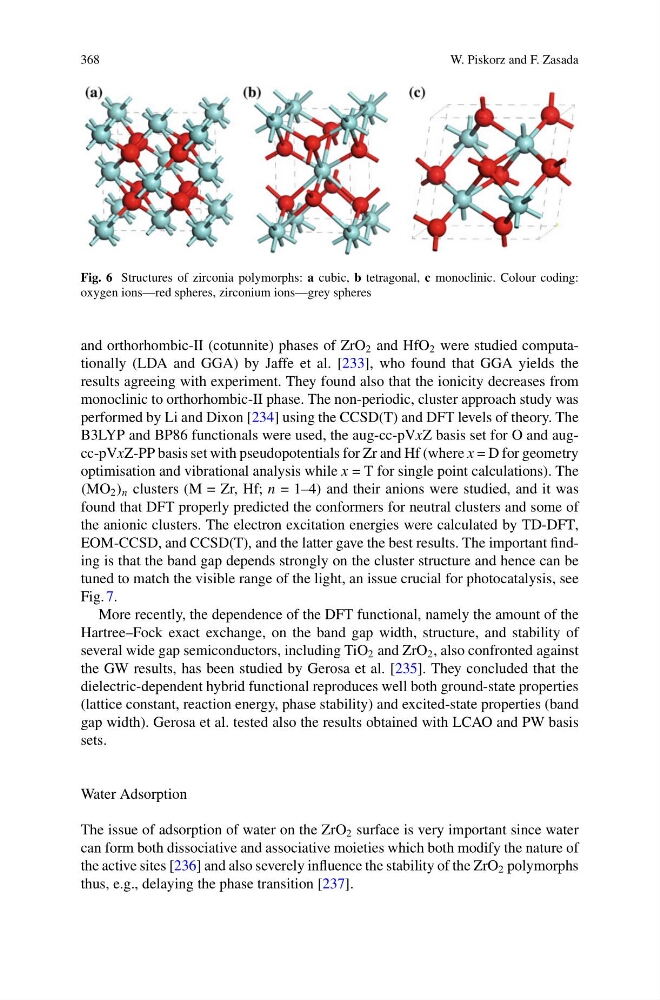
Fig. 6 Structures of zirconia polymorphs: a cubic, b tetragonal, c monoclinic. Colour coding:
oxygen ions—red spheres, zirconium ions—grey spheres
and orthorhombic-II (cotunnite) phases of ZrO 2 and HfO 2 were studied computationally (LDA and GGA) by Jaffe et al. [233], who found that GGA yields the
results agreeing with experiment. They found also that the ionicity decreases from
monoclinic to orthorhombic-II phase. The non-periodic, cluster approach study was
performed by Li and Dixon [234] using the CCSD(T) and DFT levels of theory. The
B3LYP and BP86 functionals were used, the aug-cc-pVxZ basis set for O and augcc-pVxZ-PP basis set with pseudopotentials for Zr and Hf (where x = D for geometry
optimisation and vibrational analysis while x = T for single point calculations). The
(MO 2 ) n clusters (M = Zr, Hf; n = 1–4) and their anions were studied, and it was
found that DFT properly predicted the conformers for neutral clusters and some of
the anionic clusters. The electron excitation energies were calculated by TD-DFT,
EOM-CCSD, and CCSD(T), and the latter gave the best results. The important finding is that the band gap depends strongly on the cluster structure and hence can be
tuned to match the visible range of the light, an issue crucial for photocatalysis, see
Fig. 7.
More recently, the dependence of the DFT functional, namely the amount of the
Hartree–Fock exact exchange, on the band gap width, structure, and stability of
several wide gap semiconductors, including TiO 2 and ZrO 2 , also confronted against
the GW results, has been studied by Gerosa et al. [235]. They concluded that the
dielectric-dependent hybrid functional reproduces well both ground-state properties
(lattice constant, reaction energy, phase stability) and excited-state properties (band
gap width). Gerosa et al. tested also the results obtained with LCAO and PW basis
sets.
Water Adsorption
The issue of adsorption of water on the ZrO 2 surface is very important since water
can form both dissociative and associative moieties which both modify the nature of
the active sites [236] and also severely influence the stability of the ZrO 2 polymorphs
thus, e.g., delaying the phase transition [237].
W. Piskorz and F. Zasada
Fig. 6 Structures of zirconia polymorphs: a cubic, b tetragonal, c monoclinic. Colour coding:
oxygen ions—red spheres, zirconium ions—grey spheres
and orthorhombic-II (cotunnite) phases of ZrO 2 and HfO 2 were studied computationally (LDA and GGA) by Jaffe et al. [233], who found that GGA yields the
results agreeing with experiment. They found also that the ionicity decreases from
monoclinic to orthorhombic-II phase. The non-periodic, cluster approach study was
performed by Li and Dixon [234] using the CCSD(T) and DFT levels of theory. The
B3LYP and BP86 functionals were used, the aug-cc-pVxZ basis set for O and augcc-pVxZ-PP basis set with pseudopotentials for Zr and Hf (where x = D for geometry
optimisation and vibrational analysis while x = T for single point calculations). The
(MO 2 ) n clusters (M = Zr, Hf; n = 1–4) and their anions were studied, and it was
found that DFT properly predicted the conformers for neutral clusters and some of
the anionic clusters. The electron excitation energies were calculated by TD-DFT,
EOM-CCSD, and CCSD(T), and the latter gave the best results. The important finding is that the band gap depends strongly on the cluster structure and hence can be
tuned to match the visible range of the light, an issue crucial for photocatalysis, see
Fig. 7.
More recently, the dependence of the DFT functional, namely the amount of the
Hartree–Fock exact exchange, on the band gap width, structure, and stability of
several wide gap semiconductors, including TiO 2 and ZrO 2 , also confronted against
the GW results, has been studied by Gerosa et al. [235]. They concluded that the
dielectric-dependent hybrid functional reproduces well both ground-state properties
(lattice constant, reaction energy, phase stability) and excited-state properties (band
gap width). Gerosa et al. tested also the results obtained with LCAO and PW basis
sets.
Water Adsorption
The issue of adsorption of water on the ZrO 2 surface is very important since water
can form both dissociative and associative moieties which both modify the nature of
the active sites [236] and also severely influence the stability of the ZrO 2 polymorphs
thus, e.g., delaying the phase transition [237].