

362
W. Piskorz and F. Zasada
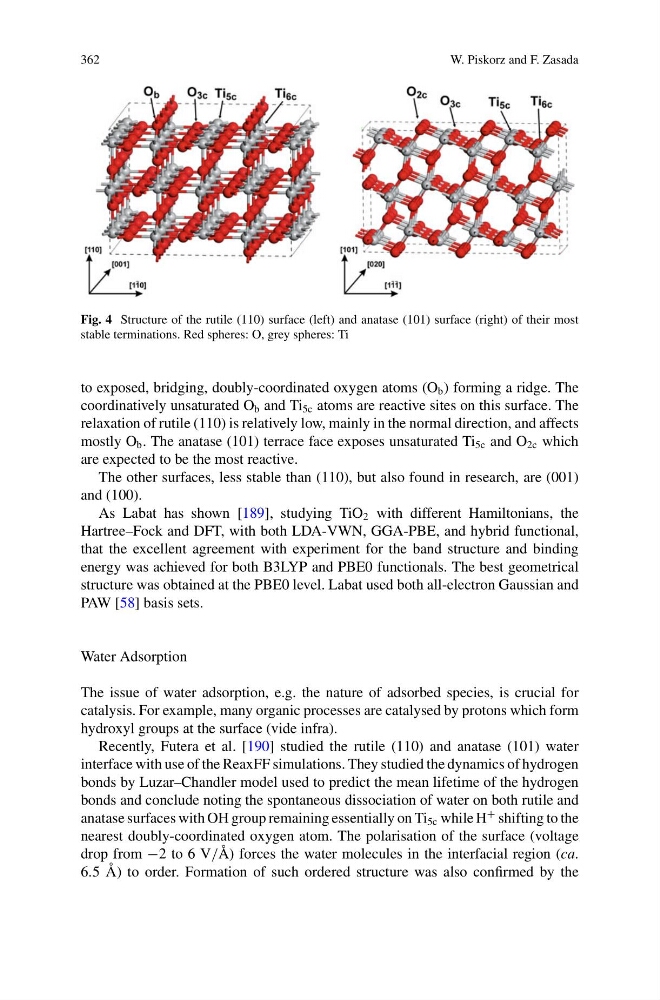
Fig. 4 Structure of the rutile (110) surface (left) and anatase (101) surface (right) of their most
stable terminations. Red spheres: O, grey spheres: Ti
to exposed, bridging, doubly-coordinated oxygen atoms (O b ) forming a ridge. The
coordinatively unsaturated O b and Ti 5c atoms are reactive sites on this surface. The
relaxation of rutile (110) is relatively low, mainly in the normal direction, and affects
mostly O b . The anatase (101) terrace face exposes unsaturated Ti 5c and O 2c which
are expected to be the most reactive.
The other surfaces, less stable than (110), but also found in research, are (001)
and (100).
As Labat has shown [189], studying TiO 2 with different Hamiltonians, the
Hartree–Fock and DFT, with both LDA-VWN, GGA-PBE, and hybrid functional,
that the excellent agreement with experiment for the band structure and binding
energy was achieved for both B3LYP and PBE0 functionals. The best geometrical
structure was obtained at the PBE0 level. Labat used both all-electron Gaussian and
PAW [58] basis sets.
Water Adsorption
The issue of water adsorption, e.g. the nature of adsorbed species, is crucial for
catalysis. For example, many organic processes are catalysed by protons which form
hydroxyl groups at the surface (vide infra).
Recently, Futera et al. [190] studied the rutile (110) and anatase (101) water
interface with use of the ReaxFF simulations. They studied the dynamics of hydrogen
bonds by Luzar–Chandler model used to predict the mean lifetime of the hydrogen
bonds and conclude noting the spontaneous dissociation of water on both rutile and
anatase surfaces with OH group remaining essentially on Ti 5c while H
+ shifting to the
nearest doubly-coordinated oxygen atom. The polarisation of the surface (voltage
drop from −2 to 6 V/Å) forces the water molecules in the interfacial region (ca.
6.5 ˚
A) to order. Formation of such ordered structure was also confirmed by the
W. Piskorz and F. Zasada
Fig. 4 Structure of the rutile (110) surface (left) and anatase (101) surface (right) of their most
stable terminations. Red spheres: O, grey spheres: Ti
to exposed, bridging, doubly-coordinated oxygen atoms (O b ) forming a ridge. The
coordinatively unsaturated O b and Ti 5c atoms are reactive sites on this surface. The
relaxation of rutile (110) is relatively low, mainly in the normal direction, and affects
mostly O b . The anatase (101) terrace face exposes unsaturated Ti 5c and O 2c which
are expected to be the most reactive.
The other surfaces, less stable than (110), but also found in research, are (001)
and (100).
As Labat has shown [189], studying TiO 2 with different Hamiltonians, the
Hartree–Fock and DFT, with both LDA-VWN, GGA-PBE, and hybrid functional,
that the excellent agreement with experiment for the band structure and binding
energy was achieved for both B3LYP and PBE0 functionals. The best geometrical
structure was obtained at the PBE0 level. Labat used both all-electron Gaussian and
PAW [58] basis sets.
Water Adsorption
The issue of water adsorption, e.g. the nature of adsorbed species, is crucial for
catalysis. For example, many organic processes are catalysed by protons which form
hydroxyl groups at the surface (vide infra).
Recently, Futera et al. [190] studied the rutile (110) and anatase (101) water
interface with use of the ReaxFF simulations. They studied the dynamics of hydrogen
bonds by Luzar–Chandler model used to predict the mean lifetime of the hydrogen
bonds and conclude noting the spontaneous dissociation of water on both rutile and
anatase surfaces with OH group remaining essentially on Ti 5c while H
+ shifting to the
nearest doubly-coordinated oxygen atom. The polarisation of the surface (voltage
drop from −2 to 6 V/Å) forces the water molecules in the interfacial region (ca.
6.5 ˚
A) to order. Formation of such ordered structure was also confirmed by the