

Catalytic Properties of Selected Transition Metal Oxides—Computational Studies
361
are directly related with those from photoemission spectroscopy. The results revealed
that systematic correlation exists between band gaps, ionisation potentials, and electron affinities of TiO 2 nanoparticles. In the paper by Berardo et al., a wide range
of many-body (G 0 W 0 , qsGW, EA/IP-EOM-CCSD) and DFT (B3LYP, PBE) methods were used to study the ionisation potentials and electron affinities (vertical and
adiabatic) together with fundamental gap and exciton binding energy values of bare
and hydroxylated TiO 2 nanoclusters [187]. Berardo et al. describe how the clusters
electronic properties change as a function of size and hydroxylation and compare
the performance and predictions of the different classes of methods as well.
The importance of the reduced Ti
3+ species in the electric conductivity [177],
photocatalysis, photochemical water splitting, photochemical oxidation of pollutants, and the technology of dye-sensitised solar cells is well recognised in the literature. The presence of the (paramagnetic) Ti
3+ cation, whose presence supports the
proposed mechanism, in reduced rutile was proved via the EPR spectroscopy (the
g-tensor typical for the Ti 3d
1 state [188]).
Structure and Morphology
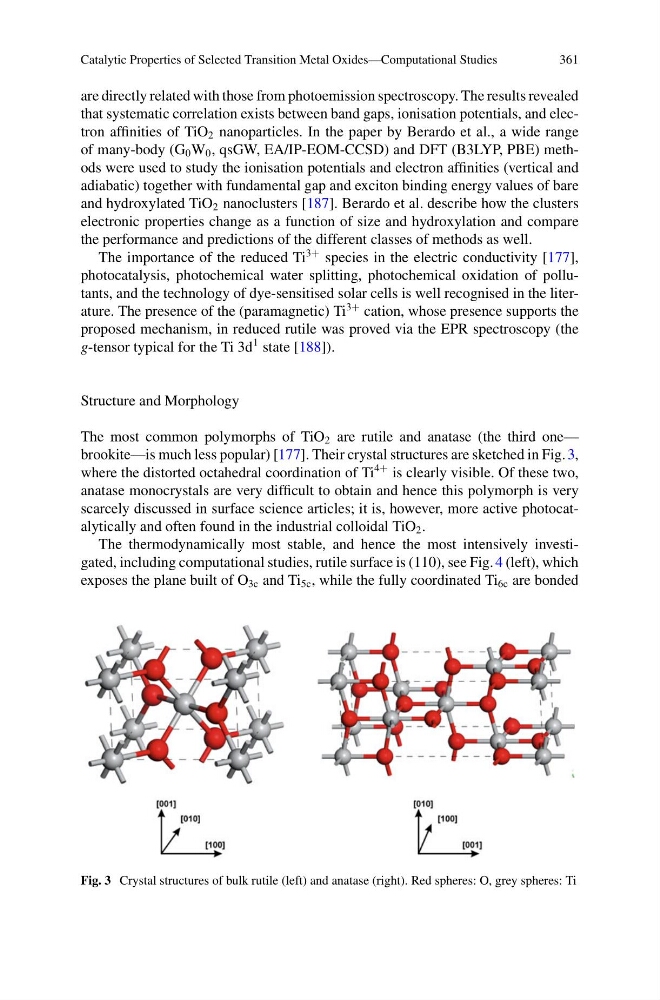
The most common polymorphs of TiO 2 are rutile and anatase (the third one—
brookite—is much less popular) [177]. Their crystal structures are sketched in Fig. 3,
where the distorted octahedral coordination of Ti
4+ is clearly visible. Of these two,
anatase monocrystals are very difficult to obtain and hence this polymorph is very
scarcely discussed in surface science articles; it is, however, more active photocatalytically and often found in the industrial colloidal TiO 2 .
The thermodynamically most stable, and hence the most intensively investigated, including computational studies, rutile surface is (110), see Fig. 4 (left), which
exposes the plane built of O 3c and Ti 5c , while the fully coordinated Ti 6c are bonded
Fig. 3 Crystal structures of bulk rutile (left) and anatase (right). Red spheres: O, grey spheres: Ti
361
are directly related with those from photoemission spectroscopy. The results revealed
that systematic correlation exists between band gaps, ionisation potentials, and electron affinities of TiO 2 nanoparticles. In the paper by Berardo et al., a wide range
of many-body (G 0 W 0 , qsGW, EA/IP-EOM-CCSD) and DFT (B3LYP, PBE) methods were used to study the ionisation potentials and electron affinities (vertical and
adiabatic) together with fundamental gap and exciton binding energy values of bare
and hydroxylated TiO 2 nanoclusters [187]. Berardo et al. describe how the clusters
electronic properties change as a function of size and hydroxylation and compare
the performance and predictions of the different classes of methods as well.
The importance of the reduced Ti
3+ species in the electric conductivity [177],
photocatalysis, photochemical water splitting, photochemical oxidation of pollutants, and the technology of dye-sensitised solar cells is well recognised in the literature. The presence of the (paramagnetic) Ti
3+ cation, whose presence supports the
proposed mechanism, in reduced rutile was proved via the EPR spectroscopy (the
g-tensor typical for the Ti 3d
1 state [188]).
Structure and Morphology
The most common polymorphs of TiO 2 are rutile and anatase (the third one—
brookite—is much less popular) [177]. Their crystal structures are sketched in Fig. 3,
where the distorted octahedral coordination of Ti
4+ is clearly visible. Of these two,
anatase monocrystals are very difficult to obtain and hence this polymorph is very
scarcely discussed in surface science articles; it is, however, more active photocatalytically and often found in the industrial colloidal TiO 2 .
The thermodynamically most stable, and hence the most intensively investigated, including computational studies, rutile surface is (110), see Fig. 4 (left), which
exposes the plane built of O 3c and Ti 5c , while the fully coordinated Ti 6c are bonded
Fig. 3 Crystal structures of bulk rutile (left) and anatase (right). Red spheres: O, grey spheres: Ti