

The Electronic Determinants of Spin Crossover Described …
17
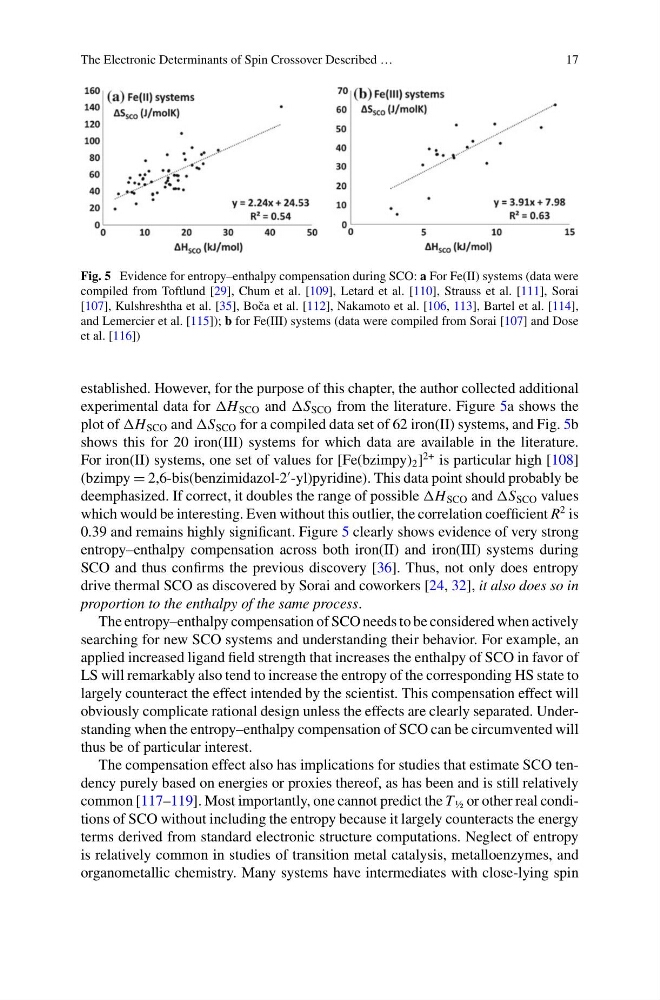
Fig. 5 Evidence for entropy–enthalpy compensation during SCO: a For Fe(II) systems (data were
compiled from Toftlund [29], Chum et al. [109], Letard et al. [110], Strauss et al. [111], Sorai
[107], Kulshreshtha et al. [35], Boˇ ca et al. [112], Nakamoto et al. [106, 113], Bartel et al. [114],
and Lemercier et al. [115]); b for Fe(III) systems (data were compiled from Sorai [107] and Dose
et al. [116])
established. However, for the purpose of this chapter, the author collected additional
experimental data for H SCO and S SCO from the literature. Figure 5a shows the
plot of H SCO and S SCO for a compiled data set of 62 iron(II) systems, and Fig. 5b
shows this for 20 iron(III) systems for which data are available in the literature.
For iron(II) systems, one set of values for [Fe(bzimpy) 2 ]
2+ is particular high [108]
(bzimpy 2,6-bis(benzimidazol-2
-yl)pyridine). This data point should probably be
deemphasized. If correct, it doubles the range of possible H SCO and S SCO values
which would be interesting. Even without this outlier, the correlation coefficient R
2 is
0.39 and remains highly significant. Figure 5 clearly shows evidence of very strong
entropy–enthalpy compensation across both iron(II) and iron(III) systems during
SCO and thus confirms the previous discovery [36]. Thus, not only does entropy
drive thermal SCO as discovered by Sorai and coworkers [24, 32], it also does so in
proportion to the enthalpy of the same process.
The entropy–enthalpy compensation of SCO needs to be considered when actively
searching for new SCO systems and understanding their behavior. For example, an
applied increased ligand field strength that increases the enthalpy of SCO in favor of
LS will remarkably also tend to increase the entropy of the corresponding HS state to
largely counteract the effect intended by the scientist. This compensation effect will
obviously complicate rational design unless the effects are clearly separated. Understanding when the entropy–enthalpy compensation of SCO can be circumvented will
thus be of particular interest.
The compensation effect also has implications for studies that estimate SCO tendency purely based on energies or proxies thereof, as has been and is still relatively
common [117–119]. Most importantly, one cannot predict the T ½ or other real conditions of SCO without including the entropy because it largely counteracts the energy
terms derived from standard electronic structure computations. Neglect of entropy
is relatively common in studies of transition metal catalysis, metalloenzymes, and
organometallic chemistry. Many systems have intermediates with close-lying spin
17
Fig. 5 Evidence for entropy–enthalpy compensation during SCO: a For Fe(II) systems (data were
compiled from Toftlund [29], Chum et al. [109], Letard et al. [110], Strauss et al. [111], Sorai
[107], Kulshreshtha et al. [35], Boˇ ca et al. [112], Nakamoto et al. [106, 113], Bartel et al. [114],
and Lemercier et al. [115]); b for Fe(III) systems (data were compiled from Sorai [107] and Dose
et al. [116])
established. However, for the purpose of this chapter, the author collected additional
experimental data for H SCO and S SCO from the literature. Figure 5a shows the
plot of H SCO and S SCO for a compiled data set of 62 iron(II) systems, and Fig. 5b
shows this for 20 iron(III) systems for which data are available in the literature.
For iron(II) systems, one set of values for [Fe(bzimpy) 2 ]
2+ is particular high [108]
(bzimpy 2,6-bis(benzimidazol-2
-yl)pyridine). This data point should probably be
deemphasized. If correct, it doubles the range of possible H SCO and S SCO values
which would be interesting. Even without this outlier, the correlation coefficient R
2 is
0.39 and remains highly significant. Figure 5 clearly shows evidence of very strong
entropy–enthalpy compensation across both iron(II) and iron(III) systems during
SCO and thus confirms the previous discovery [36]. Thus, not only does entropy
drive thermal SCO as discovered by Sorai and coworkers [24, 32], it also does so in
proportion to the enthalpy of the same process.
The entropy–enthalpy compensation of SCO needs to be considered when actively
searching for new SCO systems and understanding their behavior. For example, an
applied increased ligand field strength that increases the enthalpy of SCO in favor of
LS will remarkably also tend to increase the entropy of the corresponding HS state to
largely counteract the effect intended by the scientist. This compensation effect will
obviously complicate rational design unless the effects are clearly separated. Understanding when the entropy–enthalpy compensation of SCO can be circumvented will
thus be of particular interest.
The compensation effect also has implications for studies that estimate SCO tendency purely based on energies or proxies thereof, as has been and is still relatively
common [117–119]. Most importantly, one cannot predict the T ½ or other real conditions of SCO without including the entropy because it largely counteracts the energy
terms derived from standard electronic structure computations. Neglect of entropy
is relatively common in studies of transition metal catalysis, metalloenzymes, and
organometallic chemistry. Many systems have intermediates with close-lying spin