

16
K. P. Kepp
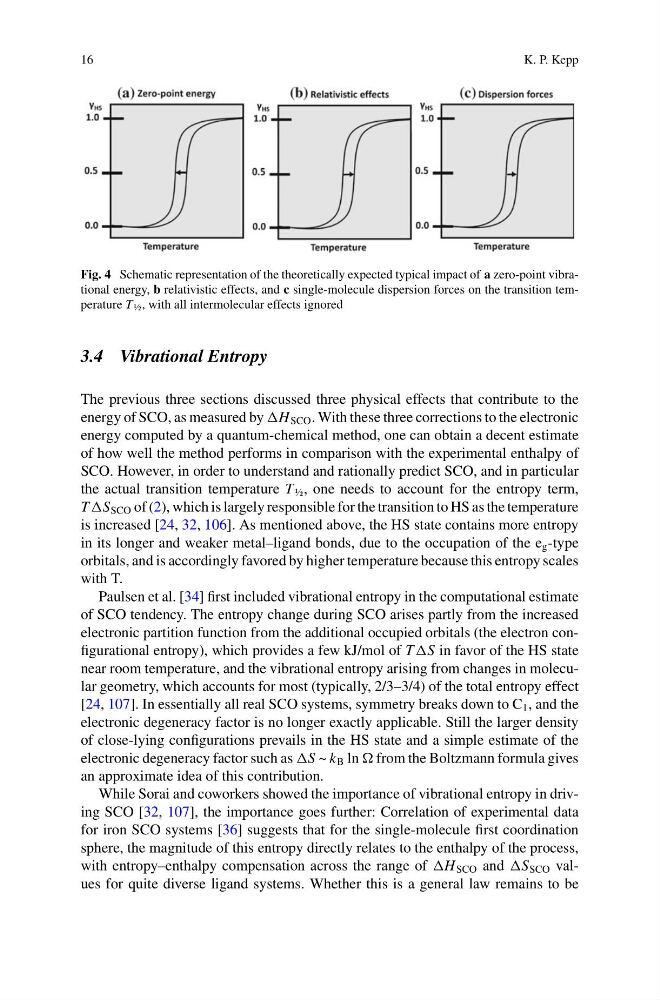
Fig. 4 Schematic representation of the theoretically expected typical impact of a zero-point vibrational energy, b relativistic effects, and c single-molecule dispersion forces on the transition temperature T ½ , with all intermolecular effects ignored
3.4 Vibrational Entropy
The previous three sections discussed three physical effects that contribute to the
energy of SCO, as measured by H SCO . With these three corrections to the electronic
energy computed by a quantum-chemical method, one can obtain a decent estimate
of how well the method performs in comparison with the experimental enthalpy of
SCO. However, in order to understand and rationally predict SCO, and in particular
the actual transition temperature T ½ , one needs to account for the entropy term,
T S SCO of (2), which is largely responsible for the transition to HS as the temperature
is increased [24, 32, 106]. As mentioned above, the HS state contains more entropy
in its longer and weaker metal–ligand bonds, due to the occupation of the e g -type
orbitals, and is accordingly favored by higher temperature because this entropy scales
with T.
Paulsen et al. [34] first included vibrational entropy in the computational estimate
of SCO tendency. The entropy change during SCO arises partly from the increased
electronic partition function from the additional occupied orbitals (the electron configurational entropy), which provides a few kJ/mol of T S in favor of the HS state
near room temperature, and the vibrational entropy arising from changes in molecular geometry, which accounts for most (typically, 2/3–3/4) of the total entropy effect
[24, 107]. In essentially all real SCO systems, symmetry breaks down to C 1 , and the
electronic degeneracy factor is no longer exactly applicable. Still the larger density
of close-lying configurations prevails in the HS state and a simple estimate of the
electronic degeneracy factor such as S ~ k B ln from the Boltzmann formula gives
an approximate idea of this contribution.
While Sorai and coworkers showed the importance of vibrational entropy in driving SCO [32, 107], the importance goes further: Correlation of experimental data
for iron SCO systems [36] suggests that for the single-molecule first coordination
sphere, the magnitude of this entropy directly relates to the enthalpy of the process,
with entropy–enthalpy compensation across the range of H SCO and S SCO values for quite diverse ligand systems. Whether this is a general law remains to be
K. P. Kepp
Fig. 4 Schematic representation of the theoretically expected typical impact of a zero-point vibrational energy, b relativistic effects, and c single-molecule dispersion forces on the transition temperature T ½ , with all intermolecular effects ignored
3.4 Vibrational Entropy
The previous three sections discussed three physical effects that contribute to the
energy of SCO, as measured by H SCO . With these three corrections to the electronic
energy computed by a quantum-chemical method, one can obtain a decent estimate
of how well the method performs in comparison with the experimental enthalpy of
SCO. However, in order to understand and rationally predict SCO, and in particular
the actual transition temperature T ½ , one needs to account for the entropy term,
T S SCO of (2), which is largely responsible for the transition to HS as the temperature
is increased [24, 32, 106]. As mentioned above, the HS state contains more entropy
in its longer and weaker metal–ligand bonds, due to the occupation of the e g -type
orbitals, and is accordingly favored by higher temperature because this entropy scales
with T.
Paulsen et al. [34] first included vibrational entropy in the computational estimate
of SCO tendency. The entropy change during SCO arises partly from the increased
electronic partition function from the additional occupied orbitals (the electron configurational entropy), which provides a few kJ/mol of T S in favor of the HS state
near room temperature, and the vibrational entropy arising from changes in molecular geometry, which accounts for most (typically, 2/3–3/4) of the total entropy effect
[24, 107]. In essentially all real SCO systems, symmetry breaks down to C 1 , and the
electronic degeneracy factor is no longer exactly applicable. Still the larger density
of close-lying configurations prevails in the HS state and a simple estimate of the
electronic degeneracy factor such as S ~ k B ln from the Boltzmann formula gives
an approximate idea of this contribution.
While Sorai and coworkers showed the importance of vibrational entropy in driving SCO [32, 107], the importance goes further: Correlation of experimental data
for iron SCO systems [36] suggests that for the single-molecule first coordination
sphere, the magnitude of this entropy directly relates to the enthalpy of the process,
with entropy–enthalpy compensation across the range of H SCO and S SCO values for quite diverse ligand systems. Whether this is a general law remains to be