

Mechanism and Kinetics in Homogeneous Catalysis …
305
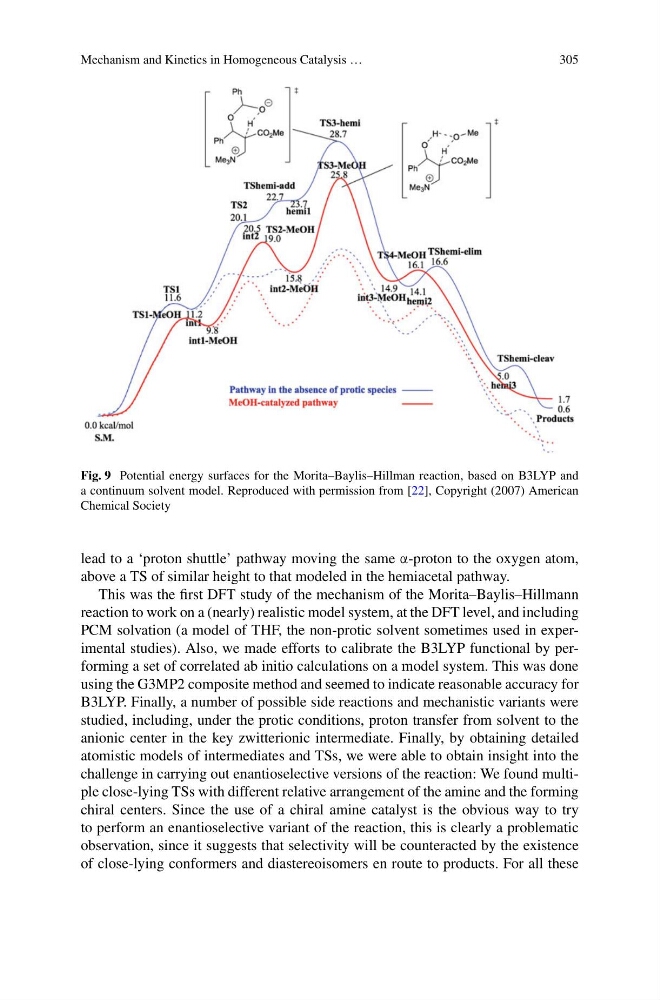
Fig. 9 Potential energy surfaces for the Morita–Baylis–Hillman reaction, based on B3LYP and
a continuum solvent model. Reproduced with permission from [22], Copyright (2007) American
Chemical Society
lead to a ‘proton shuttle’ pathway moving the same α-proton to the oxygen atom,
above a TS of similar height to that modeled in the hemiacetal pathway.
This was the first DFT study of the mechanism of the Morita–Baylis–Hillmann
reaction to work on a (nearly) realistic model system, at the DFT level, and including
PCM solvation (a model of THF, the non-protic solvent sometimes used in experimental studies). Also, we made efforts to calibrate the B3LYP functional by performing a set of correlated ab initio calculations on a model system. This was done
using the G3MP2 composite method and seemed to indicate reasonable accuracy for
B3LYP. Finally, a number of possible side reactions and mechanistic variants were
studied, including, under the protic conditions, proton transfer from solvent to the
anionic center in the key zwitterionic intermediate. Finally, by obtaining detailed
atomistic models of intermediates and TSs, we were able to obtain insight into the
challenge in carrying out enantioselective versions of the reaction: We found multiple close-lying TSs with different relative arrangement of the amine and the forming
chiral centers. Since the use of a chiral amine catalyst is the obvious way to try
to perform an enantioselective variant of the reaction, this is clearly a problematic
observation, since it suggests that selectivity will be counteracted by the existence
of close-lying conformers and diastereoisomers en route to products. For all these
305
Fig. 9 Potential energy surfaces for the Morita–Baylis–Hillman reaction, based on B3LYP and
a continuum solvent model. Reproduced with permission from [22], Copyright (2007) American
Chemical Society
lead to a ‘proton shuttle’ pathway moving the same α-proton to the oxygen atom,
above a TS of similar height to that modeled in the hemiacetal pathway.
This was the first DFT study of the mechanism of the Morita–Baylis–Hillmann
reaction to work on a (nearly) realistic model system, at the DFT level, and including
PCM solvation (a model of THF, the non-protic solvent sometimes used in experimental studies). Also, we made efforts to calibrate the B3LYP functional by performing a set of correlated ab initio calculations on a model system. This was done
using the G3MP2 composite method and seemed to indicate reasonable accuracy for
B3LYP. Finally, a number of possible side reactions and mechanistic variants were
studied, including, under the protic conditions, proton transfer from solvent to the
anionic center in the key zwitterionic intermediate. Finally, by obtaining detailed
atomistic models of intermediates and TSs, we were able to obtain insight into the
challenge in carrying out enantioselective versions of the reaction: We found multiple close-lying TSs with different relative arrangement of the amine and the forming
chiral centers. Since the use of a chiral amine catalyst is the obvious way to try
to perform an enantioselective variant of the reaction, this is clearly a problematic
observation, since it suggests that selectivity will be counteracted by the existence
of close-lying conformers and diastereoisomers en route to products. For all these