

302
J. N. Harvey
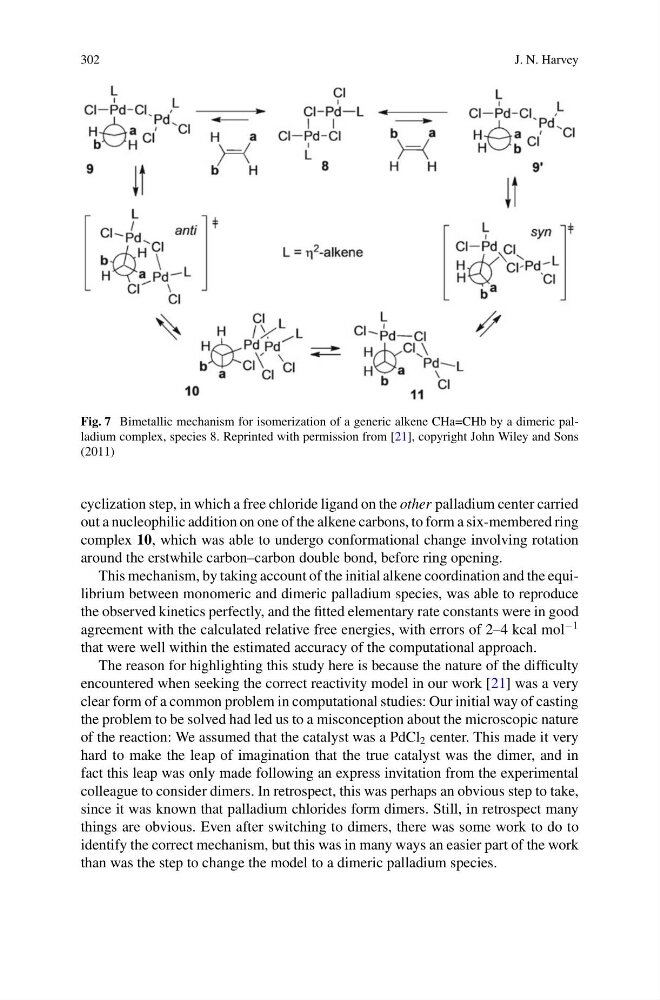
Fig. 7 Bimetallic mechanism for isomerization of a generic alkene CHa=CHb by a dimeric palladium complex, species 8. Reprinted with permission from [21], copyright John Wiley and Sons
(2011)
cyclization step, in which a free chloride ligand on the other palladium center carried
out a nucleophilic addition on one of the alkene carbons, to form a six-membered ring
complex 10, which was able to undergo conformational change involving rotation
around the erstwhile carbon–carbon double bond, before ring opening.
This mechanism, by taking account of the initial alkene coordination and the equilibrium between monomeric and dimeric palladium species, was able to reproduce
the observed kinetics perfectly, and the fitted elementary rate constants were in good
agreement with the calculated relative free energies, with errors of 2–4 kcal mol
−1
that were well within the estimated accuracy of the computational approach.
The reason for highlighting this study here is because the nature of the difficulty
encountered when seeking the correct reactivity model in our work [21] was a very
clear form of a common problem in computational studies: Our initial way of casting
the problem to be solved had led us to a misconception about the microscopic nature
of the reaction: We assumed that the catalyst was a PdCl 2 center. This made it very
hard to make the leap of imagination that the true catalyst was the dimer, and in
fact this leap was only made following an express invitation from the experimental
colleague to consider dimers. In retrospect, this was perhaps an obvious step to take,
since it was known that palladium chlorides form dimers. Still, in retrospect many
things are obvious. Even after switching to dimers, there was some work to do to
identify the correct mechanism, but this was in many ways an easier part of the work
than was the step to change the model to a dimeric palladium species.
J. N. Harvey
Fig. 7 Bimetallic mechanism for isomerization of a generic alkene CHa=CHb by a dimeric palladium complex, species 8. Reprinted with permission from [21], copyright John Wiley and Sons
(2011)
cyclization step, in which a free chloride ligand on the other palladium center carried
out a nucleophilic addition on one of the alkene carbons, to form a six-membered ring
complex 10, which was able to undergo conformational change involving rotation
around the erstwhile carbon–carbon double bond, before ring opening.
This mechanism, by taking account of the initial alkene coordination and the equilibrium between monomeric and dimeric palladium species, was able to reproduce
the observed kinetics perfectly, and the fitted elementary rate constants were in good
agreement with the calculated relative free energies, with errors of 2–4 kcal mol
−1
that were well within the estimated accuracy of the computational approach.
The reason for highlighting this study here is because the nature of the difficulty
encountered when seeking the correct reactivity model in our work [21] was a very
clear form of a common problem in computational studies: Our initial way of casting
the problem to be solved had led us to a misconception about the microscopic nature
of the reaction: We assumed that the catalyst was a PdCl 2 center. This made it very
hard to make the leap of imagination that the true catalyst was the dimer, and in
fact this leap was only made following an express invitation from the experimental
colleague to consider dimers. In retrospect, this was perhaps an obvious step to take,
since it was known that palladium chlorides form dimers. Still, in retrospect many
things are obvious. Even after switching to dimers, there was some work to do to
identify the correct mechanism, but this was in many ways an easier part of the work
than was the step to change the model to a dimeric palladium species.