

Mechanism and Kinetics in Homogeneous Catalysis …
301
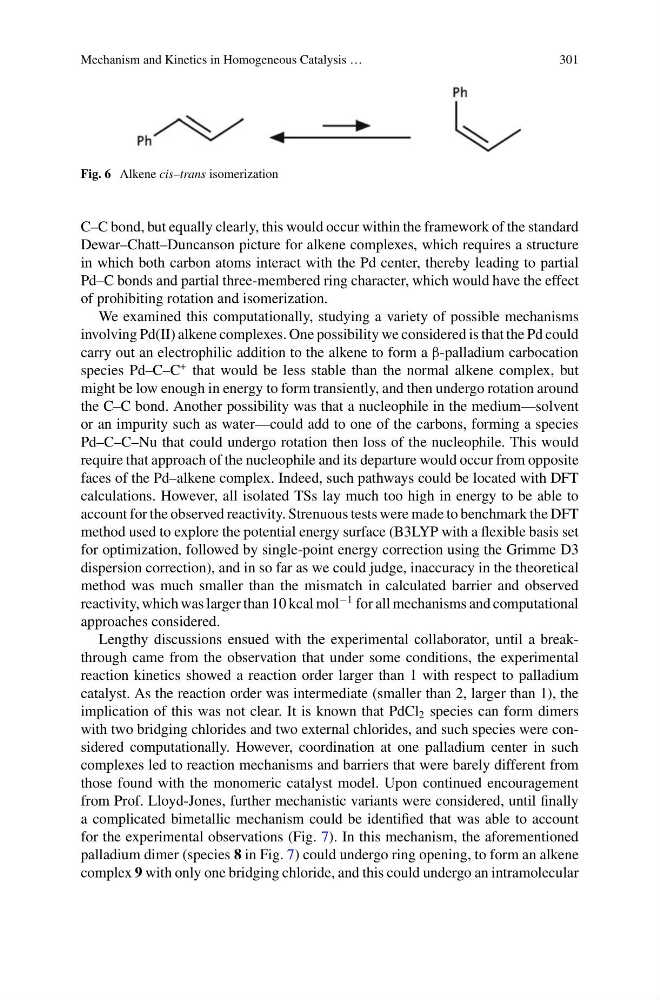
Fig. 6 Alkene cis–trans isomerization
C–C bond, but equally clearly, this would occur within the framework of the standard
Dewar–Chatt–Duncanson picture for alkene complexes, which requires a structure
in which both carbon atoms interact with the Pd center, thereby leading to partial
Pd–C bonds and partial three-membered ring character, which would have the effect
of prohibiting rotation and isomerization.
We examined this computationally, studying a variety of possible mechanisms
involving Pd(II) alkene complexes. One possibility we considered is that the Pd could
carry out an electrophilic addition to the alkene to form a β-palladium carbocation
species Pd–C–C
+ that would be less stable than the normal alkene complex, but
might be low enough in energy to form transiently, and then undergo rotation around
the C–C bond. Another possibility was that a nucleophile in the medium—solvent
or an impurity such as water—could add to one of the carbons, forming a species
Pd–C–C–Nu that could undergo rotation then loss of the nucleophile. This would
require that approach of the nucleophile and its departure would occur from opposite
faces of the Pd–alkene complex. Indeed, such pathways could be located with DFT
calculations. However, all isolated TSs lay much too high in energy to be able to
account for the observed reactivity. Strenuous tests were made to benchmark the DFT
method used to explore the potential energy surface (B3LYP with a flexible basis set
for optimization, followed by single-point energy correction using the Grimme D3
dispersion correction), and in so far as we could judge, inaccuracy in the theoretical
method was much smaller than the mismatch in calculated barrier and observed
reactivity, which was larger than 10 kcal mol
−1 for all mechanisms and computational
approaches considered.
Lengthy discussions ensued with the experimental collaborator, until a breakthrough came from the observation that under some conditions, the experimental
reaction kinetics showed a reaction order larger than 1 with respect to palladium
catalyst. As the reaction order was intermediate (smaller than 2, larger than 1), the
implication of this was not clear. It is known that PdCl 2 species can form dimers
with two bridging chlorides and two external chlorides, and such species were considered computationally. However, coordination at one palladium center in such
complexes led to reaction mechanisms and barriers that were barely different from
those found with the monomeric catalyst model. Upon continued encouragement
from Prof. Lloyd-Jones, further mechanistic variants were considered, until finally
a complicated bimetallic mechanism could be identified that was able to account
for the experimental observations (Fig. 7). In this mechanism, the aforementioned
palladium dimer (species 8 in Fig. 7) could undergo ring opening, to form an alkene
complex 9 with only one bridging chloride, and this could undergo an intramolecular
301
Fig. 6 Alkene cis–trans isomerization
C–C bond, but equally clearly, this would occur within the framework of the standard
Dewar–Chatt–Duncanson picture for alkene complexes, which requires a structure
in which both carbon atoms interact with the Pd center, thereby leading to partial
Pd–C bonds and partial three-membered ring character, which would have the effect
of prohibiting rotation and isomerization.
We examined this computationally, studying a variety of possible mechanisms
involving Pd(II) alkene complexes. One possibility we considered is that the Pd could
carry out an electrophilic addition to the alkene to form a β-palladium carbocation
species Pd–C–C
+ that would be less stable than the normal alkene complex, but
might be low enough in energy to form transiently, and then undergo rotation around
the C–C bond. Another possibility was that a nucleophile in the medium—solvent
or an impurity such as water—could add to one of the carbons, forming a species
Pd–C–C–Nu that could undergo rotation then loss of the nucleophile. This would
require that approach of the nucleophile and its departure would occur from opposite
faces of the Pd–alkene complex. Indeed, such pathways could be located with DFT
calculations. However, all isolated TSs lay much too high in energy to be able to
account for the observed reactivity. Strenuous tests were made to benchmark the DFT
method used to explore the potential energy surface (B3LYP with a flexible basis set
for optimization, followed by single-point energy correction using the Grimme D3
dispersion correction), and in so far as we could judge, inaccuracy in the theoretical
method was much smaller than the mismatch in calculated barrier and observed
reactivity, which was larger than 10 kcal mol
−1 for all mechanisms and computational
approaches considered.
Lengthy discussions ensued with the experimental collaborator, until a breakthrough came from the observation that under some conditions, the experimental
reaction kinetics showed a reaction order larger than 1 with respect to palladium
catalyst. As the reaction order was intermediate (smaller than 2, larger than 1), the
implication of this was not clear. It is known that PdCl 2 species can form dimers
with two bridging chlorides and two external chlorides, and such species were considered computationally. However, coordination at one palladium center in such
complexes led to reaction mechanisms and barriers that were barely different from
those found with the monomeric catalyst model. Upon continued encouragement
from Prof. Lloyd-Jones, further mechanistic variants were considered, until finally
a complicated bimetallic mechanism could be identified that was able to account
for the experimental observations (Fig. 7). In this mechanism, the aforementioned
palladium dimer (species 8 in Fig. 7) could undergo ring opening, to form an alkene
complex 9 with only one bridging chloride, and this could undergo an intramolecular