

294
J. N. Harvey
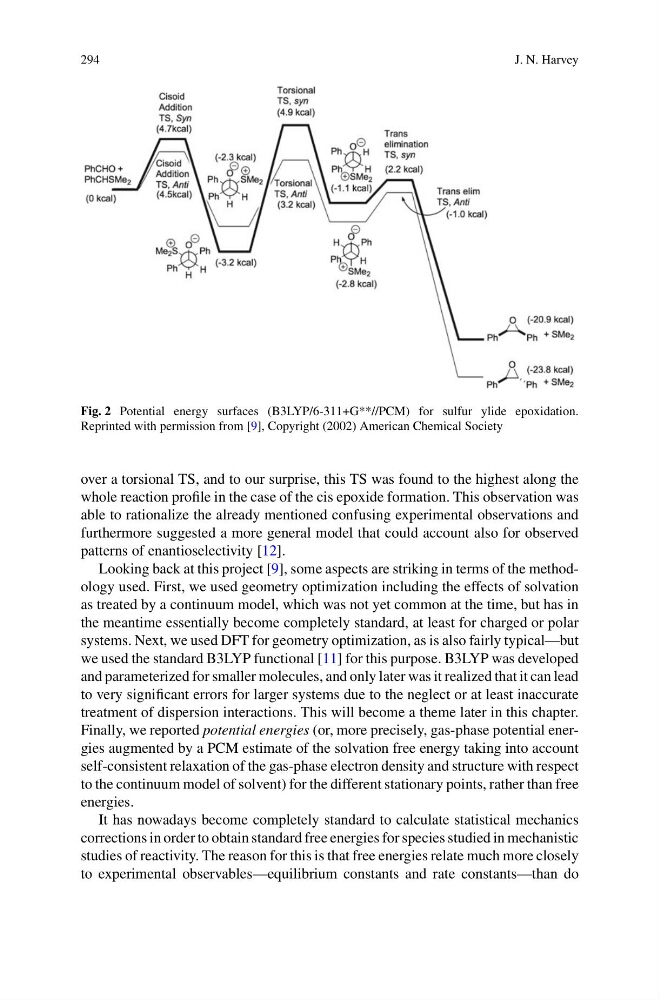
Fig. 2 Potential energy surfaces (B3LYP/6-311+G**//PCM) for sulfur ylide epoxidation.
Reprinted with permission from [9], Copyright (2002) American Chemical Society
over a torsional TS, and to our surprise, this TS was found to the highest along the
whole reaction profile in the case of the cis epoxide formation. This observation was
able to rationalize the already mentioned confusing experimental observations and
furthermore suggested a more general model that could account also for observed
patterns of enantioselectivity [12].
Looking back at this project [9], some aspects are striking in terms of the methodology used. First, we used geometry optimization including the effects of solvation
as treated by a continuum model, which was not yet common at the time, but has in
the meantime essentially become completely standard, at least for charged or polar
systems. Next, we used DFT for geometry optimization, as is also fairly typical—but
we used the standard B3LYP functional [11] for this purpose. B3LYP was developed
and parameterized for smaller molecules, and only later was it realized that it can lead
to very significant errors for larger systems due to the neglect or at least inaccurate
treatment of dispersion interactions. This will become a theme later in this chapter.
Finally, we reported potential energies (or, more precisely, gas-phase potential energies augmented by a PCM estimate of the solvation free energy taking into account
self-consistent relaxation of the gas-phase electron density and structure with respect
to the continuum model of solvent) for the different stationary points, rather than free
energies.
It has nowadays become completely standard to calculate statistical mechanics
corrections in order to obtain standard free energies for species studied in mechanistic
studies of reactivity. The reason for this is that free energies relate much more closely
to experimental observables—equilibrium constants and rate constants—than do
J. N. Harvey
Fig. 2 Potential energy surfaces (B3LYP/6-311+G**//PCM) for sulfur ylide epoxidation.
Reprinted with permission from [9], Copyright (2002) American Chemical Society
over a torsional TS, and to our surprise, this TS was found to the highest along the
whole reaction profile in the case of the cis epoxide formation. This observation was
able to rationalize the already mentioned confusing experimental observations and
furthermore suggested a more general model that could account also for observed
patterns of enantioselectivity [12].
Looking back at this project [9], some aspects are striking in terms of the methodology used. First, we used geometry optimization including the effects of solvation
as treated by a continuum model, which was not yet common at the time, but has in
the meantime essentially become completely standard, at least for charged or polar
systems. Next, we used DFT for geometry optimization, as is also fairly typical—but
we used the standard B3LYP functional [11] for this purpose. B3LYP was developed
and parameterized for smaller molecules, and only later was it realized that it can lead
to very significant errors for larger systems due to the neglect or at least inaccurate
treatment of dispersion interactions. This will become a theme later in this chapter.
Finally, we reported potential energies (or, more precisely, gas-phase potential energies augmented by a PCM estimate of the solvation free energy taking into account
self-consistent relaxation of the gas-phase electron density and structure with respect
to the continuum model of solvent) for the different stationary points, rather than free
energies.
It has nowadays become completely standard to calculate statistical mechanics
corrections in order to obtain standard free energies for species studied in mechanistic
studies of reactivity. The reason for this is that free energies relate much more closely
to experimental observables—equilibrium constants and rate constants—than do