

Mechanism and Kinetics in Homogeneous Catalysis …
293
computational chemistry, with little in the way of theoretical challenge. Given our
work in the area in the intervening years, I now believe that the perception that this
was a ‘mature’ subfield was incorrect in a number of important ways, and these will
form some of the themes for this study.
3.1 Sulfur Ylide Epoxidation
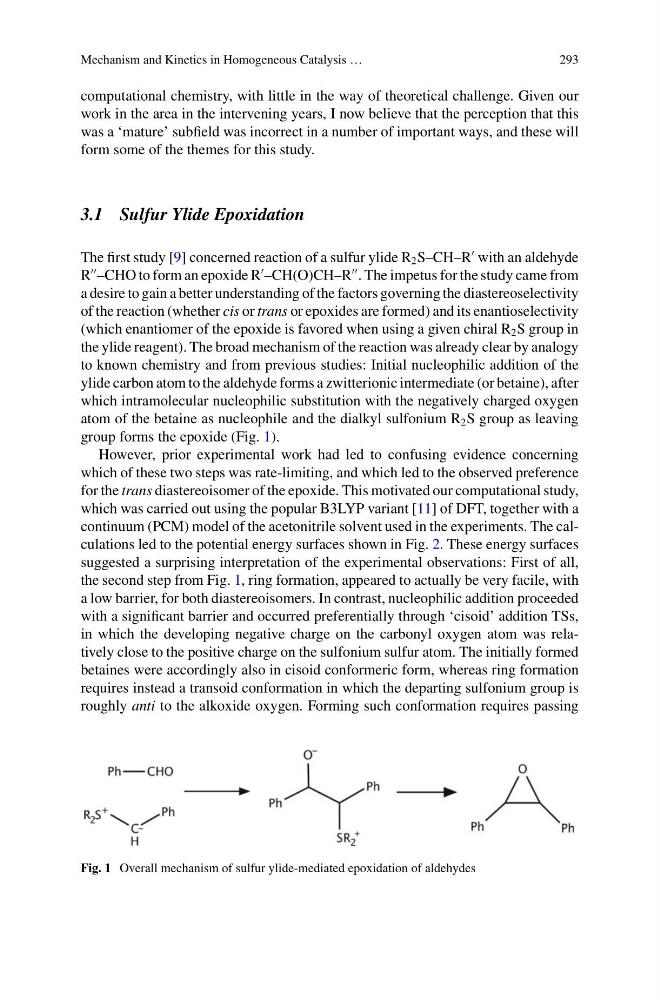
The first study [9] concerned reaction of a sulfur ylide R 2 S–CH–R
with an aldehyde
R
–CHO to form an epoxide R
–CH(O)CH–R
. The impetus for the study came from
a desire to gain a better understanding of the factors governing the diastereoselectivity
of the reaction (whether cis or trans or epoxides are formed) and its enantioselectivity
(which enantiomer of the epoxide is favored when using a given chiral R 2 S group in
the ylide reagent). The broad mechanism of the reaction was already clear by analogy
to known chemistry and from previous studies: Initial nucleophilic addition of the
ylide carbon atom to the aldehyde forms a zwitterionic intermediate (or betaine), after
which intramolecular nucleophilic substitution with the negatively charged oxygen
atom of the betaine as nucleophile and the dialkyl sulfonium R 2 S group as leaving
group forms the epoxide (Fig. 1).
However, prior experimental work had led to confusing evidence concerning
which of these two steps was rate-limiting, and which led to the observed preference
for the trans diastereoisomer of the epoxide. This motivated our computational study,
which was carried out using the popular B3LYP variant [11] of DFT, together with a
continuum (PCM) model of the acetonitrile solvent used in the experiments. The calculations led to the potential energy surfaces shown in Fig. 2. These energy surfaces
suggested a surprising interpretation of the experimental observations: First of all,
the second step from Fig. 1, ring formation, appeared to actually be very facile, with
a low barrier, for both diastereoisomers. In contrast, nucleophilic addition proceeded
with a significant barrier and occurred preferentially through ‘cisoid’ addition TSs,
in which the developing negative charge on the carbonyl oxygen atom was relatively close to the positive charge on the sulfonium sulfur atom. The initially formed
betaines were accordingly also in cisoid conformeric form, whereas ring formation
requires instead a transoid conformation in which the departing sulfonium group is
roughly anti to the alkoxide oxygen. Forming such conformation requires passing
Fig. 1 Overall mechanism of sulfur ylide-mediated epoxidation of aldehydes
293
computational chemistry, with little in the way of theoretical challenge. Given our
work in the area in the intervening years, I now believe that the perception that this
was a ‘mature’ subfield was incorrect in a number of important ways, and these will
form some of the themes for this study.
3.1 Sulfur Ylide Epoxidation
The first study [9] concerned reaction of a sulfur ylide R 2 S–CH–R
with an aldehyde
R
–CHO to form an epoxide R
–CH(O)CH–R
. The impetus for the study came from
a desire to gain a better understanding of the factors governing the diastereoselectivity
of the reaction (whether cis or trans or epoxides are formed) and its enantioselectivity
(which enantiomer of the epoxide is favored when using a given chiral R 2 S group in
the ylide reagent). The broad mechanism of the reaction was already clear by analogy
to known chemistry and from previous studies: Initial nucleophilic addition of the
ylide carbon atom to the aldehyde forms a zwitterionic intermediate (or betaine), after
which intramolecular nucleophilic substitution with the negatively charged oxygen
atom of the betaine as nucleophile and the dialkyl sulfonium R 2 S group as leaving
group forms the epoxide (Fig. 1).
However, prior experimental work had led to confusing evidence concerning
which of these two steps was rate-limiting, and which led to the observed preference
for the trans diastereoisomer of the epoxide. This motivated our computational study,
which was carried out using the popular B3LYP variant [11] of DFT, together with a
continuum (PCM) model of the acetonitrile solvent used in the experiments. The calculations led to the potential energy surfaces shown in Fig. 2. These energy surfaces
suggested a surprising interpretation of the experimental observations: First of all,
the second step from Fig. 1, ring formation, appeared to actually be very facile, with
a low barrier, for both diastereoisomers. In contrast, nucleophilic addition proceeded
with a significant barrier and occurred preferentially through ‘cisoid’ addition TSs,
in which the developing negative charge on the carbonyl oxygen atom was relatively close to the positive charge on the sulfonium sulfur atom. The initially formed
betaines were accordingly also in cisoid conformeric form, whereas ring formation
requires instead a transoid conformation in which the departing sulfonium group is
roughly anti to the alkoxide oxygen. Forming such conformation requires passing
Fig. 1 Overall mechanism of sulfur ylide-mediated epoxidation of aldehydes