

Photodeactivation Channels of Transition Metal Complexes …
281
The phosphorescence emission maxima were computed on the basis of SCF-PCMB3LYP calculations, and then compared to the vertical singlet–triplet PCM-TD-DFT
excitations for emission. Both types of calculations supported the assignment of the
ES involved in the experimentally observed emission at 77 and 298 K. Thus, SCFPCM-B3LYP emission maxima values are 1.59 and 2.12 eV for the
3 MLCT and
3 LC
states, respectively, in good agreement with the observed blue shift when cooling
down the samples. To assess the influence of ES density-dependent relaxation effects
of the solvent polarization, a state-specific PCM approach was used in combination
with the TD-DFT calculations, namely the perturbative corrected linear response
(cLR)-PCM model [44]. In such a scheme, the dynamic component of the solvent
polarization rearranges to equilibrate with the ES charge density of the solute, which
is taken into account using the one-particle TD-DFT density matrix. cLR-PCM-TDDFT calculations are therefore better suited than their LR counterparts to compute
emission energies. The cLR-PCM-TD-DFT values are slightly red-shifted (by ca.
0.2–0.3 eV) for both the
3 MLCT and
3 LC emissions with respect to their corresponding LR-PCM-TD-DFT values, and thus, the
3 MLCT state is always the lowest
adiabatic ES regardless of the solvation scheme used. Therefore, a putative destabilization of the
3 MLCT state at 77 K due to the lack of solvent relaxation effects at
this temperature is not responsible of the blue shift observed experimentally. Indeed,
the
3 MLCT and
3 LC dipole moments are rather similar between them, thus hinting
at a limited impact of solvent relaxation effects.
Once this hypothesis is disregarded, the second hypothesis (kinetically controlled
scenario of photoluminescence) was analyzed. In Fig. 8c, the kinetic model including
all possible ES decay channels for 1 is shown. The
3 LC3 MLCT equilibrium is controlled by the forward k + (T ) and reverse k − (T ) rate constants, which can be expressed
in an Arrhenius form. At 77 K, a k + /k − 2.3 × 10
11 value is computed, hence indicating that the
3 LC →
3 MLCT process is irreversible. Thus,
3 LC-like emission is
predominantly observed at this temperature (but certainly coexisting with
3 MLCTlike emission), because k phos1 competes with k nr1 and k + (77 K). Additionally, the
3 MLCT-like emission is concomitantly observed due to the confluence of two factors: (i) k phos2 k phos1 (7.6 × 10
2 and 2.2 s
−1 are the computed values, respectively)
and (ii) a non-negligible k + (77 K) value. Conversely, at 298 K, a k + /k − 863 value
is obtained, which implies that a thermal equilibrium between the
3 LC and
3 MLCT
states is likely. Consequently, one can assess whether dual photoluminescence or
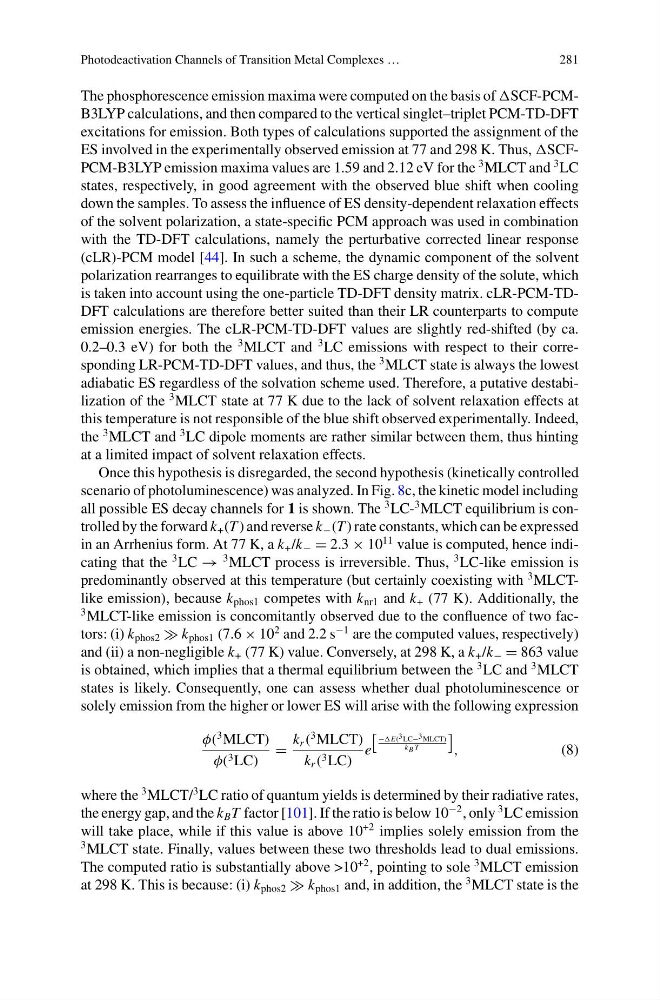
solely emission from the higher or lower ES will arise with the following expression
φ(
3 MLCT)
φ( 3 LC)
k r (
3 MLCT)
k r ( 3 LC)
e
−E( 3 LC− 3 MLCT)
k B T
,
(8)
where the
3 MLCT/
3 LC ratio of quantum yields is determined by their radiative rates,
the energy gap, and the k B T factor [101]. If the ratio is below 10
−2 , only
3 LC emission
will take place, while if this value is above 10
+2 implies solely emission from the
3 MLCT state. Finally, values between these two thresholds lead to dual emissions.
The computed ratio is substantially above >10
+2 , pointing to sole
3 MLCT emission
at 298 K. This is because: (i) k phos2 k phos1 and, in addition, the
3 MLCT state is the
281
The phosphorescence emission maxima were computed on the basis of SCF-PCMB3LYP calculations, and then compared to the vertical singlet–triplet PCM-TD-DFT
excitations for emission. Both types of calculations supported the assignment of the
ES involved in the experimentally observed emission at 77 and 298 K. Thus, SCFPCM-B3LYP emission maxima values are 1.59 and 2.12 eV for the
3 MLCT and
3 LC
states, respectively, in good agreement with the observed blue shift when cooling
down the samples. To assess the influence of ES density-dependent relaxation effects
of the solvent polarization, a state-specific PCM approach was used in combination
with the TD-DFT calculations, namely the perturbative corrected linear response
(cLR)-PCM model [44]. In such a scheme, the dynamic component of the solvent
polarization rearranges to equilibrate with the ES charge density of the solute, which
is taken into account using the one-particle TD-DFT density matrix. cLR-PCM-TDDFT calculations are therefore better suited than their LR counterparts to compute
emission energies. The cLR-PCM-TD-DFT values are slightly red-shifted (by ca.
0.2–0.3 eV) for both the
3 MLCT and
3 LC emissions with respect to their corresponding LR-PCM-TD-DFT values, and thus, the
3 MLCT state is always the lowest
adiabatic ES regardless of the solvation scheme used. Therefore, a putative destabilization of the
3 MLCT state at 77 K due to the lack of solvent relaxation effects at
this temperature is not responsible of the blue shift observed experimentally. Indeed,
the
3 MLCT and
3 LC dipole moments are rather similar between them, thus hinting
at a limited impact of solvent relaxation effects.
Once this hypothesis is disregarded, the second hypothesis (kinetically controlled
scenario of photoluminescence) was analyzed. In Fig. 8c, the kinetic model including
all possible ES decay channels for 1 is shown. The
3 LC3 MLCT equilibrium is controlled by the forward k + (T ) and reverse k − (T ) rate constants, which can be expressed
in an Arrhenius form. At 77 K, a k + /k − 2.3 × 10
11 value is computed, hence indicating that the
3 LC →
3 MLCT process is irreversible. Thus,
3 LC-like emission is
predominantly observed at this temperature (but certainly coexisting with
3 MLCTlike emission), because k phos1 competes with k nr1 and k + (77 K). Additionally, the
3 MLCT-like emission is concomitantly observed due to the confluence of two factors: (i) k phos2 k phos1 (7.6 × 10
2 and 2.2 s
−1 are the computed values, respectively)
and (ii) a non-negligible k + (77 K) value. Conversely, at 298 K, a k + /k − 863 value
is obtained, which implies that a thermal equilibrium between the
3 LC and
3 MLCT
states is likely. Consequently, one can assess whether dual photoluminescence or
solely emission from the higher or lower ES will arise with the following expression
φ(
3 MLCT)
φ( 3 LC)
k r (
3 MLCT)
k r ( 3 LC)
e
−E( 3 LC− 3 MLCT)
k B T
,
(8)
where the
3 MLCT/
3 LC ratio of quantum yields is determined by their radiative rates,
the energy gap, and the k B T factor [101]. If the ratio is below 10
−2 , only
3 LC emission
will take place, while if this value is above 10
+2 implies solely emission from the
3 MLCT state. Finally, values between these two thresholds lead to dual emissions.
The computed ratio is substantially above >10
+2 , pointing to sole
3 MLCT emission
at 298 K. This is because: (i) k phos2 k phos1 and, in addition, the
3 MLCT state is the